
GO-Invest delegation to EU
November 21, 2025

Delegation representatives during the EU study mission
— as Guyana advances Berbice deep-water port, modern port network
GUYANA’S push to become a regional trade and logistics hub has taken another major step forward, with the Guyana Office for Investment (GO-Invest) now leading a high-level investment mission to Europe, even as work accelerates on plans for a Berbice deep-water port and a wider network of modern port facilities across the country.
Chief Investment Officer and Head of GO-Invest, Peter Ramsaroop, is heading “a ground-breaking investment mission to Europe” from 20–28 November, 2025, convening senior officials and key private-sector players from Guyana and the wider region.”
The EU-funded mission visit some of Europe’s most advanced ports and logistics hubs in France, Belgium, the Netherlands and Spain, including Marseille, Antwerp-Bruges, Rotterdam and Málaga.
Over 8 days, the team will examine port operations, governance structures, digital logistics systems and agro-processing value chains, while holding talks with EU policymakers, port authorities, logistics operators and academic institutions.The visit is…
“offering Guyanese stakeholders an unprecedented opportunity to study leading European ports, logistics systems and agro-processing operations” and adapt practical models that can strengthen Guyana’s own emerging port and logistics architecture.
DEEP-WATER PORT VISION IN BERBICE
The mission leaves at a pivotal moment as President Irfaan Ali has signalled that a comprehensive feasibility study for the Berbice Deep-water Port is currently underway, led by global engineering firm Bechtel and jointly financed by the Government of Guyana and Hess Corporation.
At the Shipping Association of Guyana in July, President Ali had said the study would set the blueprint for one of the most critical infrastructural projects, aimed at expanding shipping capacity, lowering freight costs and positioning Guyana “as a major trade and logistics hub, connecting South America and the Caribbean.”
The Berbice deep-water port is being designed to anchor a wider logistics ecosystem, including integrated rail or road infrastructure, once final assessments on economic viability and return on investment are completed. It will also support the development of Guyana’s second gas project, to be built in Berbice.
The President has stressed that Guyanese businesses must sit at the centre of this transformation.
“We’ve made it very clear that our local operators must have an important stake in the project, in its totality,” President Ali had explained, noting that local companies are already mobilising financing to take advantage of the opportunity.
PUBLIC–PRIVATE TEAM IN EUROPE
Reflecting that focus on local participation, the EU study mission is a strong mix of state agencies and private companies. Ramsaroop is accompanied by Senior Director of Investment at GO-Invest, John Edghill and representatives of the Maritime Administration Department (MARAD), the National Agricultural Research and Extension Institute (NAREI), the Private Sector Commission, the CARICOM Private Sector Organisation (CPSO), Vreed-en-Hoop Shorebase Inc. (VEHSI), Crane Guyana Inc., Guyana Port Inc., Western Logistics Guyana, Banks DIH Ltd., Demerara Distillers Ltd. (DDL), UMAMI Inc. and other local firms.
Select participants from Antigua, Barbados, and St Vincent and the Grenadines, along with EU Delegation officials and technical specialists from FIAP, are part of the mission coordinated under the Caribbean-EU Cooperation Facility.
The delegation will engage with European experts on port governance, cold-chain management, clustering, agro-innovation and market access, including through exchanges with Wageningen University and specialised research centres in Spain. The mission is expected to deliver both short-term and long-term dividends.
GO-Invest says the programme is designed to generate “practical insights into port governance and logistics efficiency, potential partnerships and investment opportunities”…
…and to shape actionable pilot projects that can boost Guyana’s export competitiveness and domestic processing capacity. These efforts merge with the national development platform advanced by President Ali, including commitments made at the recent Berbice Development Summit.
There, the Head of State identified the Berbice deep-water port as a flagship undertaking to expand maritime capacity, improve logistics performance and create a modern gateway linking Guyana more effectively with regional and international markets.
That deep-water port will complement a series of other connectivity projects already in train, such as the new bridge across the Corentyne River to Suriname, the upgrading and extension of the Linden–Lethem Road and other strategic corridors designed to knit Guyana into continental and regional supply chains.
The delegation met France’s Ministry of Foreign Affairs and private-sector partners, including AIRBUS
NEW PORTS AT PARIKA, CHARITY AND BLAIRMONT
Beyond Berbice, government and private-sector investments are reshaping Guyana’s wider port footprint. The government is currently transforming the Parika Stelling into a modern international port facility, with works expected to accelerate in the coming months.
The $4.5 billion Parika port will allow Guyanese exporters to move goods more efficiently into Caribbean markets, while also providing berthing for cruise liners and cargo ships and offering new options for passenger and luxury travel.
At Charity, Region Two, a new $880 million multi-purpose wharf and port facility is under construction, aimed at enhancing riverain trade, supporting hinterland communities and strengthening domestic supply chains.
In Berbice, local port operators Muneshwers Limited and John Fernandes Limited, through their joint venture Cranes Guyana Inc., are set to invest over US$285 million in a modern port facility at Blairmont, West Coast Berbice.
The companies are in the process of finalising financing with investors for the first phase of the project, which is expected to dovetail with the emerging deep-water port framework and the broader Berbice industrial build-out.
For government and private stakeholders, the European mission is not a sightseeing tour but a targeted exercise in institution-building. Practical lessons drawn from European ports, ranging from digitalised logistics systems and governance models to agro-processing clusters and cold-chain logistics, will inform the design, regulation and operation of Guyana’s own ports and logistics corridors. The initiative is aligned with Team Europe’s Global Gateway Investment Agenda, which seeks to deepen economic linkages between the EU and the region through strategic infrastructure, green and digital investments and stronger value-chain integration.
Exxon Guyana produces 900,000 oil barrels- Well done!
2025. 11/20
Golden Guyana and ExxonMobil consortium safely accomplished a monumental triumph in its energy sector, celebrating a new high in crude oil production of 900,000 barrels of oil per day (bopd).
This extraordinary feat, fundamentally transforms the economic landscape of the burgeoning petrostate. The foundation of this rapid growth lies in the prolific Stabroek Block offshore. 45 significant oil and gas finds followed ExxonMobil’s initial discovery in May 2015 at the Liza prospect and initial oil production from the Liza development commenced in December 2019.
Four Floating Production, Storage, and Offloading (FPSO) vessels driving the current production numbers are operating offshore: the Liza Destiny (Liza Phase 1), Liza Unity ( Liza Phase 2), Prosperity ( Payara development) and ONE GUYANA ( Yellowtail development), the latest addition contributing oil marketed as Golden Arrowhead crude.
Combined production of 900,000 bopd was achieved months after the successful startup of Yellowtail, Guyana’s fourth offshore project. Yellowtail rapidly achieved its initial annual average production capacity of 250,000 bopd. The stellar performance of Yellowtail, coupled with the consistently excellent operating outputs from Liza Phase 1,
Liza Phase 2 and Payara, contributed to this significant national milestone. ExxonMobil plans to maintain this pace of development with the Uaru and Whiptail projects, Guyana’s fifth and sixth developments, expected to add approximately 250,000 bopd each, with operations anticipated to begin in 2026 and 2027, respectively.
The seventh project, Hammerhead, is expected to contribute approximately 150,000 bopd when production starts in 2029. An eighth potential project, Longtail, is undergoing regulatory review.
When all these developments are approved and brought online, ExxonMobil Guyana expects to reach a total production capacity of 1.7 million bopd from 8. dedicated developments.
Stabroek Block production passes 900,000-bbl/d milestone
The Yellowtail FPSO on the Stabroek Block reached its full initial production capacity.
Jeremy Beckman, November 19, 2025.
Yellowtail’s ONE GUYANA FPSO vessel joined the Destiny, Unity and Prosperity FPSOs in early August, bringing total installed capacity in Guyana above 900,000 bbl of oil per day.
ExxonMobil Guyana reported that oil production from its fields on the deepwater Stabroek Block surpassed 900,000 bbl/d. This follows the startup earlier in the year of the fourth project, Yellowtail, which reached its initial annual average production capacity of 250,000 bbl/d. Strong performance continues from 3 earlier projects, Liza Phase 1, Liza Phase 2 and Payara as three more are sanctioned at Uaru, Whiptail and Hammerhead.
Uaru and Whiptail, each designed to produce about 250,000 bbl/d, should start operations in 2026 and 2027, respectively, followed in 2029 by Hammerhead (about 150,000 bbl/d).
Eighth project, Longtail, is undergoing regulatory reviews. Once approved and online, the total production capacity from the 8 developments should be 1.7 MMbbl/d.
In a results statement, FPSO supplier SBM Offshore said ExxonMobil Guyana was contemplating exercising an option to acquire Yellowtail’s FPSO ONE GUYANA in early 2026, before the end of its maximum lease term in August 2027.
ExxonMobil Guyana (45%) is operator of the Stabroek Block, in partnership with Hess Guyana Exploration (30%) and CNOOC Petroleum Guyana (25%).
Fourth Exxon-operated project propels offshore output to new heights
November 13, 2025, by Dragana Nikše
Subsidiary of US-headquartered ExxonMobil reached a production milestone of 900,000 barrels of oil daily at a field it operates offshore Guyana. The energy champion scored at Stabroek Block three months after the startup of Yellowtail, Guyana’s fourth offshore project, which reached its initial nameplate capacity of 250,000 barrels of oil per day (bopd). Combined with excellent operating performance from the Liza Phase 1, Liza Phase 2, and Payara assets, this contributed to achieving this milestone.
Alistair Routledge, President, ExxonMobil Guyana, said: “We continue to safely deliver industry-leading performance, providing the oil and gas the world still demands. Guyana’s story is one of continuous achievements because of the close collaboration with the Government of Guyana, our co-venturers, suppliers, contractors, and employees. Together, we are building a world-class energy sector that is delivering significant value for the people of Guyana.”
ExxonMobil Guyana is the operator and holds a 45% interest in the Stabroek block. Its partners are Hess Guyana Exploration with a 30% interest, and CNOOC Petroleum Guyana with a 25% interest.
Over $60 billion has been invested to develop the 7 government-sanctioned projects in the offshore Stabroek block. The Uaru and Whiptail projects, fifth and sixth projects, are each expected to produce around 250,000 bopd when they become operational in 2026 and 2027, respectively.
Hammerhead, the seventh project, will add 150,000 bopd when it starts producing in 2029. MODEC recently took charge of the full engineering, procurement, construction, and installation (EPCI) scope for the floating production, storage, and offloading (FPSO) that will be deployed at Hammerhead.
An eighth project, Longtail, is currently undergoing regulatory reviews. Once approved and in production, the project will contribute to the output of 1.7 million bopd in total from the eight developments.
Stabroek delivers 900,000 bopd
November 13, 2025
Three months after ExxonMobil Guyana Limited (EMGL) brought its fourth Floating Production Storage and Offloading (FPSO) vessel, ONE GUYANA, on stream in the Stabroek Block, daily oil production finally reached 900,000 barrels. The milestone, announced by EMGL, follows the ONE GUYANA FPSO achieving initial production capacity of 250,000 barrels of oil per day (bpd) from the Yellowtail Development.
Guyana’s oil hits 900,000 barrels daily

ONE GUYANA FPSO
When the vessel began producing oil in August, it raised total installed capacity to 900,000 bpd, however, daily output only recently ramped up to meet full potential. The US$10 billion Yellowtail project received government approval on April 1, 2022. The FPSO, constructed by Dutch shipbuilder SBM Offshore, is the largest on the Stabroek Block to date, with an initial average production capacity of 250,000 barrels bpd and storage for two million barrels.
ExxonMobil said that production at Yellowtail reaching full capacity, combined with strong operating performance from Liza Phase 1, Liza Phase 2 and Payara developments, contributed to achieving this major milestone.
ExxonMobil Guyana President Alistair Routledge stated, “We continue to safely deliver industry-leading performance, providing the oil and gas the world still demands. Guyana’s story is one of continuous achievements because of close collaboration with the Government of Guyana, our co-venturers, suppliers, contractors and employees. Together, we are building a world-class energy sector that is delivering significant value for the people of Guyana,”
ExxonMobil Guyana holds a 45% interest in the Stabroek Block, while co-venturers Hess Guyana Exploration Limited and CNOOC Petroleum Guyana Limited hold 30% and 25%, respectively.
The Stabroek Block spans 6.6 million acres and is estimated to hold 11.6 billion barrels of oil equivalent. In addition to the four projects currently producing, Exxon has three others sanctioned Uaru, Whiptail, and Hammerhead. The Stabroek consortium committed over US$60 billion to develop 7 government-approved projects , including Uaru, Whiptail, and Hammerhead.
The Uaru and Whiptail projects Guyana’s fifth and sixth developments are each expected to produce approximately 250,000 bpd, with start-up targeted for 2026 and 2027, respectively. Hammerhead project, the seventh development which received government approval in September is expected to add around 150,000 bpd when production begins in 2029.
Exxon has filed an application for an eighth development, Longtail, which isundergoing regulatory review. Once approved, ExxonMobil Guyana expects to reach a total production capacity of 1.7 million bpd across its eight projects.
World-class, profitable Stabroek Block is a global oil goldmine
November 14, 2025
Multinational Chevron Corporation is the second-largest American oil company by revenue, only behind its Standard Oil stablemate ExxonMobil. At Chevron’s Investor Day in New York, Vice Chairman Mark Nelson hailed Stabroek Block as a world-class asset, boasting some of the highest cash margins and lowest breakeven costs in the global oil industry.
He praised the block’s “exceptional growth potential and profitability,” noting that its offshore oilfields are expected to drive meaningful production growth. He said Stabroek Block has industry- leading resource and meaningful production growth expected into the next decade.
“Its developments rank among the highest cash margin and lowest carbon intensity in the industry with six announced projects below $35 per barrel breakeven. Even with the recent Hammerhead FID [Final Investment Decision], they’re now seven FPSOs in production or under development.
By 2030, eight FPSOs are expected to be online, enabling over 1.7 million barrels per day of gross capacity. We’re proud to continue the work Hess began in Guyana and remain committed to supporting the country and its people.”
Chevron secured entry into the Stabroek Block, estimated to hold 11.6 billion barrels of oil, with a successful US$53 billion acquisition of Hess Corporation earlier this year.
The operator of the block, rival American oil giant ExxonMobil Corporation holds 45% interest in the block through its local subsidiary ExxonMobil Guyana. Chevron Guyana holds 30%, and CNOOC Petroleum Guyana Limited holds the remaining 25%.
Currently, four developments produce oil from the Stabroek Block: Liza Phase 1, Liza Phase 2, Payara and Yellowtail. The fourth project, Yellowtail achieved first oil in August and Exxon announced that the Stabroek Block’s daily oil production finally reached 900,000 barrels with the Yellowtail Floating Production Storage and Offloading (FPSO) vessel attaining its initial capacity of 250,000 barrels per day (bpd).
In addition to the four producing projects, Exxon has three others sanctioned, Uaru, Whiptail, and Hammerhead. Uaru and Whiptail projects, the fifth and sixth developments are each expected to produce approximately 250,000 bpd, with start-up targeted for 2026 and 2027, respectively.
Hammerhead, the seventh development which received government approval in September is expected to add around 150,000 bpd when production begins in 2029.
Stabroek Block consortium committed over US$60 billion to develop seven government-approved projects offshore Guyana. Exxon filed an application for an eighth development, Longtail, which is currently undergoing regulatory review.
QatarEnergy Joins Offshore Consortium

November 17, 2025 (Credit: QatarEnergy)
QatarEnergy signed a production sharing agreement for shallow-water Block S4 offshore Guyana, awarded through the 2022 Guyana Licensing Round. Under the terms of the agreement, QatarEnergy will hold a 35% share, while its partners
TotalEnergies will act as operator, holding 40%, with PETRONAS holding remaining 25% interest.
Block S4 an area of 1,788 km2 is situated 50-100 km from Guyana’s coast, in water depths of 30-100 meters.
President and CEO of QatarEnergy, Saad Sherida Al-Kaabi, Minister of State for Energy Affairs, said,
“We are pleased to secure this exploration block in Guyana, further building on the strategy to expand our global upstream exploration activities. I would like to thank the Government of Guyana and our partners in the block for their valued support and cooperation. We look forward to working together to deliver on our exploration objectives.”
PETRONAS marks first foray into Guyana with award of Block S4
12 November 2025
PETRONAS, through its wholly-owned subsidiary PETRONAS Energy Guyana Sdn Bhd (PEGSB), signed a Petroleum Agreement (PA) for Block S4, located in the shallow offshore region of Guyana. The PA was executed with the Government of Guyana and consortium partners TotalEnergies EP Guyana Shallow SAS (TotalEnergies) and QatarEnergy.
This signing marks PETRONAS’ first foray into Guyana, further expanding its presence in the Americas region. The award of this PA follows the consortium’s successful bid in the 2022 Guyana Licensing Bid Round.
It represents a significant milestone in PETRONAS’ expansion within the Guyana-Suriname Basin, universally recognised as an emergent exploration frontier.
Block S4 covers approx. 1,787 sq kms and is strategically located along favourable hydrocarbon migration pathways.
Under the PA, PETRONAS holds a 25% participating interest, QatarEnergy holds 35% and TotalEnergies, with a 40% stake will serve as the operator of Block S4.
All parties attended the signing ceremony in Georgetown. PETRONAS was represented by Mr. Harris Saifi B Hakimi, the Government of Guyana by its Minister for Petroleum, Hon. Vickram Bharrat, TotalEnergies by Mr. Daniel Larranaga and QatarEnergy by Mr. Ali Al-Mana.
PETRONAS Vice President of Exploration, Mr. Faisal Bakar said, ‘Our participation in the Guyana-Suriname Basin marks a notable chapter in PETRONAS’ journey of international growth. Guided by a disciplined approach to expanding our global presence, we are dedicated towards realising the basin’s proven prolificness and nurturing enduring value for our stakeholders. This partnership with TotalEnergies and QatarEnergy reinforces our shared aspiration for a resilient and progressive upstream sector.’
The inclusion of Block S4 in Guyana further strengthens PETRONAS footprint in the Americas and its position as a globally competitive energy player.
TotalEnergies takes consortium operatorship of new offshore block
November 11, 2025 (WO)
TotalEnergies expanded its presence in one of the world’s most active offshore exploration frontiers, announcing it signed a production sharing contract (PSC) with partners QatarEnergy and Petronas for Block S4 offshore Guyana.
The agreement, signed with the Ministry of Natural Resources of Guyana and represented by Minister Vickram Bharrat, formalizes the award of Block S4 under the 2022 Licensing Round. TotalEnergies will operate the block with a 40% interest, alongside QatarEnergy (35%) and Petronas (25%).
Located approximately 50 to 100 kilometers off the coast, the 1,788 km² shallow-water block lies within a proven hydrocarbon basin that has yielded some of the largest oil discoveries in the past decade.
The initial work program will include the acquisition of 2,000 km² of 3D seismic data to evaluate exploration prospects.
The new award consolidates Guyana’s position as a key offshore exploration hub, with TotalEnergies joining ExxonMobil, Hess and other operators pursuing growth in the expanding deepwater and shallow-water basins.
Senior Vice President of Exploration at TotalEnergies, Nicola Mavilla, said “This block fits our strategy of exploring for material, low-cost, and low-emission resources. We are delighted to bring our expertise as operator to Guyana and to further strengthen our global partnerships with QatarEnergy and Petronas.”
Petronas makes Guyana debut, TotalEnergies operates
Amanda Battersby Asia Bureau Chief Singapore. 12 November 2025
QatarEnergy also onboard offshore Block S4
Malaysian energy giant Petronas made its maiden foray into global upstream hotspot Guyana, securing a 25% partnership interest in the newly awarded offshore Block S4 — TotalEnergies’ first operated asset in the petrostate.
Operator French supermajor TotalEnergies and co-venturers QatarEnergy and Petronas signed a production sharing agreement (PSA) for Block S4 with Guyana’s Ministry of National Resources.
The 1788-square kilometre block is between 50 to 100 kilometres from shore in water depths ranging between 30 and 100 metres, and is strategically located along favourable hydrocarbon migration pathways. The initial work programme comprises the acquisition of 2000 line kilometres of 2D seismic.
TotalEnergies operates Block S4 with a 40% stake on behalf of QatarEnergy on 35% and Petronas having a 25% interest. The shallow-water offshore block was offered in the Guyana 2022 licensing round and awarded the following year.
The partners paid a $15 million signature bonus, which exceeded the minimum $10 million floor for shallow-water blocks and will be deposited directly into the Natural Resource Fund, ensuring full transparency and accountability, according to the host government.
The Block S4 agreement is the first to be signed under a new fiscal regime. The new PSA introduces a 10% corporate tax, enhanced environmental and regulatory standards and stricter penalties for non-compliance with work programmes. Minister of Natural Resources Vickram Bharrat hailed the agreement as a milestone that strengthens investor confidence, adding that the signing underscores the government’s ongoing effort to attract world-class investors while protecting the nation’s long-term interests.
“This investment demonstrates continued international confidence in Guyana’s transparent and robust licensing framework, and it reflects our government’s commitment to ensuring that the development of our natural resources is done sustainably and for the benefit of all Guyanese. “
Nicola Mavilla, senior vice president exploration of TotalEnergies, said, “TotalEnergies is delighted to bring its expertise as an operator to Guyana, in a shallow-water offshore block within this prolific basin, and to further strengthen its global strategic partnerships with QatarEnergy and Petronas. This block fits our strategy of exploring for material, low-cost and low-emission resources.”
Petronas said the Block S4 PSC award represents a significant milestone in its expansion within the Guyana-Suriname basin, a region “universally recognised as emergent exploration frontiers”.
Vice- president of exploration, Faisal Bakar said, “Our participation in the Guyana-Suriname basin marks a notable chapter in Petronas’ journey of international growth. Guided by a disciplined approach to expanding our global presence, we are dedicated towards realising the basin’s proven prolificness and nurturing enduring value for our stakeholders. This partnership with TotalEnergies and QatarEnergy reinforces our shared aspiration for a resilient and progressive upstream sector.”
(Copyright)
Guyana banks US$15M bonus for new PSA in Block S4.
November 11, 2025
Guyana secured a US$15 million signing bonus from a new Production Sharing Agreement (PSA) signed with a consortium comprising QatarEnergy (35%), TotalEnergies (40%, operator), and PETRONAS (25%) for the shallow-water Block S4 offshore Guyana. The bonus exceeds the minimum US$10 million floor for shallow-water blocks and will be deposited directly into the Natural Resource Fund (NRF), ensuring full transparency and accountability.The agreement is the first to be signed under Guyana’s new fiscal regime.

Minister and S4 consortium
The new PSA introduces a 10 per cent corporate tax, enhanced environmental and regulatory standards, and stricter penalties for non-compliance with work programmes. Minister of Natural Resources, Vickram Bharrat, hailed the agreement as a milestone that strengthens investor confidence and marks the first PSA signed under Guyana’s new fiscal regime.
Minister Bharrat emphasised that the signing underscores the government’s ongoing effort to attract world-class investors while protecting Guyana’s long-term interests.
“Every agreement must yield benefits for Guyana and our people. While we welcome international investment, our partnerships must support national development and uphold the highest environmental standards.”
The Guyana Basin continues to attract some of the world’s largest and most experienced energy companies, including ExxonMobil, Chevron, CNOOC, TotalEnergies, QatarEnergy, and PETRONAS, solidifying Guyana’s position as an emerging global energy hub.
He praised the technical team within the Ministry of Natural Resources for their exceptional work in managing the sector, citing Guyana’s rapid progress from its first oil production in 2019 to current production levels of approximately 930,000 barrels per day. Minister Bharrat reiterated that Guyana remains committed to balancing energy development with environmental stewardship.
“Few nations can produce nearly a million barrels of oil per day while remaining carbon negative. Guyana continues to show that sustainable development and environmental responsibility can go hand in hand.”
Local Content Legislation, Petroleum Activities Act and Natural Resource Fund Act are globally recognised as pillars of transparency and good governance.
“Guyana has emerged as a model for responsible resource management. We will continue to ensure that our natural wealth is harnessed for the prosperity of current and future generations.”
Guyana distinguished itself as one of the few new oil-producing nations to establish an NRF within just two years of commencing production, a commitment to transparency and sound fiscal management.
“Many countries took 10, 20, or even 30 years before they actually established their sovereign wealth fund. We did so two years after, or maybe less than two years after production.”
The new oil block, Block S4, spans approximately 1,788 square kilometres, located 50 to 100 kilometres offshore in water depths ranging from 30 to 100 metres. Exploration activities will adhere to Guyana’s regulatory standards and international best practices for environmental protection and resource management.
Guyana to ink first post-bid oil deal
Nov 11, 2025 (Kaieteur News)
TotalEnergies, QatarEnergy, and Petronas secure shallow block S4
The Government of Guyana, through the Ministry of Natural Resources (MNR), will today sign the country’s first Petroleum Exploration License and Production Sharing Agreement (PSA) arising from the 2022 Offshore Bid Round, awarding the Shallow Water Block S4 to a powerful consortium led by TotalEnergies, QatarEnergy, and Petronas.

Map showing Guyana’s offshore oil blocks; the areas in red attracted bids during the 2022 auction.
Guyana to ink first post-bid oil deal
This signing represents a major milestone in Guyana’s second wave of petroleum development, ushering in new fiscal terms designed to deliver greater national benefit from offshore exploration. In February this year, the MNR revealed that four Production Sharing Agreements (PSAs) with various companies were on the table to signed this year, following its successful oil blocks auction, launched in December 2022. In addition to the agreement with the Total Energies-led consortium, three other contracts were also to be signed for the blocks S5 – International Group Investment Inc.; S7 – Cybele Energy; and S10 – International Group Investment Inc.
In December 2022, President Irfaan Ali launched the country’s inaugural bid round for 14 offshore oil blocks. Bids were later opened on September 10, 2023 where it was disclosed that six companies submitted bids for eight of the blocks. Kaieteur News had reported that eleven of the oil blocks on auction are located in the shallow area and three are in the deepwater zone. Importantly, the Shallow and Deepwater blocks are governed by separate PSAs. They range between 1000 square kilometres to 3000 square kilometres with the majority of them being close to 2000 square kilometres.
Promos and deals
The oil companies will be expected to pay a 10 percent royalty and a 10 percent corporate tax to the government of Guyana. In the meantime, the cost recovery will be capped at 65 percent in a given year, while profits will be shared 50/50 between the parties. These fiscal terms vary significantly from the existing PSA enjoyed by ExxonMobil, the operator of the Stabroek Block. The company pays no taxes but shares 50% profit with government after deducting 75% each month for cost recovery. It also pays a meager 2% royalty to government. The block, which originally spanned 26,800 square kilometers, does not have a ring-fencing provision.
During the virtual launch of the country’s maiden bid round, President Ali said that each interested company participating in the auction will be required to pay US$20,000 for each Block that company or individual is interested in. Additionally, a minimum signing bonus of US$10 million will be required for the oil blocks located in shallow waters and US$20 million for the oil Blocks in the deeper water.
The President was keen to point out the difference between the two and the specific variables that will be expected. “There is different type of expertise that is required for shallow water and deepwater. There is different type of capabilities that is required for shallow water and deepwater so the criteria used in this bidding process takes that into consideration to ensure there is great transparency, that those who are participating in the bid meet the minimum requirement. But at the same time, there is enough room for greater participation in the bidding,” he explained.
The Head-of-State also stated that there is also a strict relinquishment policy, which means that if the holder of an oil block fails to meet his work commitment, that portion must be handed back to government.
Guyana partners strike loan deal
November 4, 2025, by Melisa Cavcic
CGX, a Canadian-based oil and gas exploration company focused on oil exploration in the Guyana-Suriname Basin, entered a loan agreement with a subsidiary of Frontera Energy Corporation, its joint venture partner in a petroleum prospecting license for a block offshore Guyana.
Thanks to a senior secured loan facility secured with its partner in Guyana’s Corentyne block, CGX will continue to finance its share of costs related to the corporate working capital costs and other budgeted ones.
The $2.5 million loan will be available for drawdown in tranches on a non-revolving basis for a period of six months, beginning upon the completion of the conditions precedent to the first tranche drawdown.
During the drawdown period, CGX may request drawdowns provided that the maximum amount of any tranche drawdown does not exceed $1.9 million and that the aggregate amount of all does not surpass $2.5 million.
The loan, together with all interest accrued, is set to be due and payable a year after the date it was arranged, with interest payable on the principal amount outstanding accruing at a rate of 19.32% per annum, compounding on a monthly basis.
The arrangement remains subject to customary conditions, including the Canadian player obtaining regulatory approvals. This loan comes months after Frontera and CGX urged the Guyanese government to work out the issues surrounding the Corentyne block license.
The two players were adamant in their intention to seek legal avenues to assert and defend their interests if such an attempt failed after they received another communication from the government regarding the termination of their licence.
On July 23, 2025, the government, through its legal counsel, reaffirmed its view that the joint venture’s interest expired on June 28, 2024, but noted that it may consider a final meeting in October 2025, with the JV getting informed as to whether such a meeting would occur in September 2025.
While drilling an appraisal well for the Kawa-1 appraisal program, the JV made the Wei-1 discovery in 2023 as its second one on the Corentyne block, claiming that it fulfilled the obligation under Phase 2 of the second renewal period of the original ten-year license.
The joint venture holds 100% working interest in the Corentyne block, located offshore Guyana. Frontera Guyana and CGX Resources have agreed that their respective participating interests are 72.52% and 27.48%, which includes a 4.52% interest that the latter agreed to assign to the former in 2023.
The assignment of this 4.52% participating interest remains subject to the approval of the Government of Guyana, but is believed to be enforceable between Frontera Guyana and CGX Resources.
Technology powers a safer, smarter oil and gas industry
November 16, 2025
GUYANA’S offshore oil and gas sector is undergoing a technological transformation that extends far beyond extracting hydrocarbons from beneath the seabed.
ExxonMobil Guyana’s growing deployment of advanced technology and Artificial Intelligence (AI) is fundamentally reshaping how the industry operates, with profound implications for safety, efficiency and environmental stewardship. This evolution positions Guyana not merely as an oil producer, but as the paradigm for some of the most sophisticated industrial technologies deployed anywhere in the world.
At the heart of this transformation lies AI-powered autonomous drilling, a proprietary system that ExxonMobil has deployed across its deepwater Guyana operations. This technology analyses vast streams of drilling data in real time, determining optimal parameters that maximise safety and efficiency while minimising technical complications.
The system operates in a “closed-loop” automation mode, where AI controls the drilling process with minimal human intervention.
This frees rig personnel to focus on strategic oversight rather than constant manual adjustments, fundamentally changing the nature of offshore work. When every hour of unplanned downtime can cost hundreds of thousands of dollars and potentially compromise safety, the safety benefits prove particularly significant. Predictive maintenance systems, powered by real-time data analytics, continuously monitor equipment across the FPSOs.
Remote monitoring tools such as Discovery 6, one of the world’s most powerful supercomputers, enable engineers to track performance parameters and identify potential risks early, improving response times and ensuring continuous safe operations.
These systems identify potential mechanical failures or performance degradation before they become critical issues, allowing engineers to schedule maintenance during planned downtime rather than responding to emergency breakdowns.
ExxonMobil implemented Marlin VTA, an AI-driven maritime awareness system that provides 24/7 monitoring of vessel movements in the offshore operational area. This technology creates a comprehensive operational picture that enables informed decision-making and significantly enhances maritime safety.
With dozens of support vessels, supply ships and other marine traffic operating in proximity to production facilities, this situational awareness proves critical for preventing incidents and coordinating complex offshore logistics.
Beyond immediate operational improvements, AI is enabling discoveries that expand Guyana’s petroleum potential. The technology assists in analysing deeper geological zones within the Stabroek Block, contributing to new reservoir identifications that continue to increase proven reserves.
This demonstrates how advanced technology does not simply optimise existing operations but actively creates new economic value. These technological advances align remarkably well with the Government’s broader ambitions to position Guyana as a regional technology hub. President Ali met the CEO of Cerebras, a company specialising in AI development and training.
That engagement has since progressed to an MoU between the Government of Guyana and Cerebras for the development of a 100 MW data centre. The planned facility would benefit directly from the natural gas pipeline supporting the Gas-to-Energy project, which is expected to provide reliable, behind-the-meter power to the data centre. Together, these developments strengthen the vision discussed during those meetings, linking Guyana’s emerging energy infrastructure with its technological ambitions.
This convergence between industrial technology and the national digital development strategy accelerates and creates unique opportunities for local citizens. Young professionals pursuing careers in data science, engineering or technology fields now have tangible pathways into an industry deploying world-class systems locally, rather than needing to seek opportunities abroad.
Ongoing training programmes for local engineers, technicians and data specialists ensure that workers are not merely operating advanced systems, but also gaining the expertise to manage and innovate with them. As a result, when more oil and gas companies embrace advanced technology, workers may find themselves ahead of the curve, having already gained practical experience with these systems.
This investment in human capacity also ensures that as technology evolves, local expertise evolves with it.
Integration of AI and advanced technology into Guyana’s oil and gas sector represents more than operational optimisation. It signals the advancement of a petroleum industry where data analysis, predictive systems and technological innovation become as important as traditional engineering disciplines.
For a new petrostate building its industrial capacity, this represents an opportunity to leapfrog older operational models and establish world-class standards from the outset.
The path ahead requires continued investment in both physical infrastructure and human capital. As AI systems become more sophisticated and data requirements grow.
Ability to support these technologies domestically through robust digital infrastructure and skilled professionals will determine whether Guyana captures the full value of this technological revolution or remains dependent on external expertise.
The evidence suggests Guyana is moving decisively towards technological leadership in its most important industry, with benefits that will ripple across the economy for decades.
[ExxonMobil and Chevron can acquire CNOOC 25% share in Stabroek as UK reveals risk of PRC espionage.]
SOUTHCOM commander reaffirms U.S. commitment to security, stability
November 7, 2025
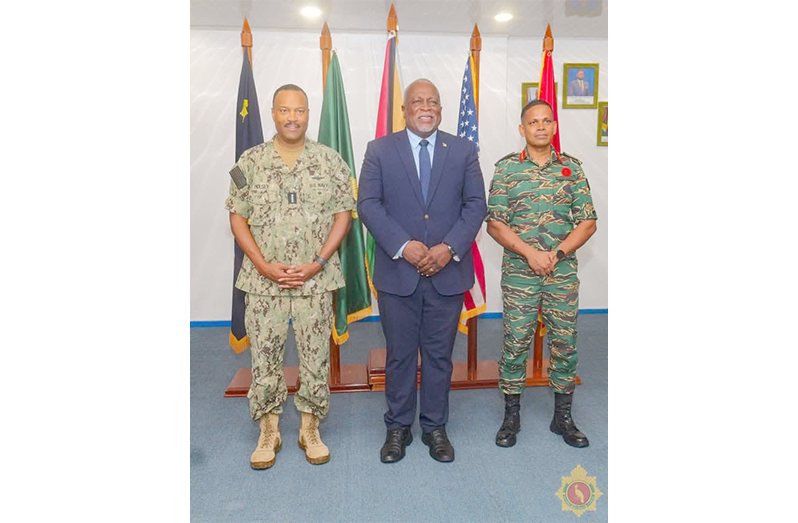
From left, Commander of the U.S. Southern Command, Admiral Alvin Holsey; Prime Minister, Brigadier Mark Phillips, who is performing the duties of President and Chief of Defence Staff, Brigadier Omar Khan following a meeting at the Guyana Defence Force Headquarters, Base Camp Ayanganna, on Thursday
The Commander of the United States Southern Command (USSOUTHCOM), Admiral Alvin Holsey, reaffirmed Washington’s steadfast commitment to Guyana’s security and regional stability on an official visit to the Guyana Defence Force (GDF) at Base Camp Ayanganna.
The visit, described by the GDF as a “significant milestone in the long-standing partnership between Guyana and the United States,” underscored the deepening defence co-operation between the two nations amid evolving global and hemispheric security challenges.
Admiral Holsey met Chief of Defence Staff, Brigadier Omar Khan and other senior officers, U.S. Ambassador Nicole Theriot, National Security Adviser Gerry Gouveia and Director of the National Intelligence and Security Agency, Colonel Sheldon Howell.

Discussions centred on strengthening interoperability; expanding joint military training; bolstering maritime security and improving co-operation in cyber defence, intelligence sharing and humanitarian assistance. Admiral Holsey’s engagement extended to the GDF Coast Guard Ship Hinds at Ruimveldt, where he met Acting President, Brigadier (Ret’d) Mark Phillips for discussions on the continued importance of strategic defence co-operation, reaffirming the mutual goal of safeguarding regional peace and security.
The exchange “reaffirmed the shared commitment to safeguarding regional security, strengthening institutional capacity and enhancing collaboration in support of peace, stability and mutual national interests throughout the hemisphere.”
The visit “underscored the shared vision of both nations to advance defence partnerships rooted in trust, transparency and respect for international law.”
Guyana and the United States have long maintained strong defence relations through joint operations, training initiatives and disaster-response collaboration.
This latest visit by the SOUTHCOM Commander reinforces that alliance, built on shared democratic values and mutual respect for sovereignty.
The talks also examined “opportunities for capacity building through professional military education and technical exchanges.”
The GDF reaffirmed its dedication to “advancing defence diplomacy and fostering enduring partnerships with friendly nations, thereby enhancing regional co-operation and improving readiness to address evolving security challenges.”
In a release from the U.S. Embassy in Georgetown, the U.S. Southern Command reaffirmed its commitment to Guyana’s sovereignty, noting that Admiral Holsey’s engagements “will focus on accelerating security co-operation, ensuring regional stability and reaffirming the United States’ steadfast support for Guyana’s territorial integrity.”
EnerMech anchors Americas expansion in Guyana
November 07, 2025
EnerMech launched a long-term investment strategy with Guyana at the heart of its Americas growth plan, reinforcing confidence in the booming offshore oil and gas sector and its fast-evolving local workforce.
The programme, spanning facilities, talent, and advanced equipment cements EnerMech’s role in enabling Guyana’s rapid industrial transformation while building regional resilience across CARICOM, the Gulf of Mexico, and LNG growth markets.
Key focus of this investment in CARICOM is Guyana, where it holds a proven track record following successful pre-commissioning work on its first four FPSOs – Liza Destiny, Unity, Prosperity and ONE Guyana – as well as securing the subsea pre-commissioning on the fifth project, Uaru.
“To meet accelerating regional demand, the company is establishing a new facility in Georgetown and investing in career development initiatives to support its existing workforce while increasing headcount. This will be complemented by a phased equipment acquisition strategy.”
Key equipment includes remote flooding consoles and subsea test pumps for major developments, along with GD-600 pumps, gas boosters, air compressors and N2 generation units to support future pre-commissioning scopes and long-term maintenance operations.
The Georgetown site will also serve as a launchpad for future growth into Suriname, where project development is expected to follow a similar trajectory and into the new frontier of deepwater projects offshore Trinidad.
Complementing its efforts in Guyana and Suriname, EnerMech’s Americas strategy is closely aligned with the region’s LNG boom, where export capacity is projected to double by 2028. In response, the company is scaling up equipment capabilities and investing in local talent to seize opportunities across the LNG value chain. This includes growing its LNG technical hub in Houston with the addition of new planners, projects managers, engineers and subject matter experts, alongside new assets such as vehicles, compressors, dryers and trailers.
To support rising demand for OPEX-related maintenance and mechanical services, a phased expansion is also included in Houston and Sulphur, two of North America’s most active industrial corridors. Strengthening its leadership team, EnerMech recently appointed Nosa Egharevba as SVP, Integrated Supply Chain & Asset Management.
Nosa said: “This isn’t about short-term wins. It’s about building enduring capacity, empowering local teams and ensuring EnerMech remains the trusted partner of choice across the Americas. Leveraging our expertise in pre-commissioning, commissioning and maintenance, we help clients deliver new LNG infrastructure at pace, while upholding technical integrity and safety.”
CEO Charles ‘Chuck’ Davison Jnr added: “This significant phased investment signals our confidence in the Americas and our determination to grow sustainably with our clients and partners. We are deepening our operational footprint, investing in our people, and building the infrastructure needed to serve energy and industrial markets for decades to come. Our focus is on long-term value creation, local content, and readiness to serve wherever demand is growing.”
SBM sale of Guyana FPSO to reduce debt
Russell Searancke Norway Correspondent Oslo
14 November 2025
SBM Offshore is satisfied that ExxonMobil is likely to exercise early a purchase option to the largest floating production, storage and offloading vessel operating in Guyana, saying it will result in a significant debt reduction.
FPSO ONE GUYANA
ExxonMobil Guyana indicated it is contemplating the exercise of its contractual purchase option to acquire FPSO ONE GUYANA in early 2026, ahead of the end of the maximum lease term in August 2027.
FPSO Prosperity
ExxonMobil Guyana completed the purchase of the FPSO Prosperity from SBM Offshore for approximately $1.23 billion, expected to reduce SBM Offshore’s net debt. SBM Offshore will continue operating the FPSO until 2033, showcasing a successful collaboration with ExxonMobil.
FPSO Liza Destiny
SBM Offshore and ExxonMobil Guyana Ltd completed the purchase of FPSO Liza Destiny, ahead of the maximum lease term, due to expire in December 2029. The purchase allows ExxonMobil Guyana to assume ownership of the unit while SBM Offshore will continue to operate and maintain the FPSO up to 2033. The transaction comprises a total cash consideration of c. US$535 million. The proceeds will primarily be used for the full repayment of the US$405 million project financing and will decrease SBM Offshore’s net debt .
Guyana debt soars
November 11, 2025
Guyana paid US$110 million in the first half of 2025 to service its debt, nearly half of which was interest, according to the Bank of Guyana’s Half-Year Report. The Central Bank disclosed that interest payments amounted to US$44.8 million between January and June, reflecting the rising cost of rapid borrowing in recent years.
“Total debt service payments amounted to US$110 million in the first half of 2025, representing a 29.1% increase relative to the corresponding period in 2024. Domestic debt service payments increased by G$1,889.6 million to G$7,762.3 million, likewise external debt service payments rose by 27.6% to US$72.8 million on account of higher principal repayments to bilateral creditors.”
About US$17.3M and US$27.5M paid for domestic and external interest, respectively during the period January to June 2025 amounting to a total of US$44.8M. The debt service to export ratio remained low. The domestic debt service to export ratio in the first half of 2025 was 0.76% while the external debt service to revenue ratio was 3.05%, both below the pre-defined thresholds.
During the first half of the year, government borrowing grew by 13.5% to US$6,804.8 million. Expansion in both domestic and external debt funded budgeted spending. “The outstanding stock of government domestic debt, which consists of treasury bills, debentures, bonds and the CARICOM loan, expanded by 17.6 percent to G$920,709.2 million.”
External debt rose by 6.7% to US$2,389 million from the end-December 2024 level. Higher external debt was resulted from increased loans from the EximBank of China and China CAMC Engineering Co. LTD (CAMCE) and higher multilateral debt to the Inter-American Development Bank (IDB).
Guyana entered the oil era in 2019 with US$1.8 billion in debt. Six years later, that figure soared to over US$7.7 billion, a four-fold explosion in borrowing under the current administration. At the end of 2024, debt stood at US$6B but another US$1.7B was added to finance the 2025 Budget, as revealed by Vice President, Bharrat Jagdeo.
Since oil production began in December 2019 Guyana earned just over US$7.8B in oil revenue, according to the third quarter Natural Resource Fund (NRF) report by Bank of Guyana. Since the inception of the Fund, government withdrew almost US$4.6B . Previously, Economist Elson Low warned of the consequences associated with dependency on oil revenues to repay debt, as a collapse in oil price could have serious effects on the economy.
ExxonMobil recovers costs of nearly US$10B
November 9, 2025
ExxonMobil Guyana Limited (EMGL), operator of the prolific Stabroek Block, recovered US$9.768 billion in the first half of 2025, almost double Guyana’s total national debt, oft US$6 billion. The Bank of Guyana (BoG) recently published its Half Year Report, following the publication of the Mid-Year Report by the Government of Guyana (GoG). According to the Central Bank, Exxon recovered US$3,157B in the first quarter of 2025 and US$6,611.1B in the second quarter, a total of US$9,768,100,000 for cost recovery in 6 months.
In keeping with the terms of the 2016 Production Sharing Agreement (PSA), EMGL is allowed to deduct 75% of oil produced each month to meet its expenses. In the absence of a ring-fencing provision, the company is not only paying for the projects currently in operation, but those that are yet to come on stream.
While stakeholders fear that the forecast of low oil price in the future will gravely affect Guyana’s ability to enjoy its wealth, the government has agreed to allow the company to maximise the revenues from the petroleum activities to benefit shareholders of the Stabroek Block partners.
Guyana’s earnings from the sector in the first half of the year paled in comparison. According to the Mid-Year Report, the Natural Resource Fund (NRF) or the oil account barely received US$1B during the period.
“In the first half of 2025, Government had 15 lifts of profit oil from the 3 producing FPSOs, Liza Destiny (3), Liza Unity (6) and Prosperity (6).” Each lift is equivalent to 1 million barrels of oil.
“During the period January to June 2025, Government received US$1,053.8 million as revenue from its share of profit oil. This included payments for two lifts that in the final quarter of 2024, and 13 of the 15 lifts that occurred in the first six months of this year.”
In July, US$140.5 million was received as profit oil payments for the 2 Government lifts executed in June. Government received US$169.6 million in royalties related to crude oil production and sales in the final quarter of 2024 and the first quarter of this year. At the end of June 2025, the NRF contained (inclusive of interest income of US$68.9M) a total of US$3,192.2 million, after withdrawals of US$1,200 million.
ExxonMobil ramps up global output with early Yellowtail startup and Permian gains
October 31, 2025
ExxonMobil reported third-quarter 2025 earnings of $7.5 billion, highlighting record upstream performance across its global portfolio, led by major gains in the Permian basin and offshore Guyana.
Companywide production averaged 4.8 million boe per day, up 139,000 boed from the prior quarter. ExxonMobil’s Permian production hit a record 1.7 MMboed, while Guyana output exceeded 700,000 boed, marking another milestone for the prolific Stabroek Block. The company also brought the Yellowtail project online four months ahead of schedule and under budget, adding an initial 250,000 boed of capacity and lifting Guyana’s total installed capacity to over 900,000 boed.
Additionally, ExxonMobil took final investment decision (FID) on Hammerhead, its seventh development in the Stabroek Block, expected to add 150,000 boed by 2029. In the U.S., the company expanded its Permian footprint with the acquisition of 80,000 additional net acres from Sinochem Petroleum, supporting continued deployment of its proprietary completion technologies, including lightweight proppants that boost well recoveries by up to 20%.
Beyond upstream growth, ExxonMobil commissioned its next-generation Discovery 6 supercomputer—developed with Hewlett Packard Enterprise and NVIDIA—to accelerate reservoir analysis, drilling optimization, and exploration modeling.
Chairman and CEO Darren Woods said the company’s operational execution and early project delivery continue to differentiate ExxonMobil’s performance:
“We delivered the highest earnings per share we’ve had in a similar oil-price environment. No one else in our industry is executing at this scale or delivering this level of innovation.”
3MW solar farm powers up as Guyana accelerates low-carbon transition
Mike Gonsalves/IDB
November 21, 2025
Rows of solar panels now cover former cane fields in rural Hampshire, marking another major step in Guyana’s drive to cut emissions, lower energy costs and expand clean power nationwide.

solar panels now cover former cane fields
The new 3MW solar farm, commissioned on Friday, is one of 8 large installations being rolled out under the Guyana Utility Scale Solar Photovoltaic (GUYSOL) Programme, financed through climate-performance payments Guyana earned by protecting forests under its partnership with the Kingdom of Norway.
Keshe Nandlall, GPL’s Executive Management Team Lead, said, “This solar plant is part of the Guyana Utility Solar Programme… with a total value of 83.8 million US dollars from our partnership with the Kingdom of Norway. It advances our renewable energy goals and delivers tangible benefits to our community.”
Cutting costs and carbon in Berbice
Region Six alone is receiving 10MW of new solar capacity, spread across Hampshire, Prospect and Trafalgar. The Hampshire plant hosts nearly 5,000 solar modules, now feeding electricity directly into the Berbice grid.
“This facility will produce about 4,800 megawatt-hours of clean energy each year… avoiding around 210 million dollars in diesel generation costs and reducing emissions across the country,” Nandlall added.
The project forms part of Guyana’s wider push to diversify its energy mix, strengthen grid reliability and reduce its dependence on imported fuel, a core component of the Low Carbon Development Strategy (LCDS) and Nationally Determined Contribution (NDC) submitted under the UNFCCC
Women and youth powering the transition
The initiative is not only transforming the energy landscape, it is opening new technical career paths, especially for young women. Under GUYSOL, 31 women from Regions 2, 5, 6 and 10 were trained in solar installation. Lorena Solórzano-Salazar, IDB Country Representative said,
“31 out of 50 women were trained and gainfully employed and 6 persons with disabilities are already working in the programme. These systems will be maintained in Guyanese hands, empowered by Guyanese talent.”
A transformation built on historic climate finance
Guyana’s rapid expansion of renewable energy is funded by a climate-finance model over a decade old. In the late 2000s, Guyana and Norway, under President Bharrat Jagdeo, signed one of the world’s first bilateral forest-climate agreements, compensating Guyana for maintaining its intact rainforest. Dr Ashni Singh, Minister of Finance, recalled,
“Norway agreed to pay Guyana 250 million US dollars, recognising the climate services provided by our standing forests. 80 million of those resources were earmarked for low-carbon investments such as these solar farms.”
That partnership remains central to the LCDS, which now guides Guyana’s national energy transformation.
“A multi-lane energy future”
With Guyana’s electricity demand expected to triple by 2028, no single source can meet the growing needs. Instead, Guyana is pursuing a multi-lane pathway. Prime Minister Mark Phillips said,
“This facility sends a clear signal that Guyana is serious about the transition to cleaner energy sources. Our energy strategy is a multi-lane pathway; natural gas, hydro, solar and wind, all moving us toward reliable, low-carbon power.”
He framed affordable energy as a matter of equity.
“Affordable energy restores dignity… and ensures development touches every home. When electricity is costly, opportunity becomes unaffordable.”
With more solar farms set to be commissioned in the coming weeks and hydropower developments advancing, Guyana’s energy transition is accelerating at a pace that mirrors its wider economic transformation. In communities across Region Six, the Hampshire solar farm is more than an energy project , it’s a sign of what clean power, climate finance and local talent can build together.