East Venezuela boosts surveillance
2025, 11/29
Members of the Bolivarian National Intelligence Service (SEBIN) marched in a government-organised civic-military rally in Caracas, Venezuela, on Tuesday. Venezuela extended its security apparatus in eastern areas in proximity to Trinidad and Tobago and the Lesser Antilles.
In a meeting with UN officials, Foreign Minister, Yván Gil, expressed concerns regarding the US military presence in the region. On Thursday, Gil met the UN resident coordinator Gianluca Rampolla to strengthen “our cooperation, based on respect for sovereignty and the leadership of the organised Venezuelan people.
We stress the urgency for the United Nations system to adopt a firm stance in defence of our Latin American region as a Zone of Peace, and for all states to respect the Charter of the United Nations.”
In a new phase in the war on drugs, US President Donald Trump suggested that the US is preparing to take new action against alleged drug trafficking networks in Venezuela, telling service members in a Thanksgiving call that efforts for strikes on land will be starting “very soon.”
Given his latest comments and heightened activity of the US military in T&T, the Venezuelan state of Sucre experienced weeks of tension and intensified surveillance, following bombings by the US against alleged drug-laden vessels near its coasts.
Reuters reported yesterday that the Venezuelan town of Güiria, where the local economy, beyond alleged drug trafficking, is partly sustained by informal trade in food and other goods with T&T, is showing signs of stagnation.
“No boats of any kind are leaving for Trinidad and Tobago anymore — not migrants, not people buying goods there to sell here and certainly not those taking Venezuelan products to sell there, which was another way to make money. Everything is practically dead,” a resident said.
Heightened patrols, which increased after the announcement of joint military exercises between the US and T&T in late October, led to arrests. Venezuelan military and intelligence officials drive unmarked sedans and SUVs, creating an atmosphere of constant surveillance. Uniformed officers conduct nighttime patrols alongside civilian motorcycle groups linked to the ruling Socialist Party.
CJCS Meets T&T Prime Minister
WASHINGTON, DISTRICT OF COLUMBIA, UNITED STATES
Benjamin D Applebaum
Office of the Chairman of the Joint Chiefs of Staff
Nov. 25, 2025

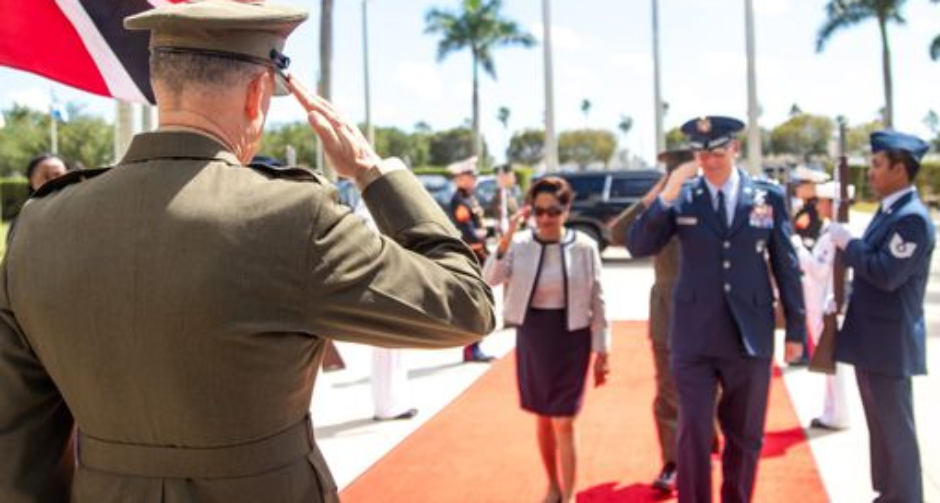
Chairman of the Joint Chiefs of Staff Gen. Dan Caine signs a guest book after meeting Prime Minister Kamla Persad-Bissessar during an office call at the Diplomatic Center in Port of Spain Nov. 25, 2025.
They discussed the strong partnership between the United States and Trinidad and Tobago and shared priorities for regional security.
Warrior Caine meets PM Bissessar – November 27 – US Thanksgiving Day
The original itinerary of Chairman of the US Joint Chiefs of Staff, General Dan Caine, was changed to include a brief visit to Trinidad and Tobago .
He was due to engage with service members in Puerto Rico, where over a dozen US warships and 15,000 troops are part of a hub for strikes on alleged drug-trafficking boats originating from Venezuela.
He completed a whirlwind visit to Port of Spain on November 25, spending three hours after he flew in specifically for a face-to-face meeting with Prime Minister Kamla Persad-Bissessar.
The top military advisor to US President Trump and US Secretary of War, Pete Hegseth, arrived at Piarco International Airport at 11 am aboard a US government aircraft and went to the Diplomatic Centre in St Ann’s.
He met Persad-Bissessar, Attorney General John Jeremie SC, Homeland Security Minister Roger Alexander, Defence Minister Wayne Sturge, Acting Foreign Minister Barry Padarath, Chief of Defence Staff, Commodore Don Polo and Commanding Officer of the TT Regiment, Colonel Dwayne Edwards.
The meeting lasted under two hours after which Caine left for the airport in a convoy of 16 vehicles including an ambulance and police in cars and on motorcycles.
In a media release at 4.30 pm, Persad-Bissessar said the meeting reaffirmed the strong relationship of T & T with the US as a global ally on the key priorities of regional security and stability.
She “expressed her government’s continued commitment to working to ensure that the harmful effects of narco-trafficking, human trafficking and transnational crime were eradicated for the benefit of our citizens, country and region.”
Persad-Bissessar “expressed gratitude for the existing co-operation between both nations as they have been built on decades of diplomacy and mutual benefit as global allies, now forming an instrumental partnership to protect our region.”
Caine acknowledged and appreciated T&T’s “continued leadership and efforts to working closely to ensure a stronger, safer and more secure region.”
In photographs released by the Office of the Chairman of the Joint Chiefs of Staff and US Embassy Port of Spain, the gallant American war hero, heavily decorated with a chest full of medals, was probably the most illustrious benefactor ever to grace the Diplomatic Centre.
Smartly attired in Blue, the Indian colour of Peace, matching the Christian colour of Royalty in his navy blue uniform, PM Persad-Bissessar was manifestly delighted as her distinguished guest signed the visitors book. Patently relieved by the high-level US response to her pleas for protection, the PM rose confidently above the clamour for a Caricom Zone of Peace to reassure the world of enthusiastic regard for her leadership from the US.
Having retrieved the Dragon OFAC licence from Secretary of State Marco Rubio in Washington DC on September 30, she welcomed a mighty American armada for training of the TTDF. Now, she hosts the top US military leader, chairman of the Joint Chiefs of Staff on November 25.
For General Caine, the visit to Venezuela’s neighbour signals to its leader, the US foreign policy of strong partnership, close collaboration and “mutual objectives” with Trinidad & Tobago in tackling “illicit narcotics, arms, human trafficking and transnational criminal organisation activities.”
No questions were taken from the media after the refreshment stop in St Ann’s. A release by the Office of the Prime Minister was similarly brief.
Gen. Caine had retired when appointed in April, having led planning for the strike on Iranian nuclear facilities in June.
He was hand-picked by President Trump, who dismissed his predecessor Charles Brown Jr. Presence of US officials in the region sparked questions about the legality of US military operations. American politicians query whether the focus on cartels is a ruse to avoid congressional authorisation for major foreign policy acts.
The UN deemed summary executions at sea violations of international law. Canada, Colombia and The Netherlands withheld information collaboration, according to global reports. PM Persad-Bissessar courageously welcomed American actions and enjoys the benefits of her pro-US stance on the Drugs-Arms-Migrants threat to T&T, blamed for over 10,000 homicides in 25 years.
No Caricom, CELAC, OAS or UN leader condemns the shadow fleet delivering sanctioned oil from totalitarian Russia to anti-democratic Venezuela which barters oil for loans from hegemon PRC.
US General did not discuss Venezuela
2025, 11/27 – akash.samaroo@cnc3.co.tt
Prime Minister Kamla Persad-Bissessar answered media questions on her way to Parliament yesterday. Venezuela was not on the agenda during her meeting with General Dan Caine, America’s’ highest-ranking military officer.
The Prime Minister said to her knowledge, the 250 marines from the 22nd Marine Expeditionary Unit have left.
Following the talks, a short media release summed up all that happened.
“What I put out yesterday, I can read it back to you. We had a very good meeting, very pleasant, bilateral relations. We are both committed to the narco-trafficking, against it, against the human trafficking, against the drug running. And that’s what we reaffirmed yesterday.”
Asked if Venezuela was discussed at the meeting, which the US requested, a day after its administration declared that the Nicolas Maduro regime is a terrorist organisation, the Prime Minister responded,
“You will not believe, the answer is no,” .
Asked if her Government will follow the US and declare Maduro a terrorist, she said, “No, we have not gone down that pathway.”
The Prime Minister in the past said her Government respects any country’s legitimately elected leader but did not want to say if they recognise Maduro as Venezuela’s President.
“I will tell you this: we stand with the people of Venezuela. We stand with the people of Venezuela.”
Acting Foreign Affairs Minister Barry Padarath said the Cabinet has not yet made those decisions.
“I think the Honourable Prime Minister has been very clear that we as a sovereign nation determine our own foreign policy, and therefore that is a matter that will have to be discussed within the Cabinet.”
The Prime Minister said, as far as she is aware, the marines who came between November 16-21 as part of a joint training exercise with the Defence Force have left.
“I think they were supposed to leave yesterday, if I’m not mistaken.”
Asked if any US military assets, such as vessels or aircraft, are in this territory, Persad-Bissessar said, “Not to my knowledge. To the best of my knowledge, we were not requested to have any of these vessels in Trinidad and Tobago waters.There is nothing to be afraid of at this time. When I do know that there may be things to be concerned about, I will let you all know.”
She said people are still attempting to “fear monger” and she will continue to be transparent.
Before the start of yesterday’s sitting of the Lower House, Venezuelan activist Yesenia Gonzalez presented the Prime Minister with a bouquet to thank her for supporting the US.
Gonzalez was in a group of Venezuelan migrants who came outside Parliament to show their support for her. A psychic, Gonzalez said, “I predicted twice you were going to be Prime Minister. As I said, she’s protected; she’s being guarded by the right people. America will protect Trinidad. They will never allow anything bad to happen here.”
Third US Military aircraft flies to Tobago
November 27, 2025
Shortly after the Prime Minister’s claim that the country was receiving help from the US with a “roadway” in Tobago, a third US military aircraft was detected overnight, heading from the Roosevelt Roads Naval Station Airport in Ceiba, Puerto Rico to Scarborough.
The Lockheed Martin C-130J Super Hercules, was detected by website FlightTracker24 around midnight descending into the ANR Robinson International Airport It is believed to have originated from the US Marine Corps Air Station in Cherry Point, North Carolina.
Yesterday, at least two other US Marine Corps operated aircraft (US Airforce Boeing C-17A Globemaster III) from the same point were detected leaving the airport and heading to North America.
Only one of the aircraft appeared on tracking site FlightRadar24, reportedly leaving Tobago at 5.53.a.m. and transiting to the United States. It is one of two of its kind that transited through the ANR Robinson Airport (TAB/TTCP) yesterday.
The two C-17’s (RCH660 C-17A 01-0192 and RCH661 C-17A 99-0165) were within the airspace, one of the aircraft tracking on FlightRadar24 when it departed and the other was not tracked at all on the platform. Both, it said, originated from the Marine Corps Air Station in Cherry Point, North Carolina. Outside
Parliament yesterday Prime Minister Kamla Persad-Bissessar told media that the aircraft were there to help the island with ‘a roadway’. The US military was helping with Tobago’s airport, but she did not disclose what she meant by this. She denied that the presence of these aircraft was related to escalating tensions between the US and Venezuela.
“It is not a military force as such, they are not here on the ground, we are not about to launch any campaign against Venezuela. I’ve made that very clear, Trinidad and Tobago has not been asked to be a base for any war against Venezuela.”
US Airforce said the C-130 Hercules is capable of operating from rough strips and is the prime transport for air-dropping troops and equipment into hostile areas. It fulfills a wide range of operational missions in both peace and war situations.
Basic and specialized versions of the aircraft airframe perform diverse roles, including airlift support, Antarctic ice resupply, aeromedical missions, weather reconnaissance, aerial spray missions, firefighting duties for the U.S. Forest Service and natural disaster relief missions.
US military in Tobago -Chief Sec probing visit
2025, 11/27
The massive US AirForce C-17 Globemaster III was seen along the runway and US Army equipment was near the compound of the ANR Robinson International Airport yesterday.
Explanations from Prime Minister Kamla Persad-Bissessar, airport workers and Chief Secretary Farley Augustine revealed why a US Air Force C-17A Globemaster III landed in Tobago.
The heavy-lift military aircraft, operating as RCH661, departed the ANR Robinson International Airport at 5.53 am and climbed to 32,000 feet before heading north.
Prime Minister Kamla Persad-Bissessar told reporters before heading into Parliament that the aircraft was assisting with activity at the airport. “They are helping us with something to do at the airport.”
She confirmed that US Marines were training locally and the visit was not tied to any regional escalation. “It’s not a military force as such; they are not here on the ground. We are not about to launch any campaign against Venezuela.”
The landing of the US Air Force C-17A Globemaster III followed the meeting of the Chairman of the Joint Chiefs of Staff, General Dan Caine, with Prime Minister Persad-Bissessar on Tuesday at the Diplomatic Centre in St Ann’s.
Chief Secretary Farley Augustine said he had no advance knowledge of the aircraft’s presence in Tobago and was asking questions about the landing. He was aware that US aircraft had been in Trinidad and Tobago airspace in recent weeks for cooperation with the Defence Force
“I am currently looking into it. I only learnt of it in online posting and WhatsApp groups; I wasn’t aware of it. I’m currently investigating it to see what transpired, why they were in the space.”
“I know that they have been in the Trinidad and Tobago airspace for a while, given the collaboration between the central Government and the US government, but I’m trying to get more details. Thus far, I know that they did refuel in Tobago, but I’m trying to get more details as to why and what else transpired.”
Workers inside the airport compound believe the C-17 delivered an underground tank needed to complete a gas line that was not installed during the terminal redevelopment. Workers were inside a cordoned-off construction area. From another secluded vantage point behind a separate perimeter fencing, media observed a large military-style trailer positioned inside a separate secured construction zone, next to a small pick-up truck. Men in high-visibility vests were nearby as activity continued behind the fence.
In communities near the airport, some heard nothing unusual when it landed at 3 am. Others were woken by the departing aircraft. One realised something had happened from social media posts. Houses in parts of Tobago West sit close to the flight path, with narrow roads and bushland up to the perimeter fence. Residents further inland reported no disturbance.
Minority Leader Kelvon Morris said explanations showed the need for a full, clear account from the Government and the Tobago House of Assembly. The public should not have to rely on rumours to learn why a foreign military aircraft was in Tobago.
Lack of immediate coordination or unified communication from officials raised concerns about transparency. The Government and the THA owe Tobagonians a clear explanation of the aircraft’s purpose and whether its visit formed part of any wider operation.
“This development is extremely concerning. The Prime Minister and the Chief Secretary need to let us know what is going on.”
From October 26 to 30, the USS Gravely, with members of the 22nd Marine Expeditionary Unit, was part of continued cooperation between the US and T&T. This month, the MEU returned for joint training exercises with the T&T Defence Force.
US intent on Venezuela
2025, 11/27
On the first day in office of his second term of office, United States President Donald Trump signed an executive order stating that certain drug cartels and foreign terrorist organisations and persons are specially designated global terrorists.
“The cartels have engaged in a campaign of violence and terror throughout the Western Hemisphere that has not only destabilised countries with significant importance for our national interests but also flooded the United States with deadly drugs, violent criminals and vicious gangs.”
This is the philosophical underpinning of the decision by the US to take the fight to the narcotraffickers in this region, which began with the blowing up of a vessel in the Caribbean Sea on September 2.
Categorisation of drug cartels as foreign terrorists on Mr Trump’s first day in office, must mean that policy advisors decided this was one of the policies that should define the Trump administration and to which the president himself had, quite literally, signed on.
Some argue that the January 20 designation of drug cartels as foreign terrorist organisations demonstrates that President Trump did not whimsically invent a pretext to go after the administration of Venezuelan President Nicolás Maduro at the end of August.
But they would still need to quantify the amount of illegal drugs heading from Venezuela to American ports and why the US, hegemon of the Western Hemisphere, resiled from its previous policy of the US Coast Guard leading the fight against narcotraffickers in this region.
In light of his January 20 determination to criminalise drug cartels, it is easy to perceive Monday’s designation of the Cartel de los Soles ( Cartel of the Suns) as a foreign terrorist organisation and for the US to allege that this amorphous group is headed by President Maduro and senior figures in his government.
The designation allows the US to impose significant legal, financial and operational consequences on members of the Cartel de Los Soles, including asset freezing, fines, deportation and increased scrutiny of the members of the cartel and its associates.
Of greater consequence to T&T, Guyana and the entire region, the designation of the Maduro inner circle allows the US government to employ counterterrorism tools, including military action and intelligence operations, to disrupt the activities of the Venezuelan administration.
That provides a different context to Tuesday’s short visit to Port-of-Spain by the chairman of the US Joint Chiefs of Staff, General Dan Caine, yesterday’s visit to the Dominican Republic by the US Secretary of War, Pete Hegseth, the massive build-up of the US military in the region, as well as the back-to-back training missions of the US military in T&T. All the evidence is pointing to a crescendo, which may mean the US is about to launch a military action against Venezuela.
Dominican Republic authorised US use of facilities for anti-drug ops
2025, 11/27
US Secretary of War Pete Hegseth and Dominican Republic President Luis Abinader held a press conference at the National Palace in Santo Domingo, Dominican Republic yesterday when President Abinader announced that he authorised the US government to operate inside the Dominican Republic to help fight drug trafficking.
WIth Secretary Hegseth at his side, Abinader said the US can refuel aircraft and transport equipment and technical personnel at restricted areas for a limited time in San Isidro Air Base and Las Américas International Airport.
In Santo Domingo to meet top leaders, including Abinader and Minister of Defence Lt Gen Carlos Antonio Fernández Onofre, Hegseth said the Dominican Republic was a regional leader willing to take on hard challenges.
“That’s why I’m here today. That’s why we decided to come here first. The Dominican Republic has stepped up.”
It is the first major public agreement the US has struck with a regional state as it seeks friendly allies to support attacks against alleged drug-smuggling boats in the region and beyond.
Since the strikes began in early September, at least 83 people have been killed.
Hegseth said the US would respect the country’s sovereignty and laws as US service members and aircraft prepare to deploy to the Dominican Republic. He did not provide additional details. – AP
US Secretary of War visits region; Maduro officials hold talks
2025, 11/26
Top US military officials are meeting Caribbean leaders this week as the Trump administration escalated its firepower in the region as part of a campaign against drug trafficking.
War Secretary Pete Hegseth will travel to Santo Domingo, Dominican Republic, today to meet leaders, including President Luis Abinader and Minister of Defence Lt Gen Carlos Antonio Fernández Onofre. The announcement was on the same day that the Chairman of the Joint Chiefs of Staff and Prime Minister Kamla Persad-Bissessar met .
The US military built up its largest presence in the region in generations and attacked alleged drug-smuggling boats since September 2. The military, under Hegseth’s command, conducted 21 known strikes on vessels said to be carrying drugs, killing at least 83 people.
Venezuela’s government and Justice Minister Diosdado Cabello did not comment on the visit of the US military head to T&T. The Venezuelan Defence Minister said the General Staff of the Bolivarian National Armed Forces (FANB) reviewed progress of the Ayacucho Plan 2024-2030 for Venezuelan military institutions.
The meeting evaluated military exercises over recent weeks, as Venezuela prepares for a possible US attack. Last Friday and on Saturday, Vladimir Padrino López sent a strong message to T&T that military exercises with the US demonstrated “aggression” against Venezuela. President Nicolas Maduro called Venezuela. “invincible” after he was designated the leader of a terrorist organisation by the US on Monday.
Raphael John-Lall
Washington calling
2025, 11/26
The visit of US Chairman of the Joint Chiefs of Staff, General Dan Caine, to meet Prime Minister Kamla Persad-Bissessar is significant for Trinidad and Tobago.
Never before has a sitting Chairman of the Joint Chiefs, the highest-ranking military officer in the United States and advisor to the US President, made an official stop in Port-of-Spain.
The relevance lies in what it signals about the current geopolitical moment.The visit reflects the marked deepening of engagement between this country and the United States.
Since the United National Congress Government took office on April 28, Port-of-Spain has found itself in more frequent and higher-level contact with Washington than in recent years.
In September, the Prime Minister held direct talks with US Secretary of State Marco Rubio. This resulted in Rubio and other officials speaking publicly in Washington about T&T’s growing alignment with the US on regional security issues, particularly drug trafficking and Venezuela.
This noticeable diplomatic alignment led to heightened military co-operation between T&T and the US. US Marines conducted two major rounds of training with the T&T Defence Force – first during the visit of the USS Gravely and later through additional exercises involving the 22nd Marine Expeditionary Unit, when the US increased its military presence in the Caribbean Sea.
It is within that context that General Caine’s brief stopover in T&T, which was added to a trip originally intended only for Puerto Rico and the USS Lake Erie, takes on added significance.
Caine’s decision to come now will be noticed in the region, Caracas and across the globe.
It suggests that Washington views T&T as worth engaging at the highest operational level at this time, a position strengthened by strong support for the current US military posture in the region.
Not all in T&T agree with the Government’s close embrace of Washington’s stance towards Venezuela , adding a layer of domestic complexity to this deepening relationship.
But we are already here, and if T&T is now firmly on Washington’s radar, the broader question is whether this moment can produce meaningful long-term benefits.
A country of our size cannot afford to treat security co-operation as an end in itself. It must serve as a gateway to deeper economic, developmental, and technological partnerships that strengthen national capacity long after this current period of geopolitical tension has passed.
Naturally, whatever the timeline for US operations in the region, their vessels will eventually withdraw or redeploy.
When they do, the hope is that today’s cooperation leaves behind a more enduring security architecture, coupled with stronger institutions and concrete economic opportunities, and not simply a country caught in the undertow of larger powers’ priorities.
Venezuela seeks Chevron Feedstock After US Blocks Russian Ship
Bloomberg November 26
Venezuela is tapping Chevron Corp. for supplies of a key feedstock after a US warship blocked the path of a sanctioned Russian tanker Seahorse offshore Venezuela, threatening to roil deliveries of vital Naphtha. The oil major can only load crude oil after it delivers diluent to Venezuela to help heavy oil flow in pipelines.
Chevron-booked Nave Neutrino, scheduled to load a parcel of crude oil at state -controlled Jose terminal, left the coast empty after two days. The vessel instead sailed to the US Virgin Islands, where it is loading naphtha for Venezuela. After discharging at Jose, it will be able to load crude.
Chevron regularly buys naphtha for its projects in Venezuela and said its operations there “continue in full compliance with laws and regulations applicable to its business and the sanctions frameworks provided for by the U.S. government.”
The last-minute change came after US destroyer USS Stockdale crossed the path of Russian vessel Seahorse on its return to Venezuela from Cuba. The Seahorse continued to Venezuela after the cat-and-mouse encounter.
Rerouting of the Nave Neutrino underscores challenges for Venezuela since the US augmented its military presence in the region to combat narcotic trade. Oil production, severely constrained, now confronts a new setback as dark-fleet ships reconsider approaching ports in Venezuela, where supplies of naphtha are tight after an explosion at an oil facility that helps separate the material.
As Russia’s vast network of opaque shipping assets skirts international sanctions to maintain energy flows through unconventional routes, a second vessel, Vasily Lanovoy, from Russia’s shadow fleet joined the Seahorse offshore Venezuela on 22 November, days after U.S. Navy forces blocked it.
This is another signal of Russia’s growing reliance on dark-fleet infrastructure of aging, poorly insured tankers operating with minimal transparency to navigate tightening export restrictions.
Amid growing friction surrounding this clandestine segment of the global energy trade, Washington is escalating efforts to disrupt Russia’s sanctions-evading logistics. Venezuelan waters are a crossroads for ships with checkered histories, drawn by the permissive regulatory environment and longstanding energy ties with Moscow and Cuba.
image.png AIS tracks of Seahorse and Vasily Lanovoy across the Atlantic and offshore Venezuela
Deeper Africa-Caribbean collaboration in project preparation.
Public Private Partnership structuring, and climate resilience investment is needed.
RABAT, Morocco – NOVEMBER 26, 2025
CDB President Calls for Renewed Partnerships to Scale Investments Across Africa and the Caribbean
Caribbean Development Bank (CDB, the Bank) President Daniel M. Best delivered a powerful keynote at the African Investment Forum (AIF) Market Days in Rabat, Morocco, urging governments, Development Finance Institutions (DFIs), and private investors to mobilise capital at scale through Public-Private Partnerships (PPPs), blended finance, and strategic alliances.
Under the theme “Bridging the Gap: Mobilizing Private Capital to Unlock Africa’s Full Potential,” Best highlighted the shared challenges and opportunities facing Africa and the Caribbean. These include narrow fiscal space, climate vulnerability and persistent infrastructure gaps and he urged bold, imaginative collaboration to transform these constraints into investable opportunities.
He underscored the catalytic role of DFIs in shaping investment ecosystems, citing Dominica’s geothermal energy project and regional risk-pooling mechanisms like the Caribbean Catastrophe Risk Insurance Facility.
Blended finance and PPPs are essential tools for crowding in private capital and accelerating sectors critical for long-term competitiveness.
“Capital is a means, not an end. Infrastructure becomes development only when it improves lives-making societies more dynamic, inclusive, and resilient.
Well-structured partnerships deliver more than assets; they deliver confidence, jobs, and growth that reach communities.
Africa and the Caribbean stand at a similar crossroads. Our challenges may be significant, but together our potential is far greater. With partnership, discipline, and ambition, we can unlock capital at scale and deliver development that endures.”
The President urged deeper Africa-Caribbean collaboration in project preparation, PPP structuring, and climate resilience investment, as platforms like the AIF provide an unparalleled opportunity to align stakeholders and scale proven models.
The African Investment Forum convened leading international voices to accelerate investment in critical sectors such as energy, transport and healthcare. Best joined an influential panel of global development leaders to explore how innovative partnerships, blended finance, and strategic risk-sharing can unlock capital at scale.
The discussions underscored the transformative role of DFIs in de-risking projects, structuring investment products, and creating confidence for private investors – affirming that collaboration and disciplined design are key to bridging the financing gap and delivering sustainable growth.
SOLUTION Both COP30 and CDB ignore the elephants in the room – addiction to aid which fuels population growth, conflict and corruption amid abundant mineral and agricultural resources. AU diaspora can choose repatriation to nations of origin instead of demanding reparation for self-inflicted woes.
Instead of rebuilding hurricane-hit islands, which can afford metal roofs, victims can accept the AU offer in 2010 to Haiti to repatriate to ancestral homelands around Gulf of Guinea.
Africa claims Caricom as its 6th region and benefits from UK Aid of £1.2 billion in 2025 but offered no aid to victims.
Africa Development Bank Ten-Year Strategy 2024-2033 is based on a positive outlook regarding Africa’s potential to significantly improve its societies, economies and the quality of life for its people. Africa experienced a prolonged period of economic growth over the last two decades, which consistently enhanced living standards.
Over the next decade, Africa can create sustained growth, drive transformation, and contribute towards critical global solutions. Progress will be driven by its unique assets: a young and dynamic workforce, growing urban consumer markets, integration of national economies, substantial clean energy potential and extensive natural resource wealth. Critical sectors for transformative growth are
- Light-up and Power Africa,
- Feed Africa,
- Industrialize Africa,
- Integrate Africa, and
- Improve Quality of Life.
US military chief in T&T to meet Prime Minister
2025, 11/25
Akash Samaroo Lead Editor – Politics akash.samaroo@cnc3.co.tt
Moments after the Donald Trump administration added Venezuelan President Nicolás Maduro and his government to the US State Department’s list of the world’s most dangerous terrorist organisations, news emerged that the United States’ highest-ranking military officer will meet the Prime Minister today.
Yesterday afternoon, the United States Embassy said Chairman of the Joint Chiefs of Staff, General Dan Caine, will visit Trinidad and Tobago today to meet Prime Minister Kamla Persad-Bissessar.
The Office of the Prime Minister issued a brief statement yesterday.
“The meeting is being held at the request of the United States and will focus on the two nations’ strong bilateral relationship, strengthening regional stability and the vital importance to both countries of countering the illicit traffic in drugs and transnational criminal organisations.
The Prime Minister welcomes the visit. Further details will be shared with the media after the meeting.” No time or location was provided.
The US Embassy’s release reinforced what the Prime Minister’s Office said about the November 25 visit.
“Caine is the 22nd Chairman of the Joint Chiefs of Staff—the United States’ highest-ranking military officer—and serves as the principal military adviser to President Donald Trump,Defence Secretary Pete Hegseth, and the National Security Council.
He assumed the chairmanship on April 11, 2025, after serving as Associate Director for Military Affairs at the Central Intelligence Agency.
His career spans a broad range of operational, staff, and joint assignments, primarily as an F-16 fighter pilot, weapons officer, special operations officer, and member of the White House staff.
Commissioned in 1990 through the ROTC programme at the Virginia Military Institute, Caine holds an MA in Air Warfare from the American Military University and has completed multiple national security and leadership programmes at institutions including the Harvard Kennedy School and Syracuse University’s Maxwell School.
A command pilot with more than 2,800 hours in the F-16, including over 150 combat hours, Caine also served part-time in the National Guard between 2009 and 2016 while working as a serial entrepreneur and investor.
His visit comes after the US officially declared Maduro the head of the “Cartel de los Soles.”
The announcement, which reclassified Maduro from a corrupt dictator to the leader of a foreign terrorist organisation, marks an unprecedented step. US President Trump maintains that this designation gives him the authority to conduct strikes inside Venezuela, though some external experts have questioned the reasoning behind it.
On November 21, Secretary of War Pete Hegseth said declaring Venezuela’s state-embedded criminal network, Cartel de los Soles, a terrorist organisation will bring “a whole bunch of new options” to how the US deals with narco-terrorists in that region.
T&T Defence Force concluded a joint training exercise with the 22nd Marine Expeditionary Unit (MEU) from November 16 to 21.
‘Kamla influential’
Political analyst Dr Shane Mohammed said General Caine’s visit highlights the influence Persad-Bissessar holds.
“That is intelligence, government to government. That is international security, regional security. That is planning. That is execution. That is strategy.
That is a lot of things that are way above any of our pay grades. It is important, it is very critical. It sends a very huge signal. It tells us that we are underestimating the power that the Prime Minister of Trinidad and Tobago holds in terms of our geographic location, our jurisdiction, our security abilities.
People have underplayed that. But the fact that the Joint Chief of Staff is coming to meet the Prime Minister of Trinidad and Tobago, a head of government, tells you a lot.
That puts into perspective what I was saying about the geopolitics and the geoeconomics, and the positioning of the country. All of those things are very important. I mean, yes, but that is government to government, that is not Republican to UNC.”
Cuba:
Melbana Energy commences mobilisation for next well
21 November 2025
Melbana Energy has provided an operational update regarding Block 9 PSC onshore Cuba, for which it is operator and holds a 30% interest.
Highlights
-
-
- Mobilisation commenced for Amistad-11.
- Drilling to begin before the end of the month and complete before year end, subject to formal completion of necessary permits and approvals.
- Amistad-11 to twin Alameda-21, up-dip and using latest well design and formation management techniques developed using previous learnings.
-
Melbana Energy’s Executive Chairman, Andrew Purcell, commented:
‘It will take some time to fully analyse the results of Amistad-2, so we’re moving the rig to be ready to drill a twin of the Alameda-2 production well whilst we secure final approvals.
Alameda-2 originally produced at more than 1200 barrels of oil per day, but we damaged the formation shutting it in to drill Alameda-3 and the workover we tried was only partially successful.
A new well updip of a known successful producer, incorporating everything we’ve learned about how to manage these formations and complete our wells, gives us high confidence that this can be brought online at an improved rate before the end of the year.
The last-minute pivot to a new well has taken some deft footwork, so my sincere thanks to our experienced operations and permitting teams as well as our partners, all of whom have responded proactively to this initiative.’
Amistad-11 Production Well
Melbana and its partners have approved the relocation of the rig to allow the drilling of the next production well in Block 9, to be designated Amistad-11. Amistad-11 is to be drilled off Pad 1 (see Figure 1 below), immediately adjacent to the Alameda-2 well that has been on production since April 2025.
Instructions to mobilise the rig, which has remained nearby on Pad 4 following the completion of Amistad-2 related activities about a week ago, – were given over the weekend.
Subject to the timing of receipt of final permits and approvals, it is expected that Amistad-11 should spud before the end of November 2025 and then take a few weeks to drill to total depth. Completion and testing operations would follow before leaving the well on production.
It was previously planned for the next well to be Amistad-3, drilled off Pad 9. It has now been decided to next drill a high confidence well to allow for the results of Amistad-2 to be studied to allow the plans for that well to be tested against any of the resultant learnings.

Source: Melbana Energy
Amistad-11 Objectives
Amistad-11 is planned to twin Alameda-2 – the Company’s most successful production well to date in Block 9.
Alameda-2 intercepted a known reservoir section (Unit 1B in the upper Amistad sheet) and flowed a significantly lighter (19° API), lower viscosity (30 cP) oil to surface than is typically recovered in Cuba.
The well flowed at a peak rate of 1903 BOPD (stabilised average flow rate of 1235 BOPD). Given these results, the Company’s independent resource certifier’s gross best estimates (P50) for contingent oil in place in Unit 1B volume is 331 million barrels of oil with a contingent (recoverable) resource of 46 million barrels of oil.
Following the successful appraisal of this discovery, Alameda-2 was shut in to allow the drilling of Alameda-3 nearby off the same pad. Upon reopening Alameda-2 in late 2023 it was discovered that its production rate had dropped to less than 300 BOPD.
Analysis of logs, cores and other data concluded that the fluids used to shut in the well may have damaged the formation near the well bore. A workover program to try and repair this damage was designed using the experience of the Cuban national oil company with similar issues as well as using the results from studies examining the interaction of various fluid types and compositions with formation samples taken from Unit 1B.
The workover program successfully increased the production rate to 488 BOPD, but the entire scope of the planned program was unable to be executed due to brine and acid losses to the formation.
Alameda-2 has remained on production since completion of the workover and had produced more than 36,000 barrels of oil as of 30 September 2025.

Source: Melbana Energy
Consideration was given to conducting another workover of Alameda-2, or re-entering it and drilling a sidetrack, but when the value risked outcomes of these alternatives were considered alongside a new well incorporating all the fluid management and well design learnings the Company has developed and incorporated into its current operational practices, it is believed a new well provides the highest probability of achieving the desired outcomes.
Amistad-11 Well Design
The plan for Amistad-11 is to drill an up-dip twin of Alameda-2 that kicks off at a shallower depth to achieve the desired separation at optimum reservoir depth then to drill on to a total depth of 1000 m.MD in the lower section of Unit 1B (see Figure 2 above).
The well is planned to have an open hole completion, but with the capability of running a slotted production liner, if required.
The reservoir drilling fluid Melbana has developed in response to its experience managing this formation previously will once again be used, given the good drilling rate of penetration and high productivity completion observed at Amistad-2.
Drainage interference from the selected well position and trajectory is also estimated to be minimal, given the small volume produced to date relative to likely total recoverable volume estimated from prior testing and location outside the communication area of Alameda-2.
Source: Melbana Energy
Industry lauds ‘historic’ U.S. offshore leasing as energy demand rises
November 20, 2025
U.S. offshore oil and gas development took a major step forward this week as the Department of the Interior (DOI) unveiled a draft five-year federal leasing program that opens the door to the most expansive Outer Continental Shelf (OCS) acreage offered in more than a decade.
The proposal, covering 2026–2031, includes up to 34 potential lease sales across 21 planning areas from Alaska to the Pacific and the Gulf of America. The draft program marks a sharp shift from the previous administration’s limited leasing schedule and immediately drew strong support from U.S. oil and gas trade groups, who said the expanded plan could restore investment certainty, strengthen energy security and accelerate long-term offshore development.
API President and CEO Mike Sommers called the proposal “a historic step toward unleashing our nation’s vast offshore resources,” praising DOI leadership for restarting a predictable leasing process after years of delay.
BOEM plans to hold its first offshore sale since 2023 in December. Industry groups highlighted the Gulf of America as the central pillar of U.S. offshore production.
NOIA President Erik Milito said the region—now formally designated “GOA Program Area A”—remains “the gold standard for offshore energy,” producing nearly 2 MMbpd with some of the lowest carbon-intensity barrels in the world. He said evaluating new offshore areas alongside core Gulf acreage will keep the U.S. competitive as global demand rises.
The proposal also introduces a new administrative planning area, the South-Central Gulf of America, and identifies 21 potential lease areas off Alaska, six along the Pacific coast, and seven in the Gulf.
Independent producers also endorsed the broader scope of the plan. IPAA President and CEO Edith Naegele said a robust five-year schedule is “essential to national security needs,” noting that including all OCS regions in early drafts enables competitive bidding and maximizes returns to the U.S. Treasury. Under the Outer Continental Shelf Lands Act, the program will undergo multi-stage revisions and public comment before it is finalized.
According to the U.S. Energy Information Administration, offshore production accounts for 14% of U.S. crude supply, nearly 2 MMbpd. Expanded leasing, industry groups say, could generate more than $8 billion in government revenue by 2040 while supporting domestic supply chains and long-term investment decisions.
The draft program’s release reflects the broader push by the Biden administration to accelerate domestic energy development while modernizing offshore safety standards and emissions performance—areas in which API, NOIA and IPAA all highlighted ongoing industry progress.
ECLAC : Guyana is top exporter
November 20, 2025
The Economic Commission for Latin America and the Caribbean (ECLAC) placed Guyana at the top of the region’s export performance rankings for 2025, projecting the highest growth in the value of goods exports among all 33 countries assessed.
According to Figure 1 of the ECLAC International Trade Outlook 2025, Guyana leads the region with the most robust projected increase in merchandise export value, outpacing heavyweights like Brazil, Mexico, Chile, and Colombia. The surge is driven overwhelmingly by crude oil, which continues to dominate Guyana’s export profile and overshadow every other sector.
The report underscores Guyana’s dependence on a single commodity places it among the most vulnerable economies in the hemisphere at a time when global trade is being reshaped by political tension, tariff battles, and shifting alliances.
ECLAC’s analysis of sectoral export trends shows mining and oil outperforming agriculture and manufacturing across the hemisphere for 2025.
ECLAC report puts Guyana as region’s top export performer

Guyana’s position within that pattern is extreme. The country’s export growth is almost entirely concentrated in oil, leaving it exposed to the same volatility, price risks, and geopolitical pressures that have long destabilised other resource-dependent nations. Latin America’s exports to the United States, still the world’s largest consumer market are undergoing strain because of Washington’s 2025 tariff shifts.
Although many South American countries face relatively low U.S. tariff rates due to the nature Figure 3 of the ECLAC report shows that only 15% of Guyana’s total goods exports went to the United States in 2024, placing it among the South American countries least dependent on the U.S. market.
On the surface, this cushions Guyana from U.S. tariff swings, but also signals something more worrisome: Guyana lacks diversified markets and is overwhelmingly tied to oil shipments into global commodity markets rather than structured bilateral trade relationships.
The report stresses that countries with weakly developed manufacturing bases, low technological capacity, and limited integration into value chains are at severe risk in today’s era of “weaponised interdependence”—a term ECLAC uses to describe the geopolitical use of trade as leverage.
In its assessment of advanced manufacturing, modern services, and high-technology exports, ECLAC paints a stark picture. Mexico dominates high-tech manufacturing exports with 85% of the region’s share; Brazil leads modern services with 33%. Costa Rica, Uruguay, Chile, Argentina, and even Panama appear prominently in the exports of high-skill, high-value sectors.
Guyana does not appear anywhere in these categories.
The report repeatedly warns that Latin American and Caribbean countries that fail to develop technological capacity, skilled human capital, and institutional strength will be locked out of the most dynamic sectors of global trade.
For Guyana, where oil revenues now drown out every other economic signal the danger is clear: without structural transformation, the country risks cementing itself as a mono-export economy with limited resilience.
Diversify trade relations
Meanwhile, the report noted that given the shift in United States trade policy this year, governments in the region should diversify their trade relations and strengthen regional integration.
In its three chapters, the document details the recent evolution of the region’s trade along with projections, analysing in particular the impact that the new United States trade policy has had on the region’s countries. It also analyzes the challenge of increasing the technology intensity and advanced human capital intensity of goods and services exports from Latin America and the Caribbean.
According to the document, as a result of the various tariff hikes implemented by the United States since February 2025, Latin American and Caribbean countries face, on average, an effective tariff rate of around 10% in that country, which is 7 percentage points lower than the average imposed globally.
The highest average tariff is faced by Brazil (33%), followed by Uruguay (20%) and Nicaragua (18%). Mexico is subject to an average effective tariff of 8%, since the majority of its exports enter tariff-free, either because they benefit from the Agreement between the United States of America, the United Mexican States and Canada (USMCA) or because they are exempted from the hikes.
Overall, the countries of Latin America and the Caribbean face lower tariffs in the United States than several of that country’s main trading partners, particularly from Asia. This situation creates opportunities for trade diversion in favor of the region’s exports, in sectors such as clothing, medical devices and agro-industry, ECLAC indicates.
Meanwhile, there is evidence that the uncertainty generated by the changes in U.S. trade policy is affecting Foreign Direct Investment (FDI) flows to the region, especially in sectors that account for a large share of exports to that market, the report states. In the first half of 2025, FDI project announcements in the region totaled $31.374 billion dollars, down 53% from the same period in 2024 and 37% lower than the 2015-2024 average.
ECLAC recommends that the region’s countries deepen their trade relations with partners such as China, the European Union, India, the Association of Southeast Asian Nations (ASEAN), the Cooperation Council for the Arab States of the Gulf, and the African Continental Free Trade Area.
In addition, it recommends strengthening regional integration in areas such as infrastructure, trade facilitation and regulatory convergence.
Regional trade performance in 2025
The International Trade Outlook for Latin America and the Caribbean 2025 report indicates that the value of regional goods exports from Latin America and the Caribbean will grow by 5% in 2025, similar to the increase seen in 2024 (4.5%). This projected expansion is attributed to a 4% increase in the volume exported and a 1% increase in prices.
Meanwhile, the region’s imports are seen rising by 6%, as a result of a 7% increase in volume and a 1% decline in prices. Among the region’s main trading partners, China is expected to account for the biggest export increase by value in 2025, with regional shipments to that country rising by 7%, due mainly to growth in the sales of meat and soybeans as well as higher prices for minerals such as copper. Exports to the European Union are seen growing by 6%, and those to the United States by 5%.
With regard to intraregional trade, it is expected to grow by around 1%. Because extraregional shipments are forecast to experience more dynamic growth than those within the region, the intraregional trade ratio is seen declining slightly, from 14% to 13%. Meanwhile, it is estimated that the value of regional services exports in 2025 will rise by 8%, which is one percentage point below the growth registered in 2024. Despite this, these exports continue to outpace goods exports in value terms
US armada offshore Trinidad
2025, 11/19
Two US warships are near the coast of T&T
A US news crew around islets near Trinidad recorded two American naval vessels moving through the channel between Trinidad and Venezuela. ABC News correspondent Matt Rivers was on a fishing boat when the team observed a destroyer and an amphibious assault ship east. The vessels were too distant for identification.
Independent satellite analysts later offered more detail. SA Defensa, an unofficial account tracking naval activity, posted imagery from the European Space Agency’s Sentinel-2 identifying an Arleigh Burke-class destroyer and a San Antonio-class landing platform dock in the Gulf of Paria. Both ships were positioned off the coasts of Trinidad and Venezuela and in proximity to the USS Iwo Jima, which it placed north of the area.
Residents in Trinidad reported hearing helicopter activity on Monday night. Official details have been lacking on naval and aviation movements or the scope of the “training exercises” involving US forces.
A social media post from the US embassy showed children with a caption saying, “Gunnery Sergeant Jeremiah Wallace of the 22nd Marine Expeditionary Unit visited the Ryu Dan Dojo Youth Empowerment Center in Chaguanas, where he spoke to children about discipline and leadership.”It was the only confirmed on-island activity involving US personnel.
US Southern Command posted a video showing AV-8B Harrier II jets conducting live-fire exercises from the USS Iwo Jima in the Caribbean Sea as part of Operation Southern Spear. Southcom did not disclose the location of the drill. Local authorities did not comment on the presence of the vessels .
Prime Minister Kamla Persad-Bissessar did not speak publicly on the military training on Tuesday. Her last statement on the issue remains Monday’s message that,
“The US has never requested use of our territory to launch any attacks against the people of Venezuela and Trinidad and Tobago territory will not be used to launch any attacks against the people of Venezuela.”
President Donald Trump said he continues to mull options for possible strikes inside Venezuela.
Chevron affirms long-term presence in Venezuela amid political pressure
November 19, 2025, (Bloomberg) –
Chevron Corp., the only major U.S. oil company left in Venezuela, wants to remain in the sanctioned country for the long-term and sees a role in rebuilding its economy when the time is right.
“The kinds of swings that you see in places like Venezuela are challenging but we play a long game,” Chief Executive Officer Mike Wirth said at the U.S.-Saudi Investment Forum in Washington DC on Wednesday.
U.S. President Donald Trump is ramping up pressure on Venezuela’s socialist leader Nicolas Maduro by encircling the South American nation with warships. The show of force designed to combat alleged drug trafficking is prompting holders of Venezuelan bonds to envision an investor-friendly successor government that will expand access to the country’s oil reserves, which are the largest in the world.
“Venezuela is blessed with a lot of geologic resource and bounty,” Wirth said. “We are committed to the people of the country and would like to be there as part of rebuilding of Venezuela’s economy in time when circumstances change.”
PM welcomes US Marines -MEU drills – USS Ford in Caribbean Sea
2025, 11/17
US Marines instructed a soldier of the T&T Regiment on use of a M240B machine gun during Exercise Tradewinds in April. A week of military exercises featuring soldiers of the TT Regiment and the US Marine Corps’ 22nd Marine Expeditionary Unit (MEU) began yesterday but with no visible activity at Teteron Barracks, Chaguaramas.
Prime Minister Kamla Persad-Bissessar welcomed the U S Marine Corps 22nd Marine Expeditionary Unit “to our shores” and confirmed the military drills started yesterday and will continue through November 21. The joint military exercises are crucial in this country’s fight against crime and in ensuring the preparedness of the T&T Defence Force.
“To win the fight against organised crime, we must strengthen and modernise our crime-fighting capability. These joint exercises with the United States are a critical step in enhancing the TTDF’s readiness, intelligence capability and operational strength.”
The exact number and locations are unclear due to heightened secrecy and security protocols as part of the exercises.
The arrival of the MEU yesterday coincided with news that the US military conducted its 21st strike on another alleged drug-smuggling boat which killed three people. The strike, which occurred on Saturday, took place in the Eastern Pacific. US Southern Command (SOUTHCOM) said the vessel was carrying narcotics and transiting along a known drug-trafficking route.
Yesterday, US SOUTHCOM revealed the USS Gerald R Ford, the largest aircraft carrier, was in the Caribbean Sea and is expected to join additional military assets, including the Iwo Jima Amphibious Ready Group, as part of Joint Task Force Southern Spear, which aims to dismantle the trafficking of illegal drugs to the US and “neighbours of the US in the Western Hemisphere.”
In her post, Persad-Bissessar also noted the impact of narco-trafficking on T&T from mainland South America, particularly on murders and violent crimes committed directly or indirectly by these networks.
“For too long, our citizens, from the elderly to our youth, and even innocent babies, have been slaughtered mercilessly by brazen criminals who profit from their connections to cartels and narco-terrorists.
Gang violence has erupted into open lawlessness on our streets, with high-powered weapons unleashing daylight terror and claiming the lives of law-abiding citizens. I urge every citizen of Trinidad and Tobago to remember the innocents who have been gunned down. Remember their names. Remember their faces. Their memories must fuel our national resolve.”
In order to effectively combat organised crime, a more modernised approach was needed, as these joint exercises were the first step in building more resilient defence capabilities.
She attached a diagram highlighting 13 different initiatives between the US military and T&T between April 2024 and October 2025.
Foreign Minister Sean Sobers announced that the 22nd MEU would be participating in a series of military drills between November 16 and 21. The training would take place in both urban and rural environments across T&T and between dusk and after dark. US military helicopters would be used in the drills.
TT Defence Force did not provide any information on the MEU exercises or what the first batch of exercises would entail. However, a TTDF source said the training exercises would only involve members of the Regiment, noting that the US Marine Corps, while it operates under the administration of the US Navy, is a primarily land-based fighting force.
The US Southern Command, on its official X account, posted a photo of a US Marine rappelling down a Black Hawk helicopter aboard the USS Iwo Jima in the Caribbean.
“A US Marine with 22nd_MEU conducts fast rope insertion drills aboard USS Iwo Jima while underway in the Caribbean Sea,” the caption read.
Fast rope insertion is a military tactic used to allow military personnel to enter high-risk environments by descending a thick rope from a hovering helicopter. This is done in areas where landing is too dangerous.
The US Southern Command’s website confirmed that the USS Gerald R Ford was in the Caribbean Sea. Commander of Carrier Strike Group 12 Rear Admiral Paul Lanzilotta said the strike group was the most “capable, adaptable and lethal” platform in the world and was prepared to defend the US against all threats.
“Our force will augment existing capabilities to protect our nation’s security and prosperity against narco-terrorism in the Western Hemisphere.”
The USS Gerald R Ford is staffed by 4,000 sailors and dozens of tactical military aircraft, which can be deployed day or night.
Trump: Talks with Maduro possible
November 17th 2025 –
Plans are being reviewed for a post-Maduro Venezuela
US President Donald Trump admitted he might be open to talks with Venezuela’s President Nicolás Maduro, signaling a possible diplomatic path alongside growing military pressure . “We may have talks with Maduro, and we will see what the outcome is. They want to talk.”
Secretary of State Marco Rubio announced that the State Department would officially designate the Cartel of the Suns as a foreign terrorist organization. Rubio directly accused Maduro of leading the group, which he said was “responsible for terrorist operations in collaboration with other organizations, as well as drug trafficking to the United States and Europe.”
When asked if this designation would allow the US to strike at Maduro’s assets and infrastructure within Venezuela, Trump responded,
”This (action) allows us to do so, but we have not said that we want to do so.”
Last week, senior administration personnel met at the White House to evaluate military options, including possible ground attacks against Venezuela, as the nuclear-powered aircraft carrier USS Gerald R. Ford and its strike group brought some 5,000 troops and dozens of fighter jets to join an already massive deployment in the region that includes eight other naval units, a nuclear-powered submarine, and F-35 fighter jets.
The heightened military activity is part of Operation Southern Spear. The White House insists it is at war with drug cartels and argues that these armed operations do not require judicial authorization, while repeatedly accusing the Venezuelan government of collaborating with drug traffickers.
Caracas and its administration have continuously rejected these accusations.
According to Politico, the Trump administration is weighing the various post-Maduro scenarios, with the Chavista leader’s exile a strong possibility. Possible destination countries include Türkiye, Russia, Azerbaijan, and Cuba. On the other hand, other officials believe that Maduro, already under a US indictment on drug charges, should be arrested and placed on trial in the United States.
Beyond the dictator’s departure, Trump aides are reportedly debating key steps for Venezuela’s future, such as lifting sanctions and economic rebuilding plans, plus the potential involvement of private security firms, possibly from other countries, to offer initial protection to a Washington-friendly successor leadership. The outlet also highlighted that, at this point, Washington was not integrating the Venezuelan opposition’s views into its ongoing planning.
Dominican Republic:
Technical Assistance Report-Revenue Administration Gap Analysis Program (RA-GAP)–Gap in the Tax on Transfers of Industrialized Commodities and Services (ITBIS) [Link ] [Matched: Dominican Republic]
Dominican Republic: 2025 Article IV Consultation-Press Release; IMF Staff Report
and
Statement by the Executive Director for Dominican Republic
PM backs US–Venezuela talks, but insists on honesty
November 18, 2025
Prime Minister Kamla Persad-Bissessar is supportive of talks between the United States and Venezuela.
However, the Prime Minister said yesterday that dialogue is always the best option when one comes to the table with honesty, transparency and not continuous defence or denial of wrongdoing. Persad-Bissessar was responding to media questions about President Donald Trump’s indication that the United States may talk with Venezuelan President Nicolas Maduro.
“The best way to solve problems is through dialogue. There are many pressing problems that require intervention. There is the problem with narco trafficking, drug running and human trafficking.
-
-
- There’s the problem of elections not being free and fair.
- There’s the problem of dangerous gangs wreaking havoc in other countries.
- There’s the problem of a humanitarian crisis where millions flee oppressive regimes.”
-
She noted there that have been calls for dialogue from other parties but this approach has never been truly fruitful and productive, because even after discussions were held there is a return to the epicentre of a problem without any meaningful resolve.
“Dialogue is always the best option when one comes to the table with honesty, transparency and not continuous defence or denial of wrong doing. I support both dialogue and direct action.”
On Sunday, President Trump said that the United States may talk with Maduro. This is the first time that Trump opened any door to entertaining conversations with the Maduro regime and may signal an avenue to defuse intense military pressure that the US applied in the region, aimed at taking deadly strike action against suspected narco-terrorist boats.
The USA does not recognise Maduro as Venezuela’s president. The US Department of State has a US$50 million reward under the Narcotics Rewards Programme (NRP) for information leading to the arrest and/or conviction of Maduro for violating US narcotics laws. It listed Maduro as leader of the Cartel de los Soles, responsible for trafficking drugs into the USA .
“We may be having some discussions with Maduro, and we’ll see how that turns out,” Trump told reporters in Florida. “They would like to talk.”
Asked if he would be going to Congress to discuss potential options he is considering with Venezuela, Trump said it was not necessary to do so, as they are stopping drug dealers from entering the US. However, he advised Secretary of State Marco Rubio to inform Congress and let them know that the US will not be letting drugs flow into the country.
“We don’t have to get their approval but I think letting them know is good,” he said.
He does not want them to leak very important and confidential information and place the military and CIA at risk. Asked if other countries are committed to helping the US, Trump said there is great support because of the crackdown on drugs.
He reiterated that Venezuela “released” hundreds of thousands of people from mental asylums, prisons and Tren de Aragua gangs into the United States.
Whilst Trump signalled that Maduro wants to talk, the US continues its strong show of force in the region and maintains a military build-up and ongoing boat strikes that have thus far killed 82.
Trump loves Venezuelans
At the White House in Washington yesterday, the media again questioned Trump and asked if he was ruling out US troops on the ground.
He responded, “I don’t rule out that, I don’t rule out anything. We just have to take care of Venezuela. They dumped hundreds of thousands of people into our country from prisons.”
He said the US has a tight border today, but a year ago “millions” of people were pouring in, and many came from Venezuela.
“I am not in love with the people running Venezuela…I love the people of Venezuela,” he said.
Homeland Security Secretary Kristi Noem agreed with Trump, saying that the Tren de Aragua gang members are killers who massacre people.
The US Department of State yesterday moved to designate the Cartel de los Soles as a Foreign Terrorist Organisation (FTO). The group was previously designated under the US Treasury Department pursuant to Presidential Executive Order 13224. A release from the State Department yesterday referred to Maduro as the leader of that group, which corrupted Venezuela’s military, intelligence, judiciary and legislature.
“Neither Maduro nor his cronies represent Venezuela’s legitimate government. Cartel de los Soles by and with other designated FTOs including Tren de Aragua and the Sinaloa Cartel are responsible for terrorist violence throughout our hemisphere as well as for trafficking drugs into the United States and Europe.
The United States will continue using all available tools to protect our national security interests and deny funding and resources to narco-terrorists.”
Since the US military presence in the region, the Maduro regime has been preparing its national security apparatus for possible attacks. They have also been lambasting Prime Minister Kamla Persad-Bissessar for her support of the US.
The Venezuelan National Assembly designated her persona non grata. As the US largest warship, the USS Gerald Ford, entered the Caribbean Sea, Maduro, despite preparing troops, increased calls for peace.
On Saturday, he took to the streets and told supporters to embrace the message of peace in John Lennon’s iconic song “Imagine.” During a rally, Maduro broke into song, singing the lyrics and urging the crowd to read the full lyrics and understand their meaning. He described Lennon as a poet and an artist who left a “gift to humanity”. emphasising the song’s universal appeal and its role as an anthem for all generations.
US lifts tariffs on T&T fertilisers after high-level talks
2025, 11/17 geisha.kowlessar@guardian.co.tt
T&T will now enjoy zero tariffs on critical agricultural exports to the United States following a decision by US President Donald Trump to modify the scope of reciprocal tariffs under the American tariff regime.
On November 14, 2025, Trump signed an executive order reversing an earlier April 2 directive that had imposed a 15 per cent tariff on nitrogen and phosphate fertilisers previously listed under Annex II of Executive Order 14257.
Under the revised policy, T&T would benefit from duty-free access for key fertiliser products, including anhydrous ammonia, urea, and urea-ammonium nitrate (UAN). These products, exported under tariff codes 2814.10.00, 3102.10.00, and 3102.80.00, represent a multi-billion-dollar trade segment with the United States, this country’s largest trading partner.
Economists welcomed the decision but urged caution, as Dr Indera Sagewan called it a major competitive and political win that strengthens foreign exchange earnings and job security. Dr Vanus James warned agriculture offers little advantage and stressed the need to focus on gas-based industries and energy security. Both agree the move signals an opportunity but underscores the importance of diversification and reliable gas supply.
The Ministry of Foreign and Caricom Affairs yesterday stated that in 2024 alone, this country exported approximately TT$3 billion worth of these fertilisers to the US market.
It emphasised that the removal of tariffs is expected to significantly boost competitiveness for local exporters, safeguard jobs across the national value chain, and strengthen the country’s position in global agricultural supply chains. These products would now enter the US market duty-free, enhancing the competitiveness of T&T’s exporters and protecting jobs across the national value chain.
The release said that since the imposition of global US tariffs earlier this year, this country has adopted a comprehensive strategy to mitigate negative impacts on both energy and non-energy exports.
Over the past four months, several high-level engagements were held to address the issue directly with senior US officials. In August 2025, the Ministers of…
-
-
-
-
-
- Foreign and Caricom Affairs;
- Energy and Energy Industries;
- Finance, Planning, Economic Affairs and Development; and
- Trade, Investment and Tourism
-
-
-
-
………met
-
-
-
- Ambassador Daniel Watson,
- US Trade Representative (USTR) for the Western Hemisphere;
- William Kimmitt, Under Secretary of Commerce for International Trade; and
- Ambassador Jamieson Lee Greer, United States Trade Representative.
-
-
In September 2025, Prime Minister Kamla Persad-Bissessar was invited by US Secretary of State Marco Rubio to high-level discussions in Washington, DC.
During this visit, Minister of Foreign and Caricom Affairs Sean Sobers and Randall Karim, Permanent Secretary/Head of the Foreign Service, engaged senior officials within the Office of the USTR to reinforce T&T’s strategic importance to US energy and food security. Sobers welcomed the decision of the US, stating he is encouraged and grateful for this outcome, which would bring meaningful relief to exporters.
“The Government of Trinidad and Tobago understands the serious impact of increased tariffs. We will continue to work tirelessly with the United States, pursuing a multipronged negotiation strategy to achieve further relief and sustained success,” he said, adding that the Government would continue to strengthen engagement with the US to secure even more favourable market access for this country’s energy and non-energy exports into the world’s largest economy.
Opposition MP Stuart Young said Government’s victory lap was nothing but an attempt to divert attention away from what is really happening in the sector.
“The UNC Government continues to attempt to hoodwink citizens and grasp at straws. The removal of tariffs by the US has nothing to do with the Trinidad and Tobago Government.
What does have to do with the UNC Government is the shutting down of four plants by Nutrien who are one of the largest producers of ammonia and urea globally.
The continued shut down of Nutrien’s plants is negatively affecting our country’s reputation, revenues, jobs and even other industries and businesses. The government’s glaring incompetence is harming Trinidad and Tobago whilst they try to mislead the population.”
‘Significant relief ’
American Chamber of Commerce of T&T agreed that the move is expected to bring significant relief to local producers impacted by previous tariffs, while reinforcing the strong trade ties between the two nations.
AMCHAM T&T said the removal of these tariffs restores balance to a sector already facing global pressures and helps safeguard the competitiveness of this country’s petrochemical industry.
President of the T&T Agriculture Association, Daryl Rampersad, welcomed the decision but cautioned it should not lead to complacency. He stressed the need for a comprehensive national strategy to leverage this advantage, including investment in technology, infrastructure, and training for farmers.
“Tariff relief is a win, but it’s only one piece of the puzzle,” he added.
Sagewan: A commercial and political win
Sagewan described the decision as a significant boost for T&T’s trade competitiveness and foreign exchange earnings.
“By restoring zero-duty access on agricultural products, the US has essentially removed a major cost barrier, strengthening the competitiveness of T&T’s exports. In 2024, the country exported around TT$3 billion worth of these products to the United States, an indication of the volume of exports that was negatively impacted by the reciprocal tariff,” she said.
She emphasised that the decision is not only an economic win but also a political one, stating:
“For the new Government, securing zero tariffs on these key exports is a tangible demonstration that they are delivering on trade and economic policy. It reinforces the message that they are proactive, globally engaged, and capable of defending Trinidad and Tobago’s primary and industrial interests on the world stage.”
She warned, that T&T should not be complacent, as the US decision is driven by its own strategic interests.
“We must be mindful that in this, the US is being strategic in its own interest. The focus is on inputs into value added in the US and ensuring that its agricultural industry has access to competitive inputs. So while we benefit, we must not be naive to the underlying dynamics,” Sagewan advised.
James: ‘Comparative advantage and energy risks.’
James offered a contrasting perspective, warning that benefits of zero tariffs on agricultural products may be overstated.
“In sharp contrast with the USA, Trinidad and Tobago has no comparative advantage in agriculture, so zero tariffs on that type of output are not especially valuable unless the country is also exploiting its advantages in producing and exporting professional services and thus creating better jobs that could attract young people out of agriculture.
Any other approach to agricultural exports is a prescription for poverty in the agricultural communities.”
He pointed to Central Statistical Office data showing agriculture generates the lowest median monthly income in the economy, about TT$3,000, compared to TT$8,000 in gas-based industries. After considering price-related risk, some advantage is available from gas-based products such as liquefied natural gas (LNG), petrochemicals like ammonia, methanol, and polyolefins, and natural gas liquids (NGLs) such as ethane, propane, and butane, stating that there is also a risk-adjusted advantage from applications such as urea and various linked specialty products.
“Zero tariffs on these products would be helpful… However, the zero tariffs are useless unless the supply of gas is available to keep and develop the existing gas-based industrial plants in Point Lisas and Point Fortin (Atlantic LNG, etc).
It is that supply that is put at risk when T&T joins the imperialist threat to Venezuela by the USA.”
T&T consumes approximately 2.3 billion standard cubic feet (scf) of natural gas per day but requires 4.1 billion scf daily to operate at full capacity This shortfall underscores the strategic importance of cross-border gas fields and Venezuela’s Dragon field in meeting domestic energy needs.
This is why both the cross-border fields and Dragon are important to the assessment of the vulnerability of the economy and the usefulness of zero tariffs. Taken together, the majority of the cross-border gas is in Venezuela, as is all of the Dragon gas.
Financial Times reports US Military ramp-up
November 14, 2025

US Marine A US Marine with the 22nd Marine Expeditionary Unit engages a target at Camp Santiago, Puerto Rico.
A US Marine with the 22nd Marine Expeditionary Unit engages a target at Camp Santiago, Puerto Rico.
US forces are deployed on the SOUTHCOM mission, US Department of War-directed operations, and the US president’s stated priorities to disrupt illicit drug trafficking and protect the homeland.
Trinidad and Tobago Attorney General John Jeremie told the Financial Times that US military exercises would intensify in T&T in the coming days, with members of the US 22nd Marine Expeditionary Unit.
The report follows arrival of the Gerald R. Ford Carrier Strike Group, led by the USS Gerald R. Ford (CVN 78)- the largest and most advanced aircraft carrier in the world – in the Caribbean Sea and the US Department of War announcement of Operation ‘Southern Spear’.
The “operation” announced by Secretary Pete Hegseth aims to rid the region of narco-terrorists following a 3- month military build-up in the Caribbean Sea and at least 19 boat strikes on alleged drug carrying vessels.
The Financial Times reported that Jeremie claimed the country was engaged with “its friends up north” in a series of exercises but did not confirm if these had begun.
Jeremie cited an agreement with the US renewed in December, which requires the country to cooperate with US forces in military engagements. He denied reports that 2 Trinidad fishermen were believed to be among 75 confirmed killed in US strikes.
“We have a problem with gangs, drugs and criminal activity, including gang-related homicides and those things are directly linked to the flow of drugs and ammunition from Venezuela,” Jeremie said.
In defending the arrival of the USS Gravely, Prime Minister Kamla Persad-Bissessar cited a renewed Status of Forces (SOFA) agreement between the government and the US which she said facilitates “interoperability” between both country’s armed forces, the Caribbean Basin Security Initiative Technical Assistance Field Team (CBSI-TAFT), and the Acquisition and Cross-Servicing Agreement (ACSA).
The CBSI-TAFT operates under US Southern Command and is a small team composed of US Coast Guard and US Army engineers and logisticians who select Caribbean coast guards and maritime-patrol units to improve maintenance and operational readiness through technical assistance visits. The ACSA is a military pact that allows for the exchange of logistics support, supplies, and services between the two countries
“We need all the help we can get to protect our people. Trinidad and Tobago must always come first. My government will continue to work with our international partners to strengthen our institutions and safeguard our nation.”
She did not, expand on what this interoperability would entail.
Details of the amended agreement renewed in December last year have never been made public. It cannot be found on the US State Department’s website, which currently hosts the original agreement’s document as well as letters requesting extensions through 2022.
Prime Minister Kamla Persad-Bissessar has since accused international media of perpetuating what she deemed “fake news. There are blatant attempts to undermine ongoing efforts to confront narco-traffickers and organized crime.”
Persad-Bissessar, who had praised the US boat strikes stating that US forces should kill all narco traffickers violently, again repeated her government’s support for the US’ military presence in the region.
She repeated her claim that it could not be considered a zone of peace, following T&T’s distancing from the mantra in recent regional declarations and joint statements.
“Upon assuming office, I made it clear that I would not stand idly by and allow criminals to terrorise and traumatise our citizens. My government will continue to stand firmly with the United States and strengthen our national security systems to ensure a safe and secure Trinidad and Tobago.”
US aircraft carrier arrives in the Caribbean Sea
BEN FINLEY -WASHINGTON (AP)
Sun 16 November 2025

USS Gerald R. Ford, on its way into the Oslofjord, at Drobak in Norway, Sept. 12, 2025. (Lise Aaserud/NTB Scanpix via AP, File)

The nation’s most advanced aircraft carrier arrived in the Caribbean Sea on Sunday in a display of U.S. military power, raising questions about what the new influx of troops and weaponry could signal for the Trump administration’s intentions in South America as it conducts military strikes against vessels suspected of transporting drugs.
Arrival of the USS Gerald R. Ford and other warships, announced by the Navy, marks a major moment in what the administration insists is a counterdrug operation, seen as an escalating pressure tactic against Venezuelan President Nicolás Maduro.
Since early September, U.S. strikes have killed at least 80 in 20 attacks on small boats accused of transporting drugs in the Caribbean Sea and eastern Pacific Ocean.
The Ford rounds off the largest buildup of U.S. firepower in the region in generations. With its arrival, the “Operation Southern Spear” mission includes nearly a dozen Navy ships and about 12,000 sailors and Marines.The carrier strike group, which includes squadrons of fighter jets and guided-missile destroyers, transited the Anegada Passage near the British Virgin Islands on Sunday morning.
Rear Admiral. Paul Lanzilotta, who commands the strike group, said it will bolster an already large force of American warships to “protect our nation’s security and prosperity against narco-terrorism in the Western Hemisphere.”
Adm. Alvin Holsey, the commander who oversees the Caribbean and Latin America, said the American forces “stand ready to combat the transnational threats that seek to destabilize our region.”
Holsey, who will retire next month after just a year on the job, said the strike group’s deployment is “a critical step in reinforcing our resolve to protect the security of the Western Hemisphere and the safety of the American Homeland.”
In Trinidad and Tobago, 7 miles from Venezuela at its closest point, government officials said troops have begun “training exercises” with the U.S. military that will run through much of the week. Foreign Minister Sean Sobers described the joint exercises as the second in under a month, aimed at tackling violent crime on the island, which has become a stopover point for drug shipments to Europe and North America.
The prime minister is a vocal supporter of the U.S. military strikes. The exercises include Marines from the 22nd Expeditionary Unit who were stationed aboard Navy ships off Venezuela’s coast for months. Venezuela described the training exercises as an act of aggression. It had no immediate comment on the arrival of the aircraft carrier.
The US administration insisted that the buildup is focused on stopping the flow of drugs into the U.S., but released no evidence to support its assertions that those killed in the boats were “narcoterrorists.” Trump has indicated military action would expand beyond strikes by sea, saying the U.S. would “stop the drugs coming in by land.”
The U.S. has long used aircraft carriers to pressure and deter aggression by other nations because their warplanes can strike targets deep inside another country. Some experts say the Ford is ill-suited to fighting cartels, but it could be an effective instrument of intimidation for Maduro to get him to step down.
Secretary of State Marco Rubio says the United States does not recognize Maduro, widely accused of stealing last year’s election, as Venezuela’s legitimate leader. Rubio called Venezuela’s government a “transshipment organization” that openly cooperates with those trafficking drugs. Maduro, who faces charges of narcoterrorism in the U.S., said the U.S. government is “fabricating” a war against him. Venezuela’s government recently touted a “massive” mobilization of troops and civilians to defend against possible U.S. attacks.
Trump has justified the attacks on drug boats by saying the U.S. is in “armed conflict” with drug cartels while claiming the boats are operated by foreign terror organizations.
Leaders in the region, the U.N. human rights chief and U.S. lawmakers, including Republicans, pressed for more information on who is being targeted and the legal justification for the boat strikes.
Senate Republicans, however, recently voted to reject legislation that would have put a check on Trump’s ability to launch an attack against Venezuela without congressional authorization. Experts disagree on whether or not American warplanes may be used to strike land targets inside Venezuela. Either way, the 100,000-ton warship is sending a message.
Elizabeth Dickinson, the International Crisis Group’s senior analyst for the Andes region, said,
“This is the anchor of what it means to have U.S. military power once again in Latin America. And it has raised a lot of anxieties in Venezuela but also throughout the region. I think everyone is watching this with bated breath to see just how willing the U.S. is to really use military force.”
Associated Press writers Anselm Gibbs in Port of Spain, Trinidad, and Gabriela Molina in Caracas, Venezuela, contributed to this report.
US Military ties run deep in Trinidad and Tobago
16 November

Students and teachers from the Lochmaben Roman Catholic School in Cedros as they toured the USS Gravely (DDG-107) in Port of Spain on October 27. – Photo courtesy US Embassy
The US Embassy sought to quell fears on the eve of the arrival of US military personnel for a week-long training mission with the TT Defence Force and growing concerns that it would fan flames of tension with Venezuela. On November 15, the embassy highlighted deep ties between the US military and the TTDF, “which has resulted in stronger security cooperation benefiting both nations and the region.”
This is the second visit by members of the 22nd Marine Expeditionary Unit, part of a contingent deployed in the Caribbean Sea since late August to combat suspected narco-traffickers, in training missions with the TTDF. Members of the specialised unit were here between October 26 and 30 when the USS Gravely, an Arleigh Burke-class guided missile destroyer, moored in Port of Spain.
Venezuela viewed the US military presence in TT then as an act of provocation and accused TT of being complicit with the US Central Intelligence Agency to conduct “a false flag” operation.
On November 14, T&T Foreign Minister Sean Sobers announced the return of the US 22nd Marine Expeditionary Unit (MEU) for training exercises over the coming week. Exercises would be in urban and rural settings , mainly at dusk and after dark, and would involve helicopters.
The close succession of visits raised eyebrows, especially given the historic buildup of US military assets in the region and some 20 lethal airstrikes killing 80 suspected drug smugglers in the Caribbean Sea and Eastern Pacific Ocean since September 2.
Washington said the buildup is against narco-trafficking, supported by Venezuelan President Nicolas Maduro. US authorities maintain Maduro’s leadership is illegitimate, with President Donald Trump hinting his days are numbered.
Trump told reporters that he has “sort of” made up his mind on his next step against the petrostate.
“I sort of have made up my mind, yeah. I can’t tell you what it would be, but I sort of have made up my mind, yeah.“
He previously stated that land strikes were being considered.
The Foreign Minister denounced any insinuation that the upcoming training exercises were a cover for intelligence gathering or to launch a war with Venezuela. The US has been amassing military assets in the Southern Caribbean Sea since August, with its largest aircraft carrier, the USS Gerald R Ford, arriving earlier last week with supporting vessels. They join assets like guided missile destroyers, reconnaissance planes, F-35 fighter jets and Reaper drones, among others.
TT Leader Kamla Persad-Bissessar expressed resounding support for the US military action , despite Caricom’s opposing view of maintaining a phantom “zone of peace.”
Her cabinet refuted the false terminology, saying TT is disproportionately affected by the illegal drugs and arms trade from Venezuela due to geographical proximity.
US military, TTDF ties
US Embassy on November 15 said that between October 27 to 29, US Marines from the 22nd MEU embarked aboard the Iwo Jima Amphibious Ready Group, conducted a military-to-military engagement and subject matter expert (SME) exchange with the TTDF.
“The engagement marked a pivotal step toward strengthening regional security and mutual understanding. It is one of an ongoing series of engagements and SME exchanges currently planned between the 22nd MEU and the TTDF.”
Docking of USS Gravely in the capital supported side-by-side training between the US Marine Corps and the TTDF to strengthen regional security cooperation.
The engagement offered “a strategically valuable opportunity to reinforce defence collaboration – highlighting shared values, operational alignment, and the importance of interpersonal connection in advancing regional stability .”
The embassy said during the visit, 35 pupils and 15 teachers from the Lochmaben Roman Catholic School, Cedros, toured the ship following completion of infrastructure upgrades and donations to their school by the US Southern Command (USSouthcom).
The school benefitted from educational materials and equipment, including 13 computers, a printer, office furniture and educational resources donated through the embassy. In August, US Southcom’s US Naval Construction Battalion Sailors (Navy Seabees) provided infrastructure upgrades to the school during Operation Continuing Promise and the USNS Comfort visit to TT from August 5 to 11.
The Seabees’ work on the school included structural repairs to the building, water and sewage system, and electrical system improvements.
During the USNS Comfort’s visit, the US and TT strengthened military-to-military cooperation through subject matter expert exchanges in health care collaboration, disaster preparedness and response, and law enforcement capacity building.
In addition to the subject matter exchanges, the crew of the USNS Comfort offered free adult medical services, pediatric medical services, dental care, optometry, physical therapy, and dermatology care and performed over 80 surgeries on board the ship free of charge.
From April 26 to May 8, US Southcom sponsored the 40th iteration of the Tradewinds exercise, co-hosted by the TTDF and United States Army South, where over 1,300 military and security personnel from 24 nations from the region participated, facilitating training to counter transnational organised crime and conduct humanitarian assistance operations and natural disaster response.
On May 27, the embassy unveiled a commemorative plaque at its Marli Street courtyard honouring the decades-long relationship between the two militaries, timed with US Memorial Day. The plaque commemorates the legacy of over 130,000 US military personnel and over 10,000 residents who served in TT from the 1940s t0 1970s.
“These individuals played a critical role in safeguarding allied supply lines during World War II and maintaining vital lines of communication to the Panama Canal.
The plaque, commissioned by the American Battle Monuments Commission, stands as a permanent tribute to the enduring bonds of friendship, shared sacrifice and cooperation between the United States and Trinidad and Tobago. It honours the deep and lasting contributions made by both nations in defence of global peace and security during a pivotal time in world history.”
In July 2024, US Southcom, through the embassy, donated 45 military Harris radios, valued at US$653,000 to the TTDF.
From April 27 to May 15, 2024, the Delaware National Guard (DENG) and the TTDF engaged in joint aviation interoperability training, which included mutual sharing of expertise and consisted of planning and executing air operations and enhancing maintenance practices. Training involved the use of two UH-60 Blackhawk helicopters along with approximately 20 air crew and support personnel in urban and rural areas.
“Training with the Blackhawks enhanced maritime domain awareness through the use of air assets and demonstrated the value of greater military-to-military cooperation.”
Training between the DENG and the TTDF was part of the 21-year-long State Partnership Program between the US state of Delaware and TT. In 2022, the TT/Delaware partnership won Partnership of the Year as the top partnership in the world. The State Partnership Program began in 1993 and pairs a United States state with a foreign country based on specific criteria. At present, there are 100 partnerships.
USS Gerald Ford sparks Venezuelan military mobilization
November 12th 2025 –

The USS Gerald Ford was deployed from the Mediterranean to the Caribbean to up the ante against alleged drug traffickers in the area The USS Gerald Ford was deployed from the Mediterranean to the Caribbean Sea to up the ante against alleged drug traffickers in the area
The USS Gerald Ford, the world’s largest aircraft carrier, arrived in the Caribbean Sea on Tuesday, reinforcing the US military presence in Latin America for what the Pentagon claims is an operation to combat drug trafficking.
Deployment of the nuclear-powered vessel, which carries over 5,000 personnel and up to 75 aircraft, including F-18 fighter jets, was met with an immediate military response from Venezuela.
The Bolivarian Armed Forces, including civilian militias, initiated a new phase of military exercises across Venezuela.
Defense Minister Vladimir Padrino López declared a “massive deployment” of ground, air, and river forces, asserting that Venezuela was ready to defend its sovereignty in the face of what it terms an “imperialist threat.”
The Gerald Ford strike group, which includes guided missile warships, destroyers and submarines, was deployed to Latin America in late October, traversing over 8,000 kilometers from the Mediterranean Sea.
The Pentagon claims the fleet’s objective is to “combat drug trafficking and dismantle transnational criminal organizations,” joining an existing US fleet that includes eight warships and a nuclear submarine.
Venezuelan President Nicolás Maduro maintains that the actual goal is to remove him from power. The deployment comes amid aggressive rhetoric from the US, which is offering a US$50 million reward for information leading to Maduro’s arrest for commanding a drug cartel classified as a terrorist organization.
The US naval deployment and its accompanying operations triggered a diplomatic rift with key allies over the lethality of recent anti-drug operations in the region. They believe US military attacks, believed to have resulted in at least 76 deaths across 19 strikes since September, violate international law, as operations now include lethal measures against smaller vessels rather than traditional interception and boarding.
UN High Commissioner for Human Rights, Volker Türk, condemned the strikes as a “clear violation of international law,” labeling them “extrajudicial executions.”
Canada, formally asked Washington not to use Canadian intelligence in lethal operations. Military sources in the US raised concerns. Admiral Alvin Holsey, head of US Southern Command, offered his resignation after questioning the legality of the strikes.
Legal experts contend that the US justification—labeling drug traffickers as “enemy combatants”—does not hold up under international law.
Maduro enacted the Law on the Command for the Comprehensive Defense of the Nation which “powerfully institutionalizes joint responsibility for the defense of the nation,” reflecting the military doctrine of “Integral Defense of the Nation.” The new 22-article law is intended to synthesize the principle of “shared responsibility of the whole society, of the whole nation” and formalize the “popular, military, and police fusion.”
Largest US carrier arrives in Caribbean Sea
November 12, 2025
USS Gerald R. Ford

USS Gerald R. Ford USS Gerald R Ford
USS Gerald R Ford yesterday steamed into the US Southern Command (SOUTHCOM) area of responsibility, bringing 4,000 sailors and dozens of tactical aircraft. The Gerald R Ford Carrier Strike Group, led by the USS Gerald R Ford (CVN 78), arrived on Tuesday morning on the direction of US Secretary of War Pete Hegseth as part of an effort to dismantle transnational criminal organisations and counter narco-terrorism. Southcom’s area of responsibility includes the land mass of Latin America south of Mexico, the waters adjacent to Central and South America and the Caribbean Sea.
The Ford, the largest, most advanced aircraft carrier in the world, arrives against a backdrop of a two-month military build-up in the Caribbean Sea and multiple lethal boat strikes in the region.
As it ended its journey across the Atlantic Ocean yesterday, strikes killed at least 75 people who the US claims were narco-terrorists on board small fast vessels. In October, Pentagon Press Secretary Sean Parnell said its deployment was under President Donald Trump’s directive to dismantle transnational crime organisations.
Accompanying the Ford are
- nine embarked squadrons of Carrier Air Wing Eight,
- Destroyer Squadron, Two’s Arleigh Burke-class guided-missile destroyers USS Bainbridge (DDG 96) and USS Mahan (DDG 72), and
- the integrated air and missile defence command ship USS Winston S. Churchill (DDG 81).
The group will join the Iwo Jima Amphibious Ready Group and a marine expeditionary unit under a Joint Task Force.
Destroyers in the armada brought anti-air, anti-submarine and anti-surface capabilities including the Aegis Combat System, missile vertical launch systems, and various large-mount guns.
Venezuela heightens military alert
Hours before the USS Gerald R Ford was predicted to arrive, Venezuela President Nicolas Maduro ordered military operations to confront “imperial threats.”
Defence Minister Vladimir Padrino Lopez announced that a higher phase of “Independencia 200” operations—the national defence and mobilisation framework—will be in effect from 4 p.m. until today (Wednesday).
Independencia 200, activated by President Nicolás Maduro in mid-September after the US began its campaign of military boat strikes, is intended to defend the sovereignty and territorial integrity active in strategic points, such as the coasts of Falcón, the Zulian Catatumbo, the Andes and the Aureño plain.
The release from Padrino states that the higher phase of the plan was aimed at “optimising command, control and communications within the framework of armed and unarmed forms of struggle for the integral defence of the nation.
It will involve massive mobilisation of land, air, naval, riverine and missile assets, weapon systems, military units, Bolivarian militia, citizen security bodies and the commands for integral defence across the geographic space.
“(It)…will carry out various tasks to ensure the integration of elements of national power in the mission to confront imperial threats….In the same way, the Direction Organs for Integral Defense (ODDI) in all states and in federal and municipal entities will be fully activated in order to carry out the inter-institutional and popular coordinations necessary to guarantee the multi-sector support required by the national mobilisation,” he said.
The Venezuelan military (FANB) was strong in its unity, moral cohesion and equipment. Together with the people, the military would preserve the interests of Venezuela at all costs.
“It’s liberty, sovereignty, independence, stability and peace. Following the example of ancestors and liberator Simón Bolívar, we will continue to foster the will to fight and combative spirit, to defend without hesitation the territorial integrity of our beloved homeland.”