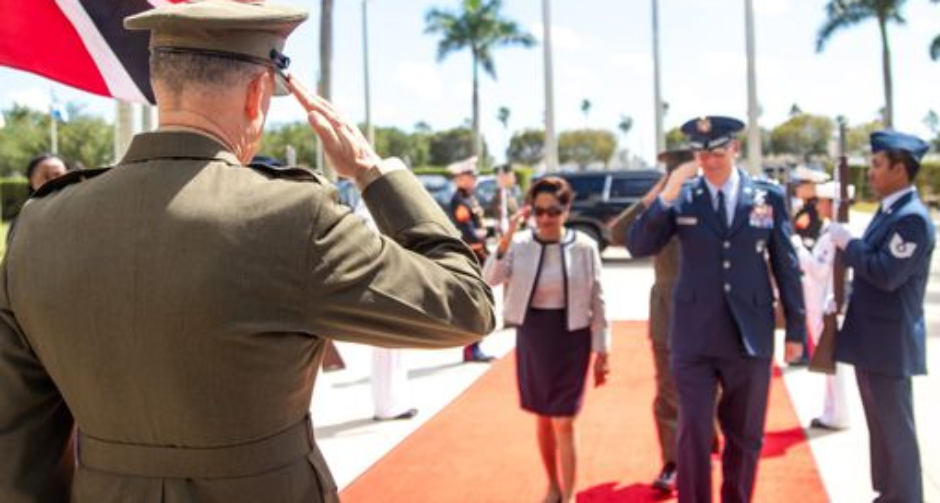
Secretary Rubio Calls President Ali
January 6, 2026
US Secretary of State Marco Rubio spoke with President Irfaan Ali to discuss further strengthening bilateral security cooperation.
He commended President Ali for his leadership as a regional security partner and for Guyana’s growing role in promoting stability across our hemisphere. The Secretary reaffirmed the US commitment to deepening security cooperation with Guyana to address shared challenges, including illicit narcotics and firearms trafficking, which threaten regional stability and economic resilience.
Both leaders underscored the importance of continued collaboration to disrupt foreign terrorist organizations and transnational criminal networks while strengthening law enforcement capabilities and border security.
Local company seeks permit for US$81M deepwater seismic survey
December 24, 2025
Latitude Energy Inc submitted an application to the Environmental Protection Agency (EPA) to conduct seismic surveys in three deepwater oil blocks, responding to a government request for proposals for Lot 1 seismic surveys, relating to the specific areas.
According to the project summary, Latitude and partner Shearwater GeoServices plan to conduct the proposed survey in Blocks D1, D2 and D3. The maximum 3D seismic activity area is approximately 13,512 square kilometers with an overall working area of 16,857 square kilometers but is subject to change. Water depth will range from approximately 2,500-3,500 meters in the survey site located in the Atlantic Ocean within the Guyana Exclusive Economic Zone.

Guyanese company seeking permit for US$81M deepwater seismic survey Seismic activity : EPA Project Summary
The US$81 million budget includes mobilisation and demobilisation, acquisition, processing and interpretation of the data, associated costs, such as a software license, provision of a Virtual Data room and marketing among others.
The 3D seismic acquisition is estimated to take five and a half months and is expected to start in the fourth quarter of 2025, following the acquisition of the necessary permits but subject to weather conditions. Following the data collection process, the information will be transferred to a data processing center for interpretation.
The project summary explains, “The purpose of the Project is to acquire and process, 3D marine seismic data to create a high quality geophysical and geological imaging of the subsurface.
3D marine seismic surveys are used in offshore oil and gas exploration to map subsurface geology and derisk drilling projects.”
It involves towing an array of cables (streamers) behind the seismic vessel. These streamers contain receivers (hydrophones) that pick up reflected sound from the subsurface.
The vessel tows a sound source that emits a sound wave using compressed air in the water. This sound penetrates the subsurface, reflecting off geological features and being picked up on the streamers. This data undergoes processing where it can be used to create a 3-dimensional map.
The EPA will vet the application to determine whether an Environmental Impact Assessment (EIA) is required before it grants approval. The regulator ruled out the need for an EIA for 3D seismic activity in shallow waters offshore Guyana. The planned activity is expected to be conducted over a three-year period, commencing January 1, 2026 to 2028 in three sites, measuring a total of 25,604.78 square kilometers.
The GoG recently concluded its maiden bid round for 14 offshore oil blocks, when 8 attracted bidders. In the absence of seismic information, the response was favourable and indicated its intention to pursue seismic activity to further increase the attractiveness of the Guyana basin.
Bourbon scores 5-year vessel gig with ExxonMobil
December 10, 2025, by Melisa Cavcic
ExxonMobil Guyana Limited (EMGL), a subsidiary of the U.S.based oil and gas major ExxonMobil, hired French maritime services player Bourbon on a long-term assignment offshoref Guyana.

PSV Bourbon Calm; Source: Bourbon
Months after winning a 5-year deal with ExxonMobil in Angola, Bourbon signed another 5-year contract that contains extension options with the U.S. player’s subsidiary for the provision of maritime services in Guyana The assignment will start in the first quarter of 2026, with commissioning of the large platform supply vessel (PSV) Bourbon Calm and covers the transport of products essential to offshore operations in one of the world’s most dynamic oil basins.
Following discovery of oil fields in 2015, Guyana turned into one of the fastest-growing offshore operations, with the planned commissioning of additional floating production, storage and offloading units (FPSOs).
Bourbon has supported development of this industry since 2019, thanks to the technical quality of its fleet and the expertise of its local teams. The solution proposed by the firm is said to be both competitive, sustainable and immediately operational.
The company claims that this contract marks a major step forward for the sector, as it allows the transport of chemicals in Guyana by a PSV for the first time in compliance with the OSV Chemical Code.
As a result, the Bourbon Calm will become one of the few offshore vessels in the world authorized to carry out this type of operation. Adjustments and upgrades have been made on board, including modifications to the pumping systems, enhanced tank cleaning and strengthened operational procedures, following validation by the maritime authorities and DNV classification society.
Karim Mebarek, Chief Commercial Officer , commented: “This new contract illustrates ExxonMobil Guyana’s confidence in Bourbon’s ability to offer safe, innovative, and economically efficient maritime solutions that comply with the highest regulatory standards. Thanks to its high-quality design and above-average liquid storage capacity, the Bourbon Calm meets high technical and environmental standards while ensuring optimal operational safety.”
ExxonMobil’s approved portfolio in Guyana entails the Liza Phase 1, Liza Phase 2, Payara, Yellowtail, Uaru, Whiptail and Hammerhead. An eighth project, Longtail, is currently undergoing regulatory reviews.
First African firm wins Guyana oil block
December 10, 2025
Beatrice Mensah-Tayui and Minister Vickram Bharrat
Accra-based Cybele Energy is the first African company to secure offshore acreage in Guyana, signing a USD 17-million exploration deal for shallow‑water Block S7, awarded under Guyana’s first competitive licensing round.
Block S7 is estimated to hold 400 million barrels of recoverable oil. Drilling of the first exploration well is due within 12 months of the PSA effective date.
50 kilometres from ExxonMobil’s Liza projects, Block S7 is located outside disputed territorial zones and benefits from 3D-seismic data overlapping the Carapa‑1 area. Cybele Energy expects to produce up to 160,000 bopd from a development concept using 8 production wells and onshore early production facilities.
The PSA structure includes a 65% cost‑recovery clause for shallow‑water blocks, enhancing the block’s commercial viability.
Cybele Energy is an African‑owned E&P firm with shallow‑water experience across multiple African jurisdictions. Led by president Beatrice Mensah‑Tayui, the company focuses on ESG‑led development, skills transfer and indigenous capacity building. Technical partners include Norway‑based Well Expertise.
The agreement was signed in Georgetown at a government‑hosted ceremony, supported by Africa Legal Associates which advised Cybele Energy through a 3‑year licensing and negotiation process. Accra-based ALA is a full‑service corporate law firm with a pan‑African vision, offering clients in Ghana and beyond commercial legal solutions drawn from its regional knowledge of ECOWAS and the AfCFTA.
Lawyers are qualified to practise in Ghana and England & Wales, allowing ALA to deliver integrated domestic and international legal solutions across sectors including energy, mining, corporate transactions, regulatory compliance, disputes and ESG advisory, well‑suited to handle complex upstream deals such as Block S7.
Guyana benefits from PSA with Ghana explorer
-including stronger fiscal position, clearer environmental safeguards
December 19, 2025
Compared with the 2016 ExxonMobil Stabroek Production Sharing Agreement, the newly adopted PSA which France’s Total Energies and Ghana’s Cybele signed shows a decisive shift in the country’s approach to petroleum governance.
The 2023 agreement shows that Guyana gains a stronger fiscal position, clearer environmental safeguards, and more tools for accountability.
Both contracts operate within very different regulatory eras and the contrast highlights the evolution of Guyana’s oversight structures.
The new PSA crafted under the Irfaan Ali government which companies in the 2023 bid auction and beyond will sign, leaves open the option for higher than the proposed minimum signing bonus and most of the bidders have gone above the minimum, Minister of Natural Resources Vickram Bharrat says.
Ghana player teams up with engineering heavyweight for shallow-water block concession
December 7, 2025
Sub-Saharan exploration and production company, CYBELE Energy, announced collaboration with engineering heavyweight, Well Expertise AS/Elemental Energies, ahead of Cybele’s signing for shallow-water Block S7, expected to earn Guyana a signing bonus of US$10 million. Cybele said this collaboration reflects its commitment to leveraging world-class technical capabilities and strategic alliances to enhance its global energy operations.
“It underscores our focus on frontier and emerging markets, combining regional expertise with international wells engineering excellence.”
Chief Executive Officer (CEO) of Cybele Energy, Beatrice Mensah Tayui, noted that Well Expertise AS/Elemental Energies will be working for Cybele on the Guyana block., the second offshore concession to be awarded following the 2022 bid round.
“This marks a significant milestone in Guyana’s upstream oil and gas industry, given the unique visionary PSA [Production Sharing Agreement] to boost Guyana’s energy security, a diversified resource development and grassroots inclusivity and local-content advancement.”
The agreement Cybele is poised to sign for the block is outfitted with robust requirements for the training and employment of Guyanese. It includes a requirement for US$1 million to be provided annually to a government training fund for five years, during which exploration and seismic work would take place.
The S7 block was initially awarded to Cybele in partnership with Liberty Petroleum Corporation of the USA. With Liberty no longer part of the arrangement, Cybele will be the sole company signing and assuming all responsibilities for the block.
As the lone woman-owned company, she said, “The leadership of Guyana has made a historic and bold statement in its commitment to the advancement and empowerment of women.”
Collaboration with Well Expertise AS/Elemental Energies reflects a merger of 2 European companies. Specifically, Elemental Energies had acquired Norway’s Well Expertise AS in July 2024, creating one of the world’s largest specialist wells, subsurface, and project- management companies.
The strategic merger combined Scotland’s leading independent wells expert with Norway’s premier well-management company, establishing a comprehensive service provider with over 230 experts worldwide. The combined entity now operates as a unified organisation delivering well-engineering excellence across the full energy spectrum, from traditional oil and gas through decommissioning to low-carbon solutions, including carbon capture and storage and geothermal projects.
With over 30 years of North Sea experience, the merged company employs over 230 wells-engineering and subsurface specialists, operating from strategic locations in Westhill, Scotland and across Norway in Stavanger, Trondheim, and Kristiansund.
Operations span 4 continents, covering the North Sea (UK and Norway), Middle East, Asia-Pacific, Africa, and the Americas and the company serves a broad client base with long-term partnerships, including Equinor, TotalEnergies, ExxonMobil, ENI and Shell.
Non-oil sector grows over 13%
December 27, 2025
The non-oil economy grew by 13.8% in the first half of 2025, according to the mid-year economic report. Tourism, Industry and Commerce Minister Susan Rodrigues described the figures as exceptional by global standards, saying “by any measure, that is a remarkable growth percentage”.
The overall economy grew by 7.5% for the fifth consecutive year of broad-based economic expansion in Guyana, highlighting the performance across the non-oil sectors in a number of areas including agriculture, tourism, trade and infrastructure. On the country’s next phase of development, she said,
“Guyana’s economy is extremely diversified, something that we are very proud of and we will continue to build on. Our objective is very simple—to ensure that prosperity reaches every single Guyanese regardless of geography, background, ethnicity, religion or political affiliation.”
This strategic direction will be reflected in agencies such as the Small Business Bureau, National Bureau of Standards, Tourism Authority and the Competition Consumer Affairs Commission.
ECLAC – Guyana to continue leading regional growth in 2026
December 17, 2025
Economic transformation in GUYANA shows no signs of slowing down, after posting unprecedented growth in 2024 and maintaining double digits expansion in 2025. The United Nations Economic Commission for Latin America and the Caribbean forecast 24 per cent real GDP growth in another year of acceleration in 2026, highlighting the projections in its Preliminary Overview of the Economies of Latin America and the Caribbean 2025.
Real Gross Domestic Product (GDP) growth is projected at 24 per cent for 2026, after growth in 2024 and 2025 was estimated at 43.6 per cent and 15.2 per cent, respectively, underscoring Guyana’s continued performance in the region, forecast to grow by 1.8 per cent in 2026, slightly slower than 2025.
UN ECLAC noted that economic expansion is subject to tourism and construction trends in the subregion, highly vulnerable through dependence on imported energy, high transport costs and exposure to natural disasters.
The positive outlook for Guyana reinforces the assertion advanced by President Dr. Irfaan Ali that Guyana is entering its “Golden Era,” driven not only by oil and gas but by a strategic plan to foster long-term, diversified development.
In a recent address, he noted that while much of Guyana’s momentum is around its burgeoning oil and gas sector, the government remains disciplined in its efforts in ensuring that the economy will be built on pillars of diversification.
“This journey that we are on is now getting fired up, but we are not only injecting fuel on this leg of the transformation.” Guyana built its energy ecosystems around understanding the global environment to ‘shock proof’ its economy from shortfalls. “We are living in Guyana’s Golden Era, a time where our nation will be the envy of many, when the world is looking to us, not out of curiosity, but out of admiration and critically it means that opportunities for Guyanese firms will multiply.”
Guyana is building out an infrastructure, to enhance its capacity to take care of consumption, an energy mix and integration critical for resilience and sustainability. Long-term strength will not be on how much oil it produces, but how wisely it converts that wealth into infrastructure, human capital, energy security and a diversified economy.
SOCIAL INVESTMENT ALONGSIDE GROWTH
In August, President Ali described the PPP/C’s manifesto as a “blueprint for development” and a binding pact with the people, rather than a collection of campaign promises. He had stressed at the manifesto’s official launch that it was crafted over several years through community engagement and policy planning, ensuring that it reflects national priorities rather than election-period rhetoric. At its core, the manifesto focuses on strengthening macroeconomic stability while building resilience against global shocks such as market volatility and international conflicts. It prioritises regional development, major infrastructure projects, household empowerment and small-business growth, with the overarching goal of ensuring prosperity and stability across all sectors of society.
Returning to office following the September 1 polls, President Ali touted government plans to unveil a suite of comprehensive measures to support households and cushion the global trend of increased cost of living. The government invested heavily in social welfare while building out the infrastructural landscape to enable long-term growth and sustained development.
Among the plethora of measures rolled out from 2020 to 2025 are the re-introduction and increase of the education grant to children; increase in old-age pension and public assistance; targeted cash transfers and the grant for persons with disabilities; health vouchers and programmes, removal and reduction of taxes and other targeted tax-deduction measures.
The government abolished tuition fees at the University of Guyana and several technical vocational institutions, making tertiary education free. Several nursery, primary and secondary schools were rehabilitated and newly commissioned to promote equitable access to education levels. New regional hospitals enhance delivery of healthcare across the country.
POLICY CONTINUITY
Finance Minister, Dr Ashni Singh, had stated that the 2026 Budget will be firmly anchored in manifesto commitments, setting the direction for delivery over the next 5 years. “We pride ourselves on policy, clarity and policy continuity. We pride ourselves as a party in government and we have been very clear about what we intend to do over the next five years before the 2025 general elections of the 1st of September.”
Policy consistency, clarity and continuity remain central to the administration’s approach. He had outlined the government’s proactive role in shaping economic trajectory, stressing that the transformation underway is not accidental but the result of a clear and focused vision.
Ghana-IMF Staff Complete Post-Governance Diagnostic Mission
December 12, 2025
An International Monetary Fund (IMF) Technical Assistance mission, led by Ms. Tina Burjaliani and including Mr. Gomiluk Otokwala and Ms. Nusula Nassuna, visited Accra from December 8–11, 2025, to engage with stakeholders on the implementation of the Governance Diagnostic recommendations. The Governance Diagnostic Report for Ghana, prepared by IMF staff at the request of the Ghanaian authorities and published on November 3, 2025, provides a comprehensive analysis of governance and corruption vulnerabilities and outlines priority reforms to strengthen governance in public financial management, revenue administration, property rights, public-sector integrity, transparency, and accountability mechanisms across state institutions.
The mission focused on supporting the authorities as they begin to implement actions to address the key recommendations, and on identifying opportunities to coordinate assistance among development partners to advance this agenda. Discussions with senior officials, representatives of civil society and international development partners aimed to help the authorities prioritize follow-up actions, implementation arrangements and options for leveraging support to sustain reform momentum.
IMF staff will continue to collaborate closely with the authorities and development partners as work progresses on actions, including in the context of the ongoing Extended Credit Facility, to address the Governance Diagnostic recommendations.
Ghana: Technical Assistance Report-Governance Diagnostic Assessment
November 3, 2025
Summary
The Ghana Governance Diagnostic Report has been prepared by IMF staff at the request of the authorities.
Informed by political economy analysis, the GD discusses
-
- the nature and severity of corruption and
- provides a comprehensive analysis of governance weaknesses and
- corruption vulnerabilities affecting key state functions:
- fiscal governance (public financial management and revenue administration),
- financial sector oversight,
- rule of law,
- anti-money laundering and
- countering the financing of terrorism.
The GD report proposes a set of prioritized, time-bound reform measures aimed at strengthening economic governance, rule of law and reducing corruption vulnerabilities.
The authorities committed to strengthening governance and reducing corruption, providing a critical opportunity to address long-standing vulnerabilities.
Strong compliance and record output in petroleum sector
December 7, 2025
The Oil and Gas sector progresses on a foundation of clearly defined rules that allow the ExxonMobil consortium to meet obligations, while bringing value to shareholders and Guyana.
This is evident in the way ExxonMobil manages exploration and the Stabroek Block discoveries that follow. Since 2015, the company reported 51 discoveries, with over 30 announced as significant.
Only finds that meet an established threshold are determined to be significant and are subsequently announced publicly but every single discovery, regardless of scale, is required by law to be reported to the Government.
ExxonMobil repeatedly affirmed that it continues to fulfil this obligation and the Ministry of Natural Resources confirmed that each Notice of Discovery has been filed as required. This is a routine part of the regulatory process, grounded in law and Exxon’s contractual obligations.
The transparency of this system remains one of the strengths of the sector’s development. With such discipline fostered through the constructive relationship between the state and oil companies, Guyana’s production story is one of the most compelling globally.
With 4 floating production vessels operating offshore, output reached 900,000 barrels per day (b/d). Each project to date has come online on or ahead of schedule, distinguishing Guyana from many global deepwater provinces.
The production ramp-up continues to be safe and incident-free, reflecting the unsurpassed operational standards applied across ExxonMobil activities and strong government. oversight.
The advancing Uaru project is expected to push national production capacity beyond the 1-million-barrel bpd mark in 2026. That scale of output places Guyana among the world’s most significant new oil producers and gives the petrostate resources it needs for long-term economic planning.
As production grows, Guyana crude is reaching a wider range of global markets, with shipments to destinations not usually associated with Guyana. More refineries around the world are processing this light to medium sweet oil, giving Guyana a broader international footprint.
ExxonMobil and its partners continue to support the wider development agenda driven by the government. Through the Greater Guyana Initiative, they fund programmes to help local businesses build capacity and improve competitiveness.
The Centre for Local Business Development remains an important institution, offering training and guidance that support broad economic diversification, in keeping with the policy agenda. Across the country, businesses continue to examine ways in which they can capitalise on growing opportunities, not only in oil and gas, but across multiple sectors.
Events by groups like the Guyana Oil and Gas Energy Chamber and the Guyana Manufacturing and Services Association continue to be underlined, not just by a celebration of the gains made in the private sector so far, but also by future developments.
Guyana’s ambitions around natural gas now add another dimension. The government is pursuing a gas-based development strategy beyond what is underway in Wales, with new opportunities being explored in Berbice.
ExxonMobil collaborated with the government on an investment summit aimed at unifying planning among interested investors. This potential spans
-
-
- expanded gas-fired power generation,
- fertiliser production,
- gas-based manufacturing and
- the development of large-scale data centres.
-
These projects can revolutionise the local economy in ways that build on progress made from upstream oil development. Affordable and reliable energy will be central to these industries and ExxonMobil’s gas projects are central to making that vision possible.
Together, these developments reflect a sector that continues to meet its obligations while collaborating with the government for sustainable development.
New PSA gives Guyana ownership of assets after Total Energies recover costs
November 30, 2025
Guyana’s oil repays ExxonMobil over US$40B spent to develop Stabroek Block but the company owns the assets.
This has been controversial, as stakeholders argue Guyana paid for the assets and is therefore the rightful owner. While government defended the arrangement with Exxon, it corrected this provision in the new oil contract signed with Total Energies for a shallow water oil block, more than ten times smaller than the massive Stabroek Block concession.
Guyana to take ownership of assets after costs recovered by Total Energies New PSA
Daniel Larranaga VP of Total Energies.

Daniel Larranaga VP of Total Energies.
The Stabroek Block now measures about 24,000 square kilometers, following completion of 20% relinquishment this year.
Block S4, which was awarded to a consortium led by Total Energies barely measures 1,788 square kilometers.
In the oil deal with Total, “All assets purchased by the Contractor for use in Petroleum Operations hereunder shall become the property of the Minister upon recovery of costs under Article 35 notwithstanding any costs that may be under dispute. The Contractor shall be liable to keep the assets in good repair and working order in accordance with the Act and Best International Industry Standards and Practices.”
Section 24 of the Petroleum Agreement highlights that upon expiry or termination of the contract, the contractor shall upon notification by the Minister deliver all machinery or assets to the minister free of charge.
While the new contract is clear regarding the ownership of assets paid for with the country’s oil, ExxonMobil has been extended what seems questionable contract terms which allow the company to remain owners of property financed through cost recovery. Vice President Bharrat Jagdeo said that although Guyana was repaying ExxonMobil for assets in the Stabroek Block, they belong to the operator.
“So first of all, the assets still belong to the company. They don’t change ownership from the company.These assets are still working, if you pay off with the assets, then you have more money left now to distribute as profits.”
Chief policymaker for the sector, Jagdeo said that the country does not become owner of the assets after costs have been recovered but still stands to benefit from an increased share of profits as a result.
“So now we will have more money to distribute as profit, because we paid off for the assets. They are off our books.
So, the government’s share of revenue skyrockets, which will happen in future years.
So, the assets ownership don’t change, it’s just the composition of the distribution, or the share, the proportion of the revenue set aside for distribution, to government and the investor, as profit, their share goes up.”
Guyana currently pays 75% towards cost recovery while the remaining 25% is shared with the operator as profits, with the country gaining an additional 2% in royalty. As the value of the cost bank declines, he reasoned that the country will experience a higher flow of revenue, although the ratio will remain the same for calculating profits.
“So, we’ll get 50% of the profit, now in the future our 50% would be of a bigger pool. The same ratio will maintain, 50%, but of a bigger pool of resources, and then plus 2%.”
Jagdeo previously said that Exxon is free to sell the assets paid for by Guyana to handle costs related to an oil spill, as the country is not a co-owner of the infrastructure.
Subsequently, former head of the Environmental Protection Agency (EPA), Dr. Vincent Adams, in a scathing response, argued that the VP’s explanation was illogical.
Chevron Corporation
3 December 2025
Chevron Corporation disclosed that it expects an organic capital expenditure range of $18–$19 billion for consolidated subsidiaries (capex) in 2026.
The guidance is at the lower end of its long-term outlook of $18–$21 billion. Chevron expects to allocate $1.3–$1.7 billion in capital expenditures through its affiliates next year. Chevron projects total U.S. capital spending to reach roughly $10.5 billion, accounting for over half of its 2026 capex budget.
Upstream investments at around $17.0 billion includes nearly $6.0 billion for U.S. shale and tight plays in the Permian, DJ, and Bakken basins, supporting U.S. production of over two million barrels of oil equivalent per day.
Global offshore spending is expected to be about $7.0 billion, mainly targeting growth in Guyana, the Eastern Mediterranean and the Gulf of America, with about $0.4 billion in capitalized interest, mostly tied to Guyana projects. Chevron targets downstream capex at around $1.0 billion, with nearly 75% allocated to U.S. operations. Within total upstream and downstream investments, Chevron expects to use roughly $1.0 billion for reducing carbon intensity and expanding new energy businesses.
Investor Day Highlights
Last month, the operator targeted 2%–3% annual growth in oil and gas production through 2030. At a flat $70 Brent, Chevron projects average annual adjusted EPS growth above 10% through 2030, rising over 14% with escalating real prices.In the Permian, Chevron plans to cut capital spending to about $3.5 billion starting in 2026.
Price Action: shares are up 0.27% at $152.0 premarket at the last check on Thursday.
Chevron to spend up to US$19b in 2026 on US, Guyana oil production
December 4, 2025
Chevron said that capital expenditure for 2026 will be between US$18 billion and US$19 billion as the oil major focuses on production in the U.S. and investments connected to a recently-acquired oil stake in Guyana.
The range is at the low-end of previous guidance for annual investment between US$18 billion and US$21 billion through 2030. The second-largest U.S. oil producer outlined a plan last month to cut costs, operate more efficiently and increase returns to investors through the end of the decade.
CEO Mike Wirth said, “Our 2026 capital program focuses on the highest-return opportunities while maintaining discipline and improving efficiency, enabling us to grow cash flow and earnings.”
About US$17 billion will be spent on upstream, roughly US$9 billion of which is allocated to the United States. Chevron said it expects to spend US$6 billion on American shale and plans to produce over 2 million barrels of oil equivalent per day from the USA next year.
Spending on offshore production will total about US$7 billion to support Guyana, projects in the Eastern Mediterranean and production from the U.S. Gulf of Mexico. Downstream spending about US$1 billion, will be slightly lower in 2026.
Eco Atlantic stock price up 35% after exploration deal with Navitas
VladimirAfanasiev & IainEsau, London 4 December 2025
Eco and Navitas Petroleum sign strategic partnership deal with multiple farm-in options.
London-listed junior Eco Atlantic has signed a strategic partnership agreement with Navitas Petroleum that gives the Israeli player exclusive options to take key stakes in exploration blocks offshore Guyana, South Africa and potentially, Namibia.
Eco’s stock price surged, up about 35% at 10.32 pence (13.79 US cents) in London.
Under the strategic agreement, Navitas, which operates the proposed Sea Lion project in the Falkland Islands and has exposure to US offshore and onshore assets, will pay $2 million to Eco Atlantic to secure farm-in options for the Orinduik block offshore Guyana and Block 1 CBK in South Africa’s Orange basin.
In Guyana, Navitas could exercise an option to take an 80% operating stake in Orinduik within 12 months if it pays an additional $2.5 million, which would reduce Eco’s interest to 20%. Navitas would then carry Eco through an Orinduik work programme which could include drilling an exploration well or appraising the existing Jethro-1 and Joe-1 heavy oil discoveries “for potential development and commercialisation,” said Eco.
This carry is capped at $11 million, net to Eco, and excludes mobilisation costs. Eco chief executive Gil Holzman said: “Following a joint visit by our teams to Guyana later this month, we expect to gain clarity on our work programme and appraisal plan for Orinduik.”
Guyana exports plunge
December 01, 2025
Bank of Guyana Half-Year Report showed Guyana’s export momentum faltered in the first half of 2025, with overall export receipts falling 11.5 percent to US$9.07 billion, driven largely by lower earnings from crude oil, rice, sugar, timber and other exports, while gold and bauxite were the only major commodities to record increases.
 Gold export earnings climbed to US$556.3 million, a rise of 36.1 percent or US$147.5 million compared to the end of June 2024. This was due to higher export volume and a stronger average price. Declarations pushed gold exports up by 690 ounces to 195,486 ounces, while the average price per ounce moved from US$2,099.04 to US$2,845.95.
- Bauxite earnings reached US$68.6 million, a rise of US$31.1 million from the same period last year, linked to a significant jump in export volume, which grew to 1,272,021 metric tonnes. Export prices fell sharply from US$153.11 to US$53.91 per tonne.
- Sugar exports continued to struggle as Earnings fell to US$3.6 million, down 47.6 percent. Export volume fell by 47.2 percent. to 4,533 metric tonnes, with CARICOM accounting for 95.9 percent. Average export price rose slightly to US$784.77 per tonne.
- Rice export earnings dipped, ending the period at US$123.1 million, US$4 million lower than last year even as exports grew by 5.5 percent to 224,963 metric tonnes. The EU share of rice exports fell sharply, while Latin America’s share rose to 54.6 percent. The average export price dropped 8.2 percent to US$547.35 per tonne.
- Timber earnings of US$9.1 million, reflect a 4.1 percent decline linked to reduced export volume. Timber exports fell to 14,032 cubic metres, though the average export price increased by 38.5 percent to US$649.53 per cubic metre.
- Crude oil, Guyana’s dominant export, recorded a drop in earnings to US$8.15 billion — a decline of US$1.28 billion year-on-year. Export volume grew modestly to 116.1 million barrels but the average price slid from US$83.39 to US$70.27 per barrel, driving down overall receipts.
India buys 4m barrels of Guyana oil
December 2, 2025

Indian’s High Commissioner to Guyana, Dr Amit Telang (left) presenting a study to Minister of Natural Resources, Vickram Bharrat yesterday. (Indian High Commission photo)
As US sanctions bite, 2 massive supertankers began a lengthy voyage from Guyana to India, hauling a total of 4 million barrels of crude oil over approximately 11,000 miles (17,700 kilometers) across two world oceans.
This journey results from the major shift by Indian refiners to secure non-Russian energy supplies following stepped-up US sanctions on countries taking cheap oil from Moscow.
The Very Large Crude Carriers (VLCCs) Cobalt Nova and Olympic Lion departed Guyana in late November and are scheduled to arrive in India in January.
These are the first crude shipments from Guyana to India since 2021. The primary catalyst for this trade pivot is the recent wave of US sanctions targeting Russia’s two largest oil exporters, Rosneft PJSC and Lukoil PJSC.
India, which had been importing around 1.7 million barrels a day of Russian oil, now faces significant compliance risks if it continues the trade, a situation compounded by US President Donald Trump’s decision in August to double tariffs on all Indian imports to 50%.
Most Indian refiners are reportedly skipping Russian crude purchases for December loadings, according to Bloomberg and Reuters, with India’s total Russian oil imports expected to plunge to a three-year low. This volatility prompted Indian refiners, despite their sophisticated processing capabilities, to seek alternatives to manage their supply needs.
UK , Guyana, sign MoU on forest, climate
December 3, 2025
The Ministry of Natural Resources signed a Memorandum of Understanding (MoU) with the United Kingdom, represented by the Foreign, Commonwealth & Development Office (FCDO),which aims to “strengthen the framework for cooperation under the Forest Governance, Markets and Climate Programme (FGMC2).”
Through the FGMC2 programme, “the UK will continue to provide technical, institutional, and implementation support including through the European Forest Institute’s Rapid Response Programme and other collaborative mechanisms”.
Natural Resources Minister Vickram Bharrat, stated that the agreement deepens technical cooperation at a time of growing global focus on sustainable forestry
Guyana to construct 2nd gas to shore pipeline
2025, 11/28
President Irfaan Ali told the UK Trade Mission Guyana will soon commence one of the fastest gas-to-shore projects and aims to have a second major gas pipeline ready by 2030 to support industrial growth.
The pipeline is central to long-term energy and manufacturing ambitions. Guyana will actualise the project more swiftly than any similar gas pipeline development, from conceptualisation to delivery.
Underscoring the scale and urgency of the project, he said, “Before the end of 2030, the second gas line must be brought to shore, and that will be linked to the deepwater port and the whole infrastructure being built out in Berbice. For that to happen, we will have to break every single record in the world.”
The second pipeline is expected to:
-
- fuel expanded industrial development in Berbice,
- support
- petrochemicals,
- fertilisers,
- LNG,
- agro-processing and
- light manufacturing,
- deliver cleaner, cheaper and more reliable energy,
while strengthening Guyana’s position as the region’s manufacturing hub.
The project, a collaboration with ExxonMobil, will complement the 300MW Gas-to-Energy development at Wales, the countrywide expansion of solar and hydro power and the rebuilding of the nation’s transmission networks.
Implementing the pipeline quickly needs strong international cooperation, noting the United Kingdom’s valuable partnership with Guyana. The gas- to- energy project aims to lower electricity costs by using offshore natural gas to generate power, with the project expected to double electricity-generating capacity.
The project includes
-
- a 120-mile pipeline, a 300-megawatt power plant and
- a natural gas liquids (NGL) plant.
The target for first gas is in the fourth quarter of this year, and the project’s total cost is estimated at around US$1.9 billion. (CMC)
US seizes oil tanker off Venezuela falsely flying Guyana flag

This screen grab from a video posted by Attorney General Pam Bondi, Dec. 10. 2025. @AGPamBondi/Xs
December 11, 2025
This video posted by Attorney General Pam Bondi, shows what the execution of “a seizure warrant for a crude oil tanker used to transport sanctioned oil from Venezuela and Iran” off the coast of Venezuela, Dec. 10. 2025.
The United States yesterday seized an oil tanker off the coast of Venezuela which was falsely flying a Guyana flag, Maritime Administration Department (MARAD) says, as the agency condemned the act while highlighting it will continue to work with international partners to take action against the illegal practice. MARAD said,
“Today, the Government of the United States of America (USA) informed the Guyana Maritime Administration Department that they have encountered the Motor Tanker SKIPPER (ex-ADISA), IMO Number 9304667 in International Waters.
It was falsely flying the Guyana Flag, as it is not registered in Guyana. MARAD will continue to reach out to and work with international partners and other maritime agencies to identify, pursue, and take firm action against any unauthorized use of the Guyana Flag,” it added.
MARAD’s response came after media contacted Minister of Public Works, Juan Edghill, the Guyana Defence Force, and National Security Advisor, Gerry Gouveia who referred media to Director of MARAD, Stephen Thomas.
It is not the first time that this has happened as MARAD said that it has, “observed the proliferation and unacceptable trend of the unauthorised use of the Guyana Flag by vessels that are not registered in Guyana.”
US President Donald Trump announced the seizure. “We’ve just seized a tanker on the coast of Venezuela, large tanker, very large, largest one ever, actually, and other things are happening” .
The US Attorney General Pam Bondi yesterday said that the US Federal Bureau of Investigation (FBI), Homeland Security Investigations, and the US Coast Guard, with support from the Department of War, executed the seizure.
“For multiple years, the oil tanker has been sanctioned by the United States due to its involvement in an illicit oil shipping network supporting foreign terrorist organizations. This seizure, completed off the coast of Venezuela, was conducted safely and securely—and our investigation alongside the Department of Homeland Security to prevent the transport of sanctioned oil continues.”
Reuters reported that three US officials, said the operation was led by the US Coast Guard, but had not stated which country’s flag it was flying or exactly where the interdiction took place.
British maritime risk management group Vanguard, stated that the tanker –Skipper -was believed to have been seized off Venezuela early yesterday. According to Vessel Finder, Skipper, which bears IMO/MMSI numbers 9304667 / 750330000 respectively, was last seen in South America with flag state Automatic Identification System (AIS) showing Guyana. It also showed that the last port for the vessel was Khor al Fakkan Anch in the United Arab Emirates (UAE), on September 19th last at 1:54pm.
The US imposed sanctions on the tanker for what Washington said was involvement in Iranian oil trading when it was called the Adisa. Oil futures rose following news of the seizure. After trading in negative territory, Brent crude futures LCOc1 rose 27 cents, or 0.4%, to settle at $62.21 a barrel, while US West Texas Intermediate crude futures CLc1 gained 21 cents, also 0.4%, to close at $58.46 per barrel.
Caracas last evening issued two communiques condemning the act, as the Nicolas Maduro regime accused Trump of using the seizure to get Venezuela’s oil.
“In these circumstances, the true reasons behind the prolonged aggression against Venezuela have finally been exposed.
It is not migration. It is not drug trafficking. It is not democracy. It is not human rights. It has always been about our natural resources, our oil, our energy, the resources that belong exclusively to the Venezuelan people.
We also denounce that this act of piracy seeks to distract attention and cover up the resounding failure of the political show staged today in Oslo, where the manipulations and lack of results of those who have unsuccessfully attempted for years to bring about “regime change” through violence and in open complicity with Western governments were once again exposed”.
This was a reference to the award of the Nobel Peace Prize to Maria Corina Machado.
The missive did not mention the false flag the vessel was flying but called on, “all Venezuelans to stand firm in defense of the homeland and urges the international community to reject this vandalistic, illegal, and unprecedented aggression that seeks to normalize itself as a tool of pressure and plunder.”
Over the weekend, the United States Embassy here said that United States Southern Command (USSOUTHCOM) has been assisting the Guyana Defence Force (GDF) Coast Guard in improving its radar capability to enable this country to have a better idea of activities in its sea space.
“This includes our joint development of coastal radar capability for the GDF Coast Guard. The coastal radar project is an ongoing line of effort and cooperation between USSOUTHCOM and the Guyana Defence Force that focuses on Maritime Domain Awareness,” the embassy’s public affairs department said.
Asked whether Guyana sought radar assistance from the US, the embassy said, “The U.S-Guyana military-to-military partnership spans training, exchanges, and acquisitions in key national security areas.”
The issue of US radar support or location in the Caribbean has been a major one in Grenada where the government is still studying the technical and other implications of allowing an American military radar system at the Maurice Bishop International Airport.
However, Trinidad and Tobago government quietly allowed the US to erect a RADAR at the airport on Tobago, raising concerns among Tobago politicians and the opposition People’s National Movement. Prime Minister Kamla Persad-Bissessar said the Tobago-based radar will monitor transnational crimes such as narco-trafficking and Venezuela’s breaking of sanctions on the shipment of crude.
“The US owns thousands of satellites, they own the GPS system, and they have almost 20 per cent of their navy in the Caribbean with the most sophisticated military communications technology in existence. They don’t need to put a radar in our country to use for any military purpose.
They could monitor the entire Caribbean from the Gerald Ford aircraft carrier.Sensible people understand these facts.”
U.S. Security officials, reaffirm support for regional stability and sovereignty
December 11, 2025
SENIOR officials from the U S Department of War concluded a high-level visit to Guyana this week, reinforcing Washington’s commitment to deepening security co-operation with Georgetown and supporting stability across the Caribbean and South America.
The delegation, led by Senior Advisor to the Secretary of War, Patrick Weaver and Acting Deputy Assistant Secretary of War for Americas Security Affairs, Joseph Humire, held meetings with President Dr. Irfaan Ali, Chief of Defence Staff, Brigadier Omar Khan, and other senior security leaders.
Discussions centred on strengthening bilateral defence co-operation, safeguarding Guyana’s territorial integrity, and expanding joint efforts to confront transnational threats.
The visit forms part of the United States’ broader efforts to bolster regional partnerships at a time of increasing geopolitical tension and heightened security challenges in the hemisphere.
Weaver emphasised the historic nature of U.S.–Guyana defence relations, noting that the two nations have been strategic partners since Guyana’s independence in 1966.
“Close coordination with regional partners is critical to advancing regional security,” he said. “The U.S.–Guyana partnership dates back to 1966, and it’s important that we strengthen our cooperation and help support a sovereign and prosperous Guyana.”
The talks touched on collaborative initiatives aimed at countering transnational criminal networks, improving border and maritime security, and enhancing Guyana’s defence capabilities amid persistent territorial threats from neighbouring Venezuela. U.S. officials have repeatedly voiced strong support for Guyana’s sovereignty amid ongoing tensions over the Essequibo region.
Patrick R. Weaver, Senior Advisor to the U.S. Secretary of War, serves within the Senior Executive Service and brings extensive experience in national security, border security, and Western Hemisphere affairs.
Before his current role, he served as Senior Advisor to the U.S. Homeland Security Advisor at the White House and previously held positions at the National Security Council, the Department of Homeland Security, and the U.S. House of Representatives. He holds advanced degrees in global security studies and public policy and has a background spanning government, national defence, and private-sector technology advocacy.
Joseph M. Humire, Acting Deputy Assistant Secretary of War for Americas Security Affairs, oversees U.S. defence and security policy across the Western Hemisphere. A former Marine and leading expert on transregional threats, Humire has testified before the U.S. Congress, Canadian Parliament, and European Parliament on issues including organised crime, terrorism, and foreign state influence in Latin America. Before joining the Department of War, he spent more than a decade as executive director of the Center for a Secure Free Society and served as a senior fellow at major U.S. policy institutes. He is also the author of works on Iran and China’s strategic activity in the region.
The United States and Guyana have steadily expanded defence co-operation in recent years through joint training exercises, intelligence collaboration, and maritime security operations. Washington positioned Georgetown as a key strategic partner in ensuring stability in the Caribbean Basin and countering illicit networks that operate across borders.
Guyana’s rapidly growing economy and its rising geopolitical importance, driven by the global attention on its oil sector and its role in hemispheric security, have further strengthened bilateral ties. The recent visit underscores the U.S.’s continued commitment to supporting Guyana’s democratic governance, security institutions, and territorial sovereignty.
US seizes Russian-flagged oil tanker
8 January 2026

The US Coast Guard released video of one of its ships shadowing the Russian-flagged oil tanker Bella 1 in the North Atlantic shortly before the US seized the vessel on Wednesday, January 7, 2026. – US Coast Guard
United States forces boarded and seized a Russian-flagged oil tanker in the Atlantic Ocean Wednesday following a weeks-long chase on the high seas which has escalated tensions with Moscow and piled further pressure on its ally Venezuela.
The aging, rusting tanker, originally called the Bella 1, was sanctioned by the US in 2024 for operating within a “shadow fleet” of tankers transporting illicit Iranian oil.
Last month the US Coast Guard attempted to seize the vessel while it was heading to Venezuela to pick up oil, operating under the flag of Guyana but the crew refused to be boarded and made an abrupt turn into the Atlantic. The crew later painted a Russian flag on its side and it appeared in a Russian shipping register under a new name, the Marinera.
US officials later said Moscow had dispatched a submarine to escort the vessel as it sailed toward Europe, threatening a possible confrontation between Washington and the Kremlin. The US repositioned military assets to the UK ahead of seizing the tanker.
V-22 Osprey aircraft were active in the UK over several days, with flight data appearing to show them running training missions in the UK. Two AC-130 gunships were seen arriving at Mildenhall base in the UK on Sunday.
The Bella 1 was seized Wednesday roughly 190 miles off the south coast of Iceland in the northern Atlantic Ocean, according to website MarineTraffic. The site shows the tanker taking a sharp turn south around the time it was reported seized.
Russia’s Transport Ministry confirmed that it lost contact with the tanker after US forces boarded the ship at 7 a.m. ET. US Navy SEALs were among forces that boarded the tanker after they were transported to the ship by the US Army’s 160th Special Operations Aviation Regiment, known as the “night stalkers.“
The UK defense ministry said it helped with the seizure “following a US request for assistance.”
The US did not release footage of the seizure. Russian state media RT appears to show a ship shadowing the movements of the Bella 1 in the days before the seizure. In the video shot from aboard the Bella 1, an unmarked vessel can be seen in the distance, obscured by fog. The RT said the boat was a US Coast Guard ship in the Atlantic Ocean.
US Secretary of Homeland Security Kristi Noem said the crew of the US Coast Guard Munro pursued the ship for weeks “across the high seas and through treacherous storms.”
Ahead of the vessel’s seizure, the Russian military started to move around naval assets and a submarine to protect the ship. Russia condemned the seizure, with its transport ministry arguing “no state has the right to use force against vessels that are properly registered in the jurisdictions of other nations” under the 1982 UN Convention on the Law of the Sea, a treaty which the US has not signed.
The Foreign Ministry demanded that the US return the Russian citizens aboard “to their homeland,” according to news agency TASS. Russian lawmaker Leonid Slutsky called the US seizure of the vessel an act of “21st-century piracy” which violates international law.
White House press secretary Karoline Leavitt dismissed risks of a confrontation , arguing US President Donald Trump maintains a good relationship with Putin.
China also condemned the seizure , calling it a “serious violation of international law. China has always opposed illegal unilateral sanctions that lack a basis in international law and are not authorized by the UN Security Council, and opposes any actions that violate the purposes and principles of the UN Charter and infringe upon the sovereignty and security of other countries,” the foreign ministry said.