PM: T&T business remains priority after CARICOM summit
26 February
Prime Minister Kamla Persad-Bissessar has returned after attending the 50th CARICOM Summit in Saint Kitts.
In a statement , Persad-Bissessar described the engagements as “productive and constructive” and reaffirmed that the business of Trinidad and Tobago remains her priority. Minister of Foreign and CARICOM Affairs, Sean Sobers, will continue to represent Trinidad and Tobago at the meeting and is expected to return on Friday. The Prime Minister indicated that she will chair the weekly Cabinet meeting on Thursday and that work will continue in Parliament on Friday. Persad-Bissessar thanked Jearlean John, Minister of Works and Infrastructure, for serving as Acting Prime Minister during her absence.
T&T fortunes will grow under Kamla and US ties
26 February
Foreign Minister Sean Sobers predicts Trinidad and Tobago fortunes will continue to grow under the leadership of Prime Minister Kamla Persad-Bissessar and through strengthened partnership with the USA , following her meeting with US Secretary of State Marco Rubio yesterday in St Kitts, on the margins of the 50th Caricom Summit. Persad-Bissessar has since been invited to meet US President Donald Trump in Florida on March 7. Sobers commended the Prime Minister for her leadership and for advancing Trinidad and Tobago’s interests on the international stage.
“We are very, very hopeful that our continued close relationship with the US will see Trinidad and Tobago’s fortunes continue to grow; and with the Prime Minister’s leadership, that is the direction that Trinidad and Tobago is going to go in.”
In her address at the ceremonial opening on Tuesday, Persad-Bissessar was the only regional leader to publicly rebuke the regime in Cuba. Sobers said Trinidad and Tobago foreign policy position on Cuba was clear. It stands with the people of Cuba but urged free and fair elections.
“The Prime Minister made it abundantly clear yesterday; we are all here as elected Members of Parliament, democratically elected, and it is really hypocritical to call ourselves so elected and then support a system that proffers or holds up dictatorship.”
Following the Prime Minister’s address, the United National Congress Government, ministers and members of Parliament, issued statements praising Persad-Bissessar and commending her courage in speaking the truth. In her speech, Persad-Bissessar chided the Caricom Secretariat for failing to respond to her letters in 2022 concerning kidnapping of Trinidad and Tobago national Brent Thomas, who was transported to T&T in a Regional Security System (RSS) aircraft from Barbados.
The Ministry of Foreign and Caricom Affairs supported the concerns raised by the Prime Minister.“In this regard, the ministry supports the Prime Minister’s call for enhanced accountability, transparency and institutional responsiveness within regional mechanisms.
Caricom must remain a principled, impartial and credible voice for all the peoples of the Community. I applaud and commend the honourable Prime Minister for being forthright and diplomatically elegant as she boldly confronted not just one, but a herd of elephants in the room with grace and fortitude.”
Minister of Works and Infrastructure Jearlean John said Persad-Bissessar brought long-unspoken issues to the forefront of the regional forum and advanced a necessary and timely conversation, signalling a clear commitment to meaningful regional integration rather than symbolic consensus. Minister of Homeland Security Roger Alexander described the address as “powerful”, pointing to her reference to US assistance and the resulting reduction in the homicide rate in Trinidad and Tobago.
Public Utilities Minister Barry Padarath said Persad-Bissessar had reshaped the political landscape, making it more responsive and aligned with the current global environment.
Treaty of Chaguaramas enshrines Freedom & Independence
26 February
PM defends address to regional leaders: ‘position grounded in law’
Prime Minister Kamla Persad-Bissessar yesterday defended her address to regional leaders at the opening ceremony of the 50th Caricom Summit in St Kitts. Persad-Bissessar launched a sharp critique of Caricom leadership, declaring that while Trinidad and Tobago remains “vested” in the regional bloc, it would no longer bind itself to its political ideologies, foreign policy positions, or security frameworks.
Following her meeting with US Secretary of State Marco Rubio, Persad-Bissessar said she was not concerned about the backlash, maintaining that her position was grounded in law.
“We are totally within the confines of the Treaty of Chaguaramas, which is our founding document, which says nation states are free to pursue their foreign policy decisions and directives, as well as any areas of national security. Those are left in the sovereignty of each of the Caricom states so I am not worried, we are within the law, our foundational document, the Treaty of Chaguaramas, signed in Trinidad and Tobago.”
Responding to claims that her speech was divisive, she said,
“The truth can sometimes hurt. I was very honest in what I was saying. I think sometimes we put our heads in the sand, bury our heads to what is the reality of the region at this time.” She repeated the phrase “who vex, loss”, adding that it was not meant dismissively. “We have to do what we see best for the people of Trinidad and Tobago—that is my first duty, and of course to work and co-operate with the region; so there was no intention to divide anyone, but I think we need to wake up, we can’t do things 50 years later the same way.”
She argued that the Caricom agenda this year remained largely unchanged from last year, and called for a shift in approach.
“So we talk a lot and we don’t confront the hard issues. I could have given a very nice, flowery speech but many people have that speech already.”
Persad-Bissessar emphasised Trinidad and Tobago remains committed to Caricom integration and cooperation, describing herself as a “Caricom child” who studied, worked and lived in several member states.
Not bothered by Opposition Predictably, the bellicose Opposition Leader Pennelope Beckles spewed a scathing deprecation of the Prime Minister’s speech. In response, Persad-Bissessar said the Opposition habitually criticises her positions, calling her “deranged” but she was unbothered.
“I am not surprised by their comments. Let them do what they think best but I have the mandate to run the country and the intention to do so bravely, courageously and the truth sometimes hurts. Look—the population gave me a mandate to run the country, so let me run the country with my team,” she said, adding that the mandate was overwhelming.
Persad-Bissessar noted that Andrew Holness, Prime Minister of Jamaica, made similar points in his address regarding sovereignty and balance, though she acknowledged her delivery may have been more “forceful”.
In her speech, the Prime Minister accused some regional leaders of interfering in domestic elections. She denied involvement in the actions of UNC local councillor John Michael Alibocus, allegedly sent to influence election campaigns in the region.
“He is a free man and he’s an entertainer, so you follow the money, he goes and was paid,” she said.
The Prime Minister advised that her Government was exploring alternative mechanisms to tackle criminality in Trinidad and Tobago, following defeat of the Zones of Special Operations (ZOSO) Bill. She intends to convene a meeting of the National Security Council within days to make key decisions.
U.S. DEPARTMENT of STATE
Secretary Rubio’s Meeting with Trinidad and Tobago Prime Minister Persad-Bissessar
02/25/2026 03:32 PM EST
Office of the Spokesperson
Readout February 25, 2026
The below is attributable to Principal Deputy Spokesperson Tommy Pigott:
Secretary of State Marco Rubio met Prime Minister Kamla Persad-Bissessar on the margins of the 50th Regular Meeting of the Conference of Heads of Government of the Caribbean Community (CARICOM) in Basseterre, Saint Kitts and Nevis.
Secretary Rubio commended Trinidad and Tobago as a strong U.S. partner in the Caribbean and acknowledged Prime Minister Persad-Bissessar’s public support for U.S. military operations in the South Caribbean Sea. Secretary Rubio and Prime Minister Persad-Bissessar reiterated both our governments’ commitment to energy security in our region, curbing illegal narcotics and firearms trafficking, and deepening U.S.-Trinidad and Tobago security cooperation.
Flagship Atlantic LNG to shut Train 4 for maintenance & repairs
2/6/2026
-
-
- Train 4 shutdown to last 45–50 days for maintenance.
- Atlantic LNG to continue exports from Trains 2 and 3
- Turnaround may cut output by over 600,000 tonnes (t)
-
Atlantic LNG plans to shut its 6-metric MMtpy Train 4 in May – June for extensive maintenance and repairs, which will commence on May 4 for 45 – 50 days.
During that time Atlantic will continue to export LNG from Trains 2 and 3, which together have a combined capacity of 6 metric MMtpy. Atlantic LNG said the turnaround is designed to ensure it can operate the plant safely and reliably and could not comment on whether it would allow Trains 2 and 3 to operate at full capacity with the additional gas not needed for Train 4 during the period.
Atlantic LNG is Latin America’s largest exporter of the superchilled gas with a capacity to produce 12 MMtpy of LNG. Last year, however, the plant exported around 9 MMt because of natural gas constraints, data from financial firm LSEG showed.
Atlantic is the biggest exporter of LNG to South America, according to LSEG ship tracking data. Based on last year’s production, the turnaround is likely to reduce Atlantic’s output by more than 600,000 MMt, according to calculations.
Last year Atlantic exported 143 cargoes, based on the ownership structure it potentially means the loss of 20 cargoes during the 50 days with Shell and bp each giving up 9 cargoes and the NGC, 2.
Atlantic LNG exported four cargoes to the USA during January’s Arctic freeze as some US plants became LNG importers.
Majority owned by Shell and bp – each with a 45% stake while NGC holds 10%, Atlantic LNG accounted for roughly 15% of bp total global LNG production and 10% of Shell LNG output in 2025. Shell does not comment on trading activities, while bp and NGC did not comment.
Atlantic LNG Plans Q4 Decommissioning of Train 1
01/27/2026 (Reuters) –
Atlantic LNG will begin removing one of its liquefaction trains from operations in the last quarter this year,director for capital projects, Michael Daniel, said on Tuesday. Atlantic LNG facility plans to begin decommissioning its Train 1 liquefaction unit in the fourth quarter as prolonged natural gas supply constraints persist.
Project operators say the removal will not disrupt remaining LNG trains and could serve as a benchmark for future LNG plant decommissioning efforts globally.

Project shareholders, Shell, BP and state-owned National Gas Company, agreed to decommission Train 1 due to a shortage of natural gas and because it was the most inefficient of the four plants that convert natural gas to LNG for export.
Train 1 has not been producing LNG for over a year but remains in operation because the utilities, including the power that controls all four trains, reside in Train 1.
“The common utilities for the four Trains were built out of Train 1 so we have to be very careful how we segregate and reroute the utilities for the rest of the facilities, to ensure we don’t shut down those facilities,” Daniel told an energy conference in Port of Spain.
Decommissioning of Train 1 is not expected to disrupt Atlantic’s remaining operations.
Atlantic LNG is an important part of Shell’s and BP’s LNG portfolio, with capacity to produce over 5.5 million metric tons annually for each company. The two operators provide the gas for Atlantic LNG and also earn revenue from tolling arrangements. Atlantic LNG hopes to modernize the facility as it changes out control systems and electrical worksl ..
“Train 1 is one of the early LNG plants built in the world and it will serve as a global benchmark on how we decommission future LNG plants,” Daniel said.
In December, Atlantic exported 700,000 metric tons to countries including the U.S. and Canada, according to ship tracking data from financial firm LSEG.
GAS TURNAROUND FOR ROCK STAR
Lucrative underbelly of Natural Gas Is Undisputed King of Power in T&T
Atlantic LNG plans to shut down its 6 million metric tonne per annum (mtpa) Train 4 for 45 to 50 days, starting around May 4, 2026, for maintenance and repairs.
This turnaround is expected to reduce output by over 600,000 tonnes, potentially affecting roughly 20 cargo shipments. Key details regarding the shutdown include:
-
-
- Duration and Timing: Maintenance is scheduled to commence on May 4, 2026, lasting into June.
- Impact : Train 4 is a major component of the 12 mtpa capacity facility owned by Shell, BP, and NGC. The shutdown could remove a significant portion of production during the period.
- Alternative Operations: During shutdown, the plant will continue to operate Trains 2 and 3, which have a combined capacity of 6 mtpa.
- Additional Maintenance: Separately, Train 1 is scheduled to be taken out of service in the fourth quarter of 2026 due to feed gas shortages.
-
This maintenance is part of efforts to ensure safe, reliable operations for the facility, confronting constraints due to gas supply shortages.
NGC Signs Contracts With Perenco For Natural Gas Supply
February 20, 2026 Nicole Dookie TTT
The National Gas Company signed two contracts with Perenco for supply of natural gas for Blocks 2C and 3A in a ceremony in Port of Spain on Friday. NGC Chairman Gerald Ramdeen, said the company is now in a better place to provide natural gas to the downstream industry. Signing of these agreements has positioned this country positively.
“I am proud to stand here and say to the citizens , the government and the Ministry that in the last nine months we’ve been able to secure all our upstream contracts so that our supply on the upstream is secure to be able to confidently make offers to our downstream customers and to provide them with a reasonable price, the volumes that they require, or the term that they require. We are in exciting times. We want to work together with Perenco and all our joint venture partners, upstream suppliers, multinationals, downstream customers, to demonstrate that Trinidad will once again be the leader in the energy sector in the region.”
General Manager of Perenco T&T Limited, Stephane Barc, says the company is pleased to enter into the agreement with the NGC and the Ministry of Energy and Energy Industries.
“These agreements reflect the renewed trust and commitment between Perenco, its partners, the National Gas Company, and the Ministry and reinforce our long-term ambition and future in Trinidad and Tobago. We extend our sincerest thanks to the National Gas Company and the Ministry of Energy for their collaboration and partnership. I would also like to recognise the work of the teams that have been involved in negotiation, which has been diligent and very efficient.”
Acting Permanent Secretary in the Ministry of Energy and Energy Industries Karinsa Tulsie said the signing demonstrates government support for upstream companies and the NGC to stimulate and boost natural gas production in T&T.
NGC executes Perenco deals
… better gas terms for manufacturers
21 February
Gerald Ramdeen, chairman of National Gas Company and Stephane Barc, general manager, Perenco T&T Limited, renewed gas sales contracts for supply from offshore Block 2C and Block 3A
Chairman Gerald Ramdeen has said National Gas Company may be able to offer “more favourable” gas contract terms to manufacturers after finalising three upstream supply agreements with Perenco yesterday.
NGC, earlier this year, increased natural gas prices for light industrial customers, or non-energy manufacturers, from US$3 to US$5.30 per MMBtu, triggering backlash from sections of the manufacturing sector over rising production costs and competitiveness concerns. Ramdeen yesterday defended the decision.
“It might sound like parlour economics but we took a decision at the board to not sell gas below our acquisition cost. And it was in the execution of that decision by the board of the NGC that the commercial teams at NGC had to negotiate with the LIC customers to charge a realistic price of gas. Before this present board, the price of gas offered to the LICs was highly subsidised.”
The NGC yesterday executed 3 upstream gas supply agreements covering production from the Teak, Samaan and Poui (TSP) fields, Block 2C and Block 3A, operated by Perenco. This represents almost 25% of NGC’s aggregated gas supply to the downstream.
“This is a milestone achievement for NGC, for the country, for the Ministry of Energy and for Perenco because with the signing of this contract we have now concluded all of our upstream contracts and we are able to now present to the downstream customers, price, volume, and term in terms of what gas we can supply to them,” Ramdeen said.
Ramdeen said NGC has secured upstream volumes to ensure a steady supply to downstream customers, including Light Industrial Customers (LIC) manufacturers, the Point Lisas Industrial Estate, Atlantic LNG, and the Trinidad and Tobago Electricity Commission. NGC is going to increase the supply of gas to the LIC customers by 100%.
“All of those supplies have now been secured by the upstream which is very good news for the downstream so we hope that we will be able to close those contracts in the downstream in the next few weeks. The manufacturing sector, their supply has always, I can say confidently, been secure because the volume of gas that we supply to the LIC customers outside Trinidad Cement Ltd is really about ten million standard cubic feet of gas which is really not a large amount of gas so their supply is guaranteed.
So one of the things that the new board has been mandated to do at the NGC is to double that supply from 9 million, 10 million standard cubic feet to 20 million standard cubic feet, to encourage more people to come on to our network to use natural gas in their production process because it is cheap, reliable and good for environment.
“We have been having negotiations with our customers; we have been having negotiations at the NGC; we have been having negotiations with the Ministry of Energy and the Prime Minister; and these negotiations are ongoing. We have offered a three-year contract to the LIC customers, but what we see on the horizon at the prices we offered the LIC customers, we think that we can offer some more favourable terms to them and we are in the process of trying to do that”.
Ramdeen said during his nine-month tenure as chairman, the State-owned company has made decisions to the benefit of the people of T&T.
“Trinidad and Tobago is on the cusp of becoming the leader in the region in energy as a result of the decisions of the honourable Prime Minister, the brave steps, the strategic decisions made on behalf of Trinidad and Tobago and in the coming weeks and months those decisions will position Trinidad and Tobago to become the leader in the energy sector across the region,” Ramdeen said.
He said he reviewed a draft of NGC’s 2025 financial accounts and expects that, once released, they will be well-received by the public.
“The NGC will take its proper place at the table and all the new exploration taking place will not be done without the NGC. Any exploration of gas cross-border or in Venezuela with the conversations taking place now, Trinidad and Tobago is at the centre of those negotiations, poised to benefit from exploration projects and the NGC is the body that is going to lead that exploration .”
Ramdeen said Nutrien, which closed its nitrogen plant in Point Lisas amid a dispute with NGC, has formally requested a meeting with the company. Other plants on Point Lisas Industrial Estate that have been down for years see the possibility of starting back.
“There is excitement in the energy sector, with our downstream customers, throughout the region and outside the region— here in Trinidad and across the border. It is exciting times and the people of Trinidad and Tobago have a lot to look forward to.”
NGC negotiating higher gas prices with downstream consumers
2026, 02/21
Following the signing of contracts with upstream producer Perenco T&T Ltd to renew sales contracts for the supply of gas from the 2C and 3A offshore blocks, Chairman of the National Gas Company, Gerald Ramdeen, says the state-owned natural gas aggregator is negotiating higher prices with its downstream customers and expects to conclude those agreements within the next month.
.
Asked whether NGC was raising the price of natural gas to the downstream petrochemical sector as well, Ramdeen said the signing of the contracts with Perenco signalled the closure of natural gas supply arrangements with the upstream companies.
“We now have certainty on the upstream, so that we can offer gas at a price, a term and a volume that we are confident we will not be taking a hedge,” said Ramdeen. He said the previous board of NGC exposed the company to significant financial risk through hedging arrangements linked to supply uncertainty.
“At one point in time, you had the former minister of energy telling you that the NGC was faced with $6 billion in claims because of the hedge and the risk that they were taking. So this board that I lead took the decision to ensure that we have certainty of term, certainty of price and certainty of volume,” claiming that the previous NGC board hedged the supply of gas to the downstream sector.
Asked about the volume of gas expected from the two offshore blocks, Ramdeen declined to disclose specifics, citing confidentiality clauses embedded in the natural gas supply contracts.
“The difficulty in answering these questions… is that almost every single gas supply contract is covered by a non-disclosure agreement,” he said, noting that partial disclosure could breach legal obligations and undermine the position of the parties involved.
NGC acting president, Edmund Subryan, said the natural gas produced by the two fields—plus a third field, the agreement for which was signed late last year—represents a significant portion of the company’s upstream supply, between 20 and 25 per cent. The latest published data for upstream production of natural gas in T&T indicates an average of 2.57 billion standard cubic feet was produced between January and August 2025.
In October last year, Canadian downstream producer of ammonia and urea, Nutrien, commenced a control shutdown of its facilities at the Point Lisas Industrial Estate, complaining about “a lack of reliable and economic natural gas supply that has reduced the free cash flow contribution of the Trinidad nitrogen operations over an extended period of time.”
Ramdeen also defended NGC’s decision to increase the price of natural gas to its light industrial and commercial customers (LICs), insisting it could not continue selling gas below its acquisition cost.
“It might sound like parlour economics, but we took a decision at the board to not sell below our acquisition cost, and it was in the execution of that decision by the board of the NGC that the commercial teams at the NGC had to negotiate with the LIC customers to charge a realistic price of gas.”
When the current board assumed office, it encountered a heavily subsidised pricing structure for the LICs.
“The price of gas to the LICs that was being offered before this present board was there, when we came in, was a situation where the gas price offered to the LIC was highly subsidised.”
The increase in natural gas prices is already filtering through the economy. Trinidad Cement Limited (TCL) announced a 15 per cent rise in the price of its cement bags, citing higher input costs, including energy.
“And not only was it highly subsidised, but take for example, TCL, which is not really an LIC customer, because they use between 12 and 15 million standard cubic feet of gas per day. In the last 48 months, TCL increased the price of cement to the citizens by over 40 per cent and they are proposing that we should increase the price of gas by four per cent. I can’t see how that could be economical or fair to the country,” said Ramdeen.
He maintained that the current NGC board’s approach is rooted in commercial discipline and risk management.
Ramdeen reflected on a missed strategic opportunity. He revealed that nearly one year ago, the NGC had the ability to acquire the assets now held by Perenco but relinquished that right.
“One of the most troubling things that I have had to confront at the NGC is, as we sign these contracts today… almost one year ago, the NGC had the ability to own those assets, and we gave up that right to own those assets. Those assets in the hands of Perenco today could have been in the hands of the NGC.”
He attributed the outcome in part to sustained public criticism of the NGC, its board, and the ministry at the time, describing the development as unfortunate. However, he urged stakeholders to focus on a milestone in securing upstream supply stability.
“I want us to celebrate this moment, this achievement,” Ramdeen said, thanking those involved in concluding the agreements.
Gas Revival : 8 New Projects Poised To Restart Output By 2028
February 20, 2026 Sunil Lalla
Minister of Energy Dr. Roodal Moonilal told Guyana Energy Conference that Trinidad & Tobago is on track for a long-awaited rebound in natural gas output, driven by a slate of new projects scheduled to come online between 2027 and 2028.
He confirmed fresh momentum for gas projects with Venezuela following recent regulatory approvals. 8 upstream developments, including the Manatee and Mento fields, are expected to restore the petrostate to optimal production levels. With the Cocuina, Loran-Manatee, and Dragon fields again on the table, T&T is positioned to regain full gas supply to LNG and downstream industries in 2027 and 2028.
“The good news is that eight projects may come on stream in 2027/28, and that will return Trinidad and Tobago to its optimal capacity. And that augurs well for our own industrial development.
That will also help in the sense that the people of Guyana, the Government of Guyana could look at Trinidad and Tobago as a logistical and marine hub for the transmission of gas for refining crude.”
“As you know, there has been a recent development in Venezuela where they have issued a General License 49 and 50. What is really remarkable to us and really promising is that the two major operators in Trinidad for our cross-border gas phase are Shell and BP. And both have been named on those licences as getting the green light to proceed with their gas projects, Cocuina, Loran and the Dragon. We have the data for each, but with those types of projects coming to market by 2027–28, Trinidad and Tobago looks like a good place.”
Trinidad promotes partnership with Guyana
February 18, 2026
Regretting that predecessors did not prioritise partnership with emerging oil producers, Energy Minister, Roodal Moonilal, at Guyana’s Energy Conference alongside Suriname’s Minister Patrick Brunings and Guyana’s Minister Vickram Bharrat, said he hoped that Guyana can help revitalise the closed oil refinery. Ahead of his presentation, his intention to seek Guyana’s support was well-publicised. Moonilal shared that interest clearly, pitching Trinidad as a solid partner given a long history in the regional oil and gas sector.
“We were disappointed that over the years, a former administration may not have taken advantage and worked with the Government of Guyana to advance our mutual development,” Moonilal lamented. However, the new Kamla Persad-Bissessar administration is serious about partnership with Guyana and Suriname.
One key focus is restarting operations at the Pointe-a-Pierre Refinery, closed in 2018 and Trinidad is “encouraged” to work with other stakeholders to reopen the former Petrotrin refinery . That facility can process about 150,000 barrels of oil daily and those barrels could come from regional producers.
He highlighted Trinidad petrochemical projects, from ammonia to LNG plants, operating below optimal capacity that could support regional ventures. He proposed a regional forum where Energy Ministers meet regularly to collaborate and align developmental ventures to prevent duplication and support each other.
Guyana Natural Resources Minister Vickram Bharrat confirmed ongoing discussions between the two countries and Suriname. Together, the three Caricom states could supply regional energy needs. He said investors in Guyana are encouraged to review additional opportunities in Trinidad.
Dragon gas: hope, and prudence
Feb 14, 2026
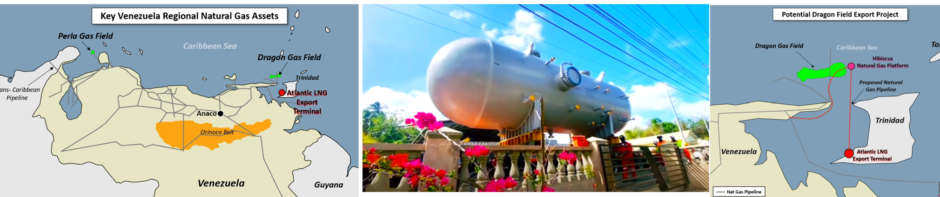
The Dragon gas field is once again in play, but whether it will play for Trinidad and Tobago remains an open question.
Last Friday, Shell plc and BP plc were listed among five energy companies granted General Licences 49 and 50 by the US Treasury. Shell holds an interest in the Dragon gas field, while BP has an interest in the Manakin-Cocuina cross-border gas field.
The Government is already making optimistic projections. Prime Minister Kamla Persad-Bissessar said, “As a long-standing close partner of the United States, Trinidad and Tobago views this development as an important opportunity to deepen hemispheric energy cooperation, strengthen regional stability, and reinforce trusted commercial ties.”
Energy Minister Dr Roodal Moonilal said the administration is looking forward “to the work now by BP, Shell and other stakeholders to ensure that we can monetise these resources to the benefit of T&T”.
The American Chamber of Commerce (AMCHAM T&T), while similarly upbeat, inserted a cautious caveat in a statement issued on Friday.“While not specifically mentioning T&T, this licence paves the way for the development of several projects in the relatively near term, including Loran, Cocuina and Dragon fields by Shell and BP, with NGC participation.”
The Confederation of Regional Business Chambers (CRBC) was also hopeful, listing in its statement 12 benefits for private companies and one for the country as a whole, once the “framework” laid out in the licences was “managed strategically and transparently”.
This is key and entirely doable. The Government must start working immediately to identify, manage and remove bureaucratic roadblocks to respond quickly and efficiently once US companies begin operating in Venezuela.
That doesn’t only mean red tape that affects government-to-government negotiations. It is even more crucial to remove public service logjams that hamper private companies and citizens who may be subcontracted by American firms.
Increasing the chances that T&T and its citizens can be part of such projects also requires strengthening T&T’s relationship with the US, based on political analyses of the policy goals of the Trump administration in Latin America and the Caribbean.
That means to resurrect the Dragon deal, the UNC administration will have to convince the American government that it is aligned with those objectives.However, given the uncertainty of the time-frame for any gas deal, the Government should remain focused on stabilising and diversifying the economy, and not rely heavily on energy windfalls.
Among other things, that means managing current arrangements with the energy companies, the National Gas Company (NGC), and light industrial and commercial manufacturers, the latter now reeling under NGC’s 77% increase in the price of natural gas.Even given the likelihood that the energy lifeline T&T has long enjoyed may get a renewed lease within the next few years, the Government should continue building on the encouraging analysis given last week by the IMF.
A balance between positivity and prudence is crucial for the country’s future prosperity.
Perenco completes field revitalization
February 9, 2026 Melisa Cavcic
While revealing the completion of its latest revitalisation program across the Teak, Samaan and Poui (TSP) fields off the southeast coast of Trinidad, Perenco explained the work, designed to simultaneously increase production and deliver more efficient and sustainable operations, entailed the electrification and the modernisation of the Teak field.
Stéphane Barc, General Manager of Perenco T&T, commented: “We are committed to sustaining these fields, which have served Trinidad and Tobago well for half a century and have the potential to continue to provide energy to the country for many years to come. The electrification at Teak reflects our expertise in maintaining mature assets and represents the latest milestones in our ongoing investment into the country.”
As part of the electrification project, a new high-voltage electrical network has been established, extending from the Macarius power hub to Teak Echo and then across all Teak satellite platforms via 28 kilometers of subsea electrical cables. High-voltage infrastructure has been installed on the platforms, entailing nine new transformers and five new electrical shelters, which enable safer and more efficient operations for the firm’s offshore teams. As the TSP fields have been producing for decades, Perenco’s ongoing investment is seen as essential to continue meeting local energy demand and supporting economic growth.
French envoy seeks deeper commercial cooperation
2026, 02/19
France’s Ambassador to Trinidad and Tobago, Guillaume Pierre, outlined an ambitious agenda to expand French investment, with energy, infrastructure, logistics and advanced technology at the centre of the bilateral relationship.
Pierre pointed to the strength of existing French commercial involvement, particularly in the energy sector, while signalling a clear interest in positioning T&T for the next phase of global energy transformation.
A cornerstone of that relationship is Perenco, the second-largest oil and gas producer in the petrostate, seeking to grow its footprint.
“They already do a lot. They want to do more,” he said, noting that Perenco remains a significant economic partner with expansion plans under consideration. He indicated that additional French energy providers are monitoring developments locally, particularly in a period of geopolitical change across the region. Investor appetite exists but clarity and stability remain critical factors.
“What companies like is predictability,” he said, adding that part of his function is to provide accurate information and facilitate connections between French firms and local decision-makers. He framed the future of the partnership as extending beyond hydrocarbons.
A developing hydrogen initiative involving Trinidadian Philip Julien, founder of Kenesjay Green Ltd (KGL) and French renewable energy firm Hydrogène de France (HDF Energy) represents long-term strategic thinking. The proposed hydrogen plant focuses on green energy solutions and reflects the accelerating global demand for cleaner fuels.
Pierre argued that while oil and gas will remain essential to T&T’s economy, a parallel investment in renewables is necessary to sustain energy leadership over the coming decades.
“If Trinidad wants to remain an energy powerhouse after 100 years as a big oil and gas-producing country, I think Trinidad has to look at renewables,” he said.
He pointed to mounting international regulatory pressure and structural shifts in global markets favouring lower-carbon energy. Countries that fail to diversify their energy base risk declining competitiveness over time, especially as gas prices fluctuate and the era of abundant, inexpensive hydrocarbons fades.
Transition will require regulatory adjustments and a recalibration of long-standing assumptions about the energy economy. However, he maintained that early positioning in green technologies could preserve the country’s relevance as a regional energy hub.
French investment extends well beyond oil and gas. Pierre highlighted a history of major infrastructure projects undertaken by French firms, underscoring a long-standing economic partnership.
Bouygues Bâtiment constructed the Port of Spain waterfront, while Vinci conducted key highway works, including the north–south interconnection.
French companies contributed to the development of the Brian Lara Cricket Academy in Tarouba. In maritime logistics, CMA CGM handles approximately half of the container traffic through T&T, reinforcing its role as a regional transshipment and logistics hub.
Pierre identified urban services and utilities as further areas of opportunity. Veolia Environnement SA is currently engaged in water management programmes with WASA, reflecting France’s global expertise in waste treatment, sewage systems and integrated city management solutions.
Security cooperation is another pillar of interest. Thales, a leader in radar, anti-drone systems and surveillance technologies, represents potential collaboration in border protection and maritime security. France maintains six naval vessels based in Martinique that patrol Caribbean waters, a presence linked directly to regional crime and trafficking challenges.
Transport and aviation have been formally added to France’s priority list. Last week, Pierre met Minister of Transport and Civil Aviation, Eli Zakour and Permanent Secretary, Nicolette Duke, to discuss expanding cooperation in the transport and aviation sectors. The meeting focused on positioning transport and aviation as drivers of economic growth, productivity and national efficiency.
Minister Zakour reaffirmed his commitment to continued engagement with the Ambassador to strengthen bilateral relations and explore strategic initiatives aligned with T&T’s transport and aviation development agenda. The Ministry is advancing strategic international partnerships aimed at fostering innovation, improving operational efficiency and supporting sustainable growth across transport and aviation systems.
Pierre noted that France possesses global leadership in aviation manufacturing, air traffic control systems, helicopter services, airport management and related technologies, creating potential alignment with T&T’s sectoral priorities.
France, with approximately one million citizens in its Caribbean territories and permanent membership on the UN Security Council, views regional stability as a matter of national interest. Trafficking in drugs, weapons and people affects French territories directly, creating space for closer cooperation with Caribbean states.
Trade volumes between France and T&T remain modest relative to potential, with hydrocarbons dominating exchanges. Pierre argued that diversification is in the interest of both countries. He referenced the concept of de-risking, particularly in relation to food imports.
Heavy reliance on a single supply channel creates vulnerability to price spikes or disruption. France and Europe could serve as balancing suppliers, especially in high-quality agricultural goods and agri-technology. France is Europe’s largest agricultural producer and Pierre suggested T&T has the scale and capability to strengthen its agricultural output within the Caribbean context, particularly if regional food production initiatives are revitalised.
Education, roots and cultural capital
Beyond commerce and security, Pierre prioritised academic and knowledge partnerships. He recently engaged with officials at The University of the West Indies St Augustine, to explore expanded student exchanges, joint research initiatives and collaboration between French companies and local faculties.
A “French Day” is scheduled at UWI St Augustine on March 26, featuring thematic workshops in engineering and computer science, alongside discussions on research funding and student mobility. France seeks to boost the number of students studying in Martinique, Guadeloupe and mainland French universities, viewing intellectual exchange as a foundation for long-term cooperation.
Pierre’s connection to T&T is also personal. Although this is his first ambassadorial posting, he lived in the country for two years as a child and attended Holy Name Prep School. Over subsequent decades, he maintained ties to the wider region, including professional assignments in Haiti following the 2010 earthquake and regular engagement with France’s regional territories.
He presented his credentials in early October and described his initial months as productive, citing strong engagement with President Christine Kangaloo, Prime Minister Kamla Persad-Bissessar and Cabinet ministers.
While economic diplomacy forms the core of his mandate, Pierre also reflected on Carnival as a defining national asset. He characterised it as an expression of creativity and social cohesion, a period when differences recede and collective identity takes centre stage. Carnival has evolved into a global entertainment industry, with Trinidad-inspired festivals in Toronto, London and New York generating employment and export earnings. For him, it stands alongside oil, gas and manufacturing as pillars of national strength.
His diplomatic focus remains on expanding tangible economic cooperation, particularly in energy transition, infrastructure modernisation and technology-driven growth. With French companies actively assessing opportunities and new delegations from Martinique and Guadeloupe expected in the coming weeks, the next phase of engagement will hinge on converting interest into sustained investment.
TOUCHSTONE EXPLORATION ANNOUNCES 2025 YEAR-END RESERVES
CALGARY, ALBERTA (February 25, 2026) –
Touchstone Exploration Inc. (“Touchstone”, “we”, “our” or the “Company”) (TSX, LSE: TXP) announces 2025 year-end reserves. Touchstone’s independent reserves evaluation was prepared by GLJ Ltd. (“GLJ”) with an effective date of December 31, 2025 (the “Reserves Report”). Highlights of our total proved developed producing (“PDP”), total proved (“1P”), and total proved plus probable (“2P”) reserves from the Reserves Report are provided below. Unless otherwise stated, all financial amounts referenced herein are stated in United States dollars. Readers are further cautioned to read the applicable advisories contained herein.
Paul Baay, President and Chief Executive Officer, commented:
“Our year-end reserves report highlights the strategic integration of the Central block into our producing reserve base, establishing a new pillar for LNG-linked growth alongside our stable oil production and Ortoire natural gas assets. This year’s report also reflects the expansion of our gas marketing portfolio, underpinned by fixed-price sales at Ortoire and high-value LNG contracts tied to Central block production.
While data from the Cascadura-5 well necessitated a downward revision to our Block B reserves, Block A remains on forecast and continues to represent a significant opportunity for production growth, particularly as natural gas pricing is subject to redetermined in October 2027.
This independent evaluation underscores the substantial value of our Trinidadian portfolio. The NPV10 of future net revenues for our 2P reserves was estimated at approximately $653 million before tax and approximately $315 million after tax, which represented a 2 percent increase over 2024 despite our 2025 production.
Furthermore, the addition of medium-gravity oil reserves from Cascadura-5 reinforces the potential of our emerging Herrera play. Through low-cost recompletion opportunities, we are well-positioned to efficiently enhance our production base by tapping lower-zone oil within our Block B assets.
Looking ahead, we remain focused on execution. We look forward to tying in Carapal Ridge-3 for production in late March 2026, commencing our legacy oil block drilling program in March, and commissioning the Cascadura compressor in the second quarter of 2026.”
2025 Operational Highlights
- Transformational acquisition: Closed and integrated the acquisition of a 65 percent working interest in the Central block, successfully adding base LNG production and significant reserves to the Company’s portfolio.
- Facility optimization: Implemented operational enhancements at the Central block natural gas processing plant, driving an approximate 20 percent production increase over acquired levels.
- Cascadura-4 drilling: While the well successfully encountered hydrocarbon-bearing zones, the drill string became irretrievably stuck during operations. Following an assessment of potential completion options, the Company has determined that the ability to safely and reliably produce from the current wellbore is unlikely.
- Cascadura-5 drilling: Drilled and brought onstream the first Block B well to produce both natural gas and medium-gravity crude oil, diversifying the Cascadura production stream. The well contributed a field estimated gross average sales of approximately 1.9 MMcf/d of natural gas and 46 bbls/d of medium crude oil (approximately 362 boe/d) in December 2025.
US allows oil majors to return to Venezuela and sign deals with PDVSA
Treasury’s OFAC gives BP, Shell, Chevron, Eni and Repsol permission to negotiate deals
Robert Stewart
North America Energy Correspondent
Baton Rouge 13 February 2026,
The USA on Friday issued two new general licences that allow oil majors to potentially explore Venezuela and produce oil from its bountiful reserves, nearly six weeks after US forces stormed Caracas and ousted Nicolas Maduro. The notices from the Treasury Department’s Office of Foreign Assets Control (OFAC) specifically allow BP, Shell, Chevron, Eni and Repsol to negotiate contracts with the petrostate and its national oil company, PDVSA.
The OFAC licences will allow the majors to sign deals with Venezuela for investments in oil and gas operations, including for new exploration, development and production. The companies could also expand existing operations or form new joint ventures with the OPEC founder. Any oil contracts with Venezuela must be governed by US laws, according to the OFAC licences. OFAC is still barring businesses based in Rusia, Iran, North Korea, Cuba and China from negotiating oil deals with Venezuela, according to the licences.
Recent OFAC moves
Friday’s move follows previous sanctions rollbacks from OFAC in recent weeks as the US continued to exert control over Venezuela’s oil industry following Maduro’s ouster. The agency on 29 January first allowed US operators to produce, transport and sell Venezuelan crude. OFAC on Wednesday permitted oilfield services contractors to bring equipment into the country. The latest OFAC licences named the five majors and allow them to sign contracts with Venezuela and PDVSA.
The US changes also follow the Venezuela National Assembly’s move last month to overhaul its hydrocarbon laws to allow more foreign investments in oil and gas.
Status of the majors
Amid ongoing tensions with the Maduro regime at the time, US President Donald Trump enacted sanctions on Venezuela’s oil industry in 2019 during his first term. As a result, a number of companies either left or curtailed operations. Chevron was the only US-based operator to remain in Venezuela after the sanctions. Eni and Repsol also maintained operations there.
BP and Shell have been in negotiations with the US over licences for offshore gas developments in waters bordering Venezuela and Trinidad & Tobago. The projects include Shell’s Dragon gas field, which had its licence revived in October, and BP’s Manakin-Cocuina field, which saw its licence revoked last April.
BP said this week that it is seeking an OFAC licence for Manakin-Cocuina.
Two other oil majors with history in Venezuela, ExxonMobil and ConocoPhillips, were not listed in the OFAC licence. Those companies left Venezuela after their assets were seized by the government in 2007 amid a nationalisation wave led by former Venezuela president Hugo Chavez.
At a White House summit days after Maduro’s capture, ExxonMobil chief executive Darren Woods called Venezuela “uninvestable”, though he said in an earnings call on 30 January that he was still willing to send a team to the country if it gets proper security guarantees.
ConocoPhillips chief executive Ryan Lance said his company is looking at Venezuela, though his priority is resolving a multibillion-dollar debt dispute with Citgo Petroleum, of which ConocoPhillips is a creditor.
Chevron executives have been more enthusiastic about the opportunities and the potential to increase oil production there within about two years.
Shell is open to opportunities in Venezuela, chief executive Wael Sawan said.
Contractors SLB and Halliburton have said their phones have been “ringing off the hook” ever since the regime change in Venezuela, which had the world’s largest proven crude oil reserves as of 2023 with roughly 303 billion barrels.
BP seeks OFAC licence for Venezuela/Trinidad gas field
10 February 2026 Reuters
BP is seeking a license from the U.S. government to develop its Manakin-Cocuina gas field that crosses the border between Trinidad and Tobago and Venezuela, its interim CEO Carol Howle said
“Since the ouster by the U.S. of Nicolas Maduro, several energy companies have been seeking to advance their projects in the OPEC founder, including Shell with its Dragon and Manatee projects and BP with Manakin. BP wants to develop the field to supply Trinidad with over 1 trillion cubic feet of gas to convert into liquefied natural gas for export. BP owns 45% of flagship Atlantic LNG plants which was 15% of BPs total LNG production in 2025, data from financial firm LSEG show.”
“Look, our interest is in the Manakin-Cocuina cross border field between Trinidad and Venezuela. So we’re working on obtaining the licence for that, and that’s really our priority at the moment,” Howle said .
BP requires a licence from the U.S. government to produce the field because of continued U.S. sanctions against Venezuela’s state-owned PDVSA, which operates on the Venezuela side of the border. BP originally had an OFAC licence from the U.S. and a licence from Venezuela to develop the field but it was canceled by the US administration in 2025. Trinidad has endured a shortage of natural gas to power its LNG and wider petrochemical sector. and wants to develop cross-border fields with Venezuela that together hold 11 tcf in proven reserves.
IMF: Staff concluding statement of the 2026 Article IV Mission
18 February
Representatives of the International Monetary Fund (IMF) Mission headed by Ana Guscina, deputy chief, Caribbean Division I, Western Hemisphere Department.
An International Monetary Fund (IMF) staff team, led by Ana Guscina, visited Port of Spain and Scarborough during January 27–February 9, 2026, and held discussions on the 2026 Article IV consultation with Trinidad and Tobago’s authorities. At the end of the consultation, the mission issued the following statement, which summarises its main conclusions and recommendations.
1. Trinidad and Tobago’s economy is gradually recovering to pre-pandemic levels amid persistent headwinds. The non-energy sector, particularly manufacturing and services, has underpinned recent growth, but stagnant production in the mature energy sector has weighed on activity Inflation and unemployment are low, the banking sector appears sound, and private sector credit growth is robust. The current account (CA) balance remains in surplus, though the external position has weakened and FX shortages persist. Foreign reserves remain adequate, with coverage at 6.4 months of prospective imports. The Heritage and Stabilisation Fund (HSF) assets continue to provide an additional sizeable buffer (US$6.38 billion as of February 2026).
2. A new administration took office in May 2025 with an economic revitalisation policy agenda. The new government is focusing on revitalising the energy sector through facilitating work on mature fields, deepwater exploration, and fostering regional collaboration with Suriname, Guyana, and Venezuela. They are also striving to lift non-energy growth through greater emphasis on improving the business environment, encouraging trade and foreign direct investment, and promoting economic diversification.
3. The fiscal deficit in FY2025 remained high and public debt has risen. The overall deficit of the central government for FY2025 is estimated at 5.5% of GDP, compared with 5.9% of GDP in FY2024, as the windfall from a tax amnesty, improved energy revenues, and contained spending on wages and capital spending more than offset a drop in non-tax revenue and increases in expenditure on goods and services and in transfers and subsidies. The non-energy central government primary deficit widened from 14.2% of non-energy GDP in FY2024 to 14.9% in FY2025. Central government debt rose to 67.8% of GDP (64.5% in FY2024), and public sector debt reached 84.2% (81.8% in FY2024). Although the FY2025 deficit was financed through domestic borrowing and HSF withdrawals of US$411 million (1.6% of GDP), strong investment returns nonetheless increased the HSF balance by about US$250 million (1% of GDP).
4. The country retains investment-grade sovereign credit ratings and international market access. In September 2025, Standard and Poor’s affirmed the BBB- rating, while revising the outlook to negative. In December 2025, Moody’s maintained its Ba2 rating but also downgraded the outlook to negative. CariCRIS continues to assign an AA rating, the highest in the Caribbean. In January 2026, the government successfully issued a US$1 billion 10-year international bond with an implied spread of about 241 bps above the comparable US Treasury Note, and the issuance was 2.5 times oversubscribed.
Macroeconomic outlook and risks
5. Economic growth is expected to remain subdued in the near term before gradually recovering over the medium term. The economy is estimated to have grown by 0.8% in 2025, driven by non-energy sectors. Real GDP growth is projected to moderate to 0.7% in 2026, as stronger growth in the non-energy sector partly offsets an anticipated decline in energy production. Medium-term growth prospects are expected to improve as several new energy projects, most notably Manatee, come on stream, lifting growth to around 2.9% in 2027 and 3.5% in 2028. Inflation is projected to hover around 2% in the near to medium term, broadly in line with international trends.
6. The CA is projected to remain in surplus. The CA surplus is expected to improve to 3% of GDP in 2025, reflecting a modest increase in energy exports and a decline in goods imports. Over the medium term, the CA surplus is projected to average about 4% of GDP. The CA is assessed as moderately weaker than fundamentals.
7. The economic outlook is subject to considerable uncertainty, and the balance of risks is tilted to the downside in the near term and to the upside in the long term. Domestic risks to growth and the external sector stem from lower oil and gas production, which could result from disruptions in mature fields or delays in new projects. Policy slippages and persistent FX shortages may weaken market confidence. Externally, elevated global uncertainty, trade disruptions, tighter global financial conditions, and regional geopolitical tensions pose additional risks. On the upside, faster progress on structural reforms and higher energy prices could strengthen economic activity and boost fiscal revenues. There is a positive momentum in the energy sector with deepwater exploration activity and potential regional agreements, which are not included in staff’s baseline until final investment decisions are announced. There are also upside risks to non-energy growth from private investment in the government’s Revitalisation Blueprint.
Enhancing fiscal discipline while strengthening the fiscal framework
8. The FY2026 budget introduces important measures to strengthen fiscal revenues, fiscal management, social protection, and economic diversification. The approved budget targets an overall fiscal deficit of 2.2% of GDP, which entails an ambitious consolidation. The budget includes an asset levy on banks and insurers, surcharges on landlords and commercial electricity consumption, and higher excise duties and fees. Additionally, the National Gas Company is expected to increase its dividend payments to the government, reflecting improved retained earnings from cost-cutting measures and the higher gas prices it announced for its light industrial and commercial customers. Together with tax administration measures to fully staff and modernise the Inland Revenue Division and Customs, these should help strengthen non-energy revenue collection. At the same time, the budget expands targeted support for agriculture, housing, and vulnerable groups.
9. Stronger fiscal consolidation is needed to place public debt on a firmly declining trajectory, rebuild policy buffers, and safeguard market access. IMF staff project an overall deficit of 5% of GDP for FY2026, slightly improving compared to FY2025. Meeting the authorities’ 2.2% of GDP fiscal balance target would require additional fiscal measures amounting to 2.8% of GDP. Under the current outlook for energy prices, agreed settlement of back pay obligations to public sector union workers and additional hiring of public sector workers in October 2025, such a large adjustment would be very difficult to implement without significantly weakening growth. Assuming an unchanged exchange rate regime, staff suggests targeting a 3.5% of GDP fiscal deficit in FY2026, by implementing 1.5% of GDP in additional high-quality measures, including broadening the tax base by phasing out extensive zero ratings and exemptions in the VAT, accelerating the removal of untargeted utility subsidies while protecting the vulnerable households, streamlining transfers to SOEs and putting them on a sounder financial footing, and improving the efficiency and quality of public expenditure. Such still sizeable and frontloaded adjustment will put debt on a firmly downward path and reduce vulnerabilities, while the emphasis on base broadening, efficiency, and targeting would help mitigate the impact on near-term growth.
10. IMF staff welcomes the authorities’ courageous steps taken to improve the long-term sustainability of the public pension system. The country faces the twin pressures of a rapidly aging population that increases expected pension and healthcare costs and an aging energy sector that limits the potential for future revenue growth to cover these costs. The announced gradual increase in the retirement age and contributions rates (already enacted) will help delay the depletion of the National Insurance System (NIS) assets by 15 years. To strengthen the system, it will be important to improve compliance, broaden the contribution base, and embed automatic adjustment mechanisms in NIS legislation. Further reforms to the non-contributory pension system are also necessary to contain costs to the budget. Better integrating the contributory and non-contributory schemes and improving administrative efficiency would enhance equity and fiscal sustainability.
11. A rules-based fiscal framework would help reinforce fiscal discipline and improve medium-term management of public finances. In a highly uncertain global environment, a rules-based medium-term fiscal framework will enhance fiscal discipline, mitigate fiscal risks, help avoid procyclical fiscal policy, and safeguard HSF savings for future generations. Broadening fiscal data coverage to include SOEs and other public bodies is important to improve transparency and assess the public sector’s broader macroeconomic footprint and any attendant risks. Finally, staff stress the need to develop an integrated asset-liability management framework to help guide borrowing decisions, strengthen risk management, and enhance governance of the HSF.
Maintaining consistent macroeconomic policies
12. Supporting the existing exchange arrangement calls for a significantly tighter macroeconomic policy mix. Staff recognise the authorities’ commitment to the current de facto stabilised exchange rate arrangement. However, maintaining it has required large, regular FX sales that are contributing to declining reserves, while FX shortages persist, impeding non-energy activity. Supporting the existing exchange rate arrangement therefore requires a sizeable and front-loaded fiscal consolidation (as discussed above) to facilitate external adjustment and put debt on a firmly downward path. This should be combined with moving the policy rate toward a more neutral stance and narrowing the negative US-T&T interest rate differential, to help support the exchange rate regime and stem reserve losses. Closing the interest rate differential with the United States would help make local assets more attractive and encourage capital inflows—the Central Bank of Trinidad and Tobago (CBTT) has maintained its repo rate at 3.5% since March 2020 despite the now- negative US-T&T interest rate differential. Such an adjustment would support macroeconomic stabilisation, but could weigh on growth.
13. A more flexible exchange rate would support external rebalancing with lower costs on growth. In staff’s view, greater exchange rate flexibility would improve the policy mix by allowing for a more gradual fiscal consolidation (0.4% of GDP per year over the next five years), while facilitating external rebalancing by stimulating exports and reducing imports, and allowing for more countercyclical monetary policy over the medium term. Gradually moving toward a more efficient, market-clearing FX allocation system would improve the business environment and support private-sector investment and diversification.
Enhancing financial sector resilience
14. Systemic financial-sector risks remain low, although vulnerabilities are rising due to a growing sovereign-financial nexus. Financial soundness indicators show that the banking system is broadly healthy and resilient: commercial banks are well-capitalised and profitable, with low non-performing loans and adequate provisioning, even as liquidity has tightened in recent months. At the same time, the domestic financial system has become an increasingly important holder of government debt, deepening the sovereign financial nexus. While this has supported public financing needs and reduced near-term external and rollover risks, it has also heightened the financial sector’s exposure to sovereign credit and interest rate risks through valuation, collateral, and funding channels.
15. The authorities continue to make strong progress in strengthening financial stability and integrity. The CBTT advanced work on Basel II/III risk disclosure rules, liquidity coverage and monitoring metrics, and revisions to insurance regulations on capital adequacy, policy liabilities, and financial conditions reporting. The National Anti-Money Laundering Committee prepared for the Caribbean Financial Action Task Force 5th round evaluation and completed Third National Risk Assessment. In 2025, the authorities enacted the Counter Proliferation Financing Act, aligning the legal and regulatory framework with global standards by strengthening the identification, assessment, and mitigation of proliferation-financing risks and enforcing targeted financial sanctions. The authorities continue to take steps to strengthen the regulatory framework for virtual assets and virtual asset service providers These measures will further enhance resilience to emerging risks, including cyber, climate, and cross-border financial crimes.
16. IMF staff commends the authorities’ progress in strengthening international tax-transparency frameworks. In 2025, the authorities signed and brought into force the Convention on Mutual Administrative Assistance in Tax Matters and improved access to legal and beneficial ownership information through amendments to the Companies Act. Staff encourages continued implementation of reforms to support the country’s removal from the EU of non-cooperative jurisdictions in 2026.
17. Notable progress has been made in addressing Anti-Money Laundering and Counter-Financing of Terrorism challenges. The authorities have strengthened the National Anti-Money Laundering and Counter-Financing of Terrorism Committee through capacity-building initiatives across key agencies. They have also enacted or introduced legislation that improves beneficial ownership transparency, expands asset-recovery tools, and tightens controls on virtual-asset activities.
Advancing structural reforms to strengthen inclusive growth and resilience
18. Trinidad and Tobago needs all engines of growth operating to build a more diversified, resilient, and inclusive economy. Oil and gas revenues have long underpinned economic development and will continue to support medium-term growth, fiscal revenue, and export earnings. However, over the long-term, achieving both horizontal and vertical diversification will be essential to navigate the challenges of global energy-market volatility and to lay the foundations for sustainable, broad-based, and inclusive growth. Trinidad and Tobago should capitalise on its comparative advantage arising from being outside of the hurricane belt.
19. IMF staff welcome the authorities’ increased emphasis on economic diversification. Guided by the Manifesto 2025 and the Revitalisation Blueprint, their agenda focuses on increasing private investment in major projects, developing agriculture and agro-processing, expanding tourism and the creative economy, promoting a knowledge-based and innovation driven economy, and strengthening Small and Medium-sized Enterprises through improved access to finance and a more supportive business environment. These efforts are complemented by broader reforms to enhance economic resilience and growth, improve governance and regulation, upgrade infrastructure, and invest in human capital.
20. Decisive steps are needed to raise labour force participation and reduce informality. High informality weighs on productivity and contributes to revenue leakage. Incentives to remain outside the formal labour market stem from generous non-contributory pensions, rigid hiring and dismissal rules, the marginal income-tax structure, and administrative barriers to business registration. Reducing informality and boosting labour force participation (especially for women) will require a multi-pronged approach that includes reducing the marginal tax burden on labour, strengthening the link between social contributions and benefits, streamlining businesses registration, and improving workforce skills to support the transition to formal employment.
21. The authorities are advancing digitalisation and bolstering AI preparedness. The newly established Ministry of Public Administration and Artificial Intelligence is leading efforts to modernise government operations and harness digital and AI technologies for national development. Strengthening digital skills across the workforce, integrating AI into production processes, and supporting smooth job transitions will ensure that workers benefit from technological change and that the country can capture AI-driven productivity gains while minimising displacement risks.
Enhancing the adequacy of statistics
22.Staff welcome the authorities’ sustained efforts to improve the quality, timeliness, and coverage of macroeconomic statistics. Transforming the Central Statistical Office into an independent National Statistical Institute would further strengthen institutional capacity and data governance. Continued efforts are needed to preserve recent improvements in reducing balance of payments errors and omissions, enhance the timeliness of national accounts, and close remaining macro-financial data gaps.
The IMF team is grateful to the authorities and to the broad range of public and private sector counterparts for their warm hospitality, cooperation, and constructive engagement.
IMF team visits Ministry of Finance
2026, 02/10
The staff team from the International Monetary Fund (IMF) visiting T&T for the 2026 Article IV Consultation highlighted several positive developments in the economy, according to news from the Ministry of Finance. In outlining the developments, the ministry said the IMF team noted the start of an economic recovery, driven in particular by continued strength in the non-energy sector, notably services and manufacturing.
The IMF pointed to favourable medium-term prospects, with anticipated developments in the energy sector projected to raise real GDP growth to around 2.9 per cent in 2027 and 3.5 per cent in 2028, while these estimates do not yet reflect potential upside from future Venezuela-related developments.
The IMF highlighted progress in public financial management, which was reflected in the 2026 Budget measures aimed at strengthening revenue mobilisation, improving expenditure efficiency and supporting vulnerable groups, as well as courageous reforms to improve the long-term sustainability of the National Insurance System.
Minister of Finance Davendranath Tancoo thanked the IMF staff team for their constructive engagement, high-quality analysis and collaborative approach throughout the visit. He welcomed the recognition that, from the very outset of its tenure, this Government undertook a clear-eyed assessment of the economic challenges and moved swiftly to implement bold and transformative reforms.
Tancoo reaffirmed that, “Under the leadership of the honourable Prime Minister Kamla Persad-Bissessar, the administration—guided by a clear plan and vision—is firmly committed to placing T&T on a stronger, more sustainable path. It will continue to advance sustainable economic growth, drive diversification and strengthen the nation’s standing on the global stage — building a stronger country.”
The Article IV Consultation is the standard annual review conducted by the IMF with all its member countries.
EU removes T&T from tax blacklist
2026, 02/19
After years of effort, Trinidad and Tobago has been officially removed from the European Union’s list of non-cooperative jurisdictions for tax purposes, following a decision by the EU’s Economic and Financial Affairs Council on Tuesday.
Prime Minister Kamla Persad-Bissessar yesterday welcomed the development, declaring that the country “is no longer blacklisted.”
“Our country has officially been removed from the European Union’s list of non-cooperative jurisdictions for tax purposes – a designation applied to countries that fail to meet international standards for tax transparency. This is a major step forward,” she said.
Persad-Bissessar argued that the previous administration did not secure compliance and removal, and maintained that her Government acted decisively after assuming office.
“Through legislative reform, sustained international engagement, and stronger institutions, we restored credibility and rebuilt trust. Blacklisting constrained investment, limited opportunity, and weakened confidence in our financial system. In less than a year, we strengthened our laws, enhanced transparency, and put Trinidad and Tobago back on the right track.”
Removal from the list signals clearly to the world that this country has met its commitments and reclaimed its standing on the global stage.
“Investor interest is rising. Confidence is returning. Momentum is building. T&T is open for business, compliant, and ready for sustainable growth.”
The EU tax listing process forms part of global efforts to combat tax evasion and avoidance risks, strengthen transparency, and promote fair taxation. Removal signals that a jurisdiction has met internationally agreed standards on tax good governance.
EU Ambassador Cécile Tassin also welcomed the development, stating: “The progress made by T&T on the path towards meeting the internationally agreed standards on tax good governance is impressive. These efforts should be commended. They are a positive sign for the continued strengthening of our partnership.”
Minister of Finance Davendranath Tancoo described the decision as the result of sustained engagement with European authorities.
“This milestone reflects my Government’s sustained commitment to transparency, fairness and adherence to internationally accepted standards. This achievement underscores our dedication to implementing robust global tax standards and strengthens confidence in our economic and regulatory frameworks. We express our appreciation to our partners in the European Union for recognizing the reforms we have undertaken, and we look forward to deepening our collaboration as we continue building a modern, competitive and globally integrated economy.”
A key element of the reform programme was the replacement of the former Free Trade Zone regime, which had been deemed harmful, with a Special Economic Zone framework aligned with international standards.
Between 2024 and 2025, T&T strengthened its tax transparency architecture. In November 2024, the country signed the OECD Multilateral Convention on Mutual Administrative Assistance in Tax Matters, significantly expanding its exchange of information network.
In July 2025, the Global Forum on Transparency and Exchange of Information for Tax Purposes awarded T&T a “Largely Compliant” rating on exchange of information on request. In December 2025, the Global Forum confirmed that local laws met standards for the automatic exchange of financial account information.
The country also addressed the Base Erosion and Profit Shifting (BEPS) Inclusive Framework’s recommendations on Country-by-Country Reporting to curb profit shifting by multinational enterprises.
Groundwork laid before the election
Former finance minister Colm Imbert said that the substantive work underpinning delisting was executed under the previous administration prior to the April 28, 2025, general election.
“The facts are straightforward: the work that put this country on the path to getting off the European Union’s non-cooperative tax jurisdictions list was done under the government before the 28 April 2025 general election.”
Imbert outlined decisive steps, including the Global Forum’s Second Round Phase Two onsite examination from October 21–25, 2024, which assessed the effectiveness of the country’s tax information exchange framework.
“That onsite examination was not a ‘paper exercise’,” he said, noting that authorities were required to demonstrate audit plans, compliance improvement strategies, enforcement statistics and practical outcomes.
Signing of the MAAC on November 7, 2024, expanded T&T’s treaty network from roughly 15 partners to 148, and a November 8, 2024, meeting in Brussels with the Directorate-General for Taxation and Customs Union pressed the case for removal. Many reports published recently reflect implementation work one to two years earlier and core actions that made delisting possible predated the 2025 election.
Business welcomes EU delisting
2026, 02/20
Minister of Finance Davendranath Tancoo greeted EU ambassador to TT Cecile Tassin during the meeting at the finance ministry, Financial Complex, Twin Towers Port-of-Spain last Tuesday.
The decision by the European Union’s Economic and Financial Affairs Council to remove T&T from the European Union’s list of non-cooperative jurisdictions for tax purposes drew support from the leading business groups, which view the move as a significant step in restoring confidence in the domestic economy. The delisting, confirmed on Tuesday, follows years of legislative and regulatory adjustments aimed at meeting internationally agreed standards on tax transparency and fair taxation. The EU tax-listing framework forms part of broader global efforts to address tax evasion and harmful tax practices and removal indicates compliance with good governance benchmarks.
Trinidad and Tobago Manufacturers’ Association described the development as a positive outcome for trade and investment prospects. TTMA said it had closely monitored the matter because of its implications for the nation’s tax standing and external commercial relationships. It noted that the removal validates reforms undertaken to address long-standing deficiencies in tax transparency and to align domestic frameworks with international standards. It highlighted anticipated benefits, including improved access to European markets for local exporters, removal of defensive tax measures and enhanced overall trading conditions. Compliance with global tax standards strengthens T&T credibility and supports its capacity to mobilise domestic resources for socio-economic development. It identified potential gains in bilateral economic relations with European partners, particularly in terms of trade, investment flows and access to international financing.
The American Chamber of Commerce of T&T (Amcham T&T) welcomed the removal from the list, expected to enhance investor confidence and reduce reputational and compliance risks for companies conducting business with European counterparts.The change should improve access to international financial markets and reinforce the stability of the local financial services sector. Amcham T&T acknowledged the sustained technical engagement led by Finance Minister Davendranath Tancoo and public officials within the Ministry of Finance and other state agencies. The Chamber credited those efforts with bringing the country into alignment with the EU’s tax good governance criteria. The organisation had consistently advocated for removal from the list, engaging both domestically and with European stakeholders. The outcome reflects constructive collaboration between the public and private sectors.
Both associations signalled that they intend to leverage the development in their ongoing promotion as a competitive destination for trade and investment. They maintain that the delisting strengthens the country’s international standing and provides a more stable platform for business expansion, cross-border partnerships, and long-term economic growth.
T&T Chamber seeks more information on NGC prices
2026, 02/12
The T&T Chamber of Industry and Commerce urged state-owned National Gas Company to provide greater transparency on its natural gas pricing formula, as it joined other private sector bodies in condemning the 77 per cent increase in natural gas prices for light industrial and commercial (LIC) customers. TTCIC warned that the business environment is under increasing strain as companies struggle to absorb sharp cost escalations following the rise in the price of natural gas to the LICs, as it sought a comprehensive energy competitiveness framework, among other measures.
Members estimate increased production costs of US$500,000 to US$1.2 million annually, expenses too significant for many companies to withstand without raising prices, reducing exports or restructuring operations. Some firms that are already dealing with new tax measures introduced on January 1, 2026, are reassessing the viability of maintaining production in T&T, which could lead to 200 to 500 job losses in certain operations, with ripple effects across national supply chains. While collaboration was strong at the beginning of the current administration’s term, there has been “a weaning” of structured engagement as the chamber issued a clarion call for greater engagement between the government and the private sector. The implications for the wider business environment are becoming increasingly evident, as these are not marginal adjustments that can simply be absorbed.
The likely consequences are higher consumer prices; reduced export competitiveness, potential job losses and contraction in manufacturing output. Although the manufacturing sector is bearing the brunt of the gas price hike, the impact of recent policy decisions is felt across all sectors.
Bars, restaurants, and cultural businesses are still reeling from increased excise duties; pharmacies continue to face regulatory uncertainty and rising import costs and a number of small enterprises have already closed as a direct response to mounting financial pressure, leading to job losses among members.
Foreign exchange shortages remain a parallel obstacle and the chamber hopes to have discussions at a national level.
While not opposed to reform, the chamber proposed measures to allow businesses to plan, invest and maintain employment while supporting government’s fiscal objectives:
• Structured engagement between Government, NGC and industry stakeholders;
• A phased and rules-based implementation framework rather than sudden shocks;
• Joint economic impact modelling to assess consequences before full implementation;
• Development of a five to 10-year national energy competitiveness framework
Policy options that merit consideration within a coordinated framework include:
• Tiered gas pricing based on consumption levels and industry classification;
• Progressive metering systems that protect vulnerable households while discouraging excess; and
• Phased subsidy adjustments linked to transparent market indicators.
Energy Minister Dr Roodal Moonilal said he has taken note of the Chamber’s position.
“I just want to reiterate that these matters are before the NGC. I’m informed that several of the companies have indeed arrived at a settlement with NGC on the matter of gas pricing. There may be one or two outstanding. So I’m not aware that many matters and many entities are still outstanding. But these are matters the NGC enters into with negotiations and settlement and resolution.”
Moonilal was “prepared to meet and treat with any member of the national community or company that would have concerns. It’s not a matter of not wanting to speak, but it’s a matter that they have been involved in successful negotiations with the NGC. The NGC has a mandate to ensure that the people get a reasonable return for the resources of Trinidad and Tobago, and they will continue their work in that regard. So in terms of the matters before us, I think they are just one or two outstanding matters.”
In response Finance Minister Davendranath Tancoo said he has “maintained an open door to discussions with business interests” including the T&T Chamber, T&T Manufacturers’ Association and the regional chambers.”These meetings have been extremely positive and productive.”
More crude exports, less revenue
10 February
The Energy Chamber says despite an “immediate and significant spike” in the export of domestic crude production to the international market since 2018,
“the overall trend reflects a persistent decline driven by falling domestic production”.
The Chamber noted that since the closure of the Pointe-a-Pierre refinery in 2018, Trinidad and Tobago has transitioned to exporting all domestic crude oil production to the international market. Currently, exports of three primary blends,
- bpTT’s Galeota Mix,
- Woodside’s Calypso Crude, and
- Heritage Petroleum’s Molo Crude
together represent total production of approximately 50,000 barrels per day (bpd). The Chamber said in contrast, prior to 2018, exports averaged only 30,000 bpd, consisting mainly of Galeota and Calypso crudes, while Molo Crude was refined locally.
“Despite the absolute increase in export volumes post-2018, the overall trend reflects a persistent decline driven by falling domestic production. This downward trajectory in output was evident even before the refinery closure and continues to limit foreign exchange (Forex) earning potential.”
Compounding this volume decline is a cooling global market.Crude prices are currently low, with West Texas Intermediate (WTI) at US$58 and Brent at US$63.
Government eyes foreign firms to restart oil refinery
Energy Minister Dr Roodal Moonilal says the Government is not considering bidding, leasing, or selling assets at the oil refinery at this stage but is instead engaging internationally reputable firms to support a potential restart.
“We are in talks with entities, particularly those with significant experience in refining, to assist us in the restart.”
He stressed that Government would not repeat past mistakes.
“There will be no NiQuan and no Malcolm Jones-style arrangement. We will not engage firms that come together in some hasty business to get a contract or gas arrangement and you go into a $25 billion debt.”
International players, including Indian Oil , are expected to visit the region after Carnival as part of a short-term exploratory approach.
“The refinery has been closed for seven years. While initial reports suggest we can restart, there is still technical work to be done, particularly in health and safety.”
Moonilal confirmed that energy cooperation with Guyana would be discussed at the upcoming Guyana Energy Conference and Supply Chain Expo, though the T&T delegation was not yet finalised. Moonilal also responded to chair of the Energy Chamber of T&T Mala Baliraj, who said the chamber would review its strategy after Government’s revocation of the Safe To Work (STOW) requirement.
“All I can say at this stage is that those persons are entitled to do whatever they want to do. It’s absolutely no issue with us. We have said before, and we reinforce the point, that we would like for the…wide cross-section of the energy sector in T&T to be easily accessible; that we will not put barriers or gateways to enter the sector for anyone, whether it is an employee or small business.”
The Government has been invited to the 2026 Caribbean Energy Week in Suriname.
“In fact, Patrick Brunnings, the minister of energy there, has been in touch with us, and he’s very eager to receive a delegation from T&T, and we will certainly consider that in the coming days.”
Indian capital could fund refinery reopening
Shastri Boodan
2026, 02/24
Minister of Trade, Investment and Tourism Satyakama Maharaj accepted a token from Indian High Commissioner Dr Pradeep Rajpurohit at the launch on Sunday of the T&T–India Business Federation at the Mahatma Gandhi Institute for Cultural Co-operation in Mt Hope. in the presence of TTIBF president, economist Dr Vaalmikki Arjoon.
The Trinidad and Tobago–India Business Federation (TTIBF) seeks strategic deepening of economic ties with India, urging local businesses to seize emerging opportunities amid shifts in the global economy.
At the launch on Sunday at the Mahatma Gandhi Institute for Cultural Co-operation (MGICC) in Mount Hope, TTIBF president Dr Vaalmikki Arjoon said Trinidad and Tobago exported approximately US$260 million in goods to India in 2024 and imported US$109 million. Arjoon identified
-
-
- energy,
- pharmaceuticals,
- agriculture and
- digital technology as key areas for collaboration.
-
Now the world’s third-largest energy consumer, India offers opportunities for exports of
-
-
- LNG,
- petrochemicals,
- ammonia and
- methanol,
-
as well as potential upstream investment from major Indian energy firms. India’s capital and technical expertise could support efforts to re-open the Point-a-Pierre refinery, once a net foreign exchange earner for the country.
Arjoon proposed joint ventures in pharmaceutical packaging within special economic zones, allowing bulk drugs from India to be processed locally for export to Caricom and Latin America.
TTIBF will focus on facilitating targeted trade missions, providing market intelligence, establishing sectoral working committees and advocating for policy reforms to simplify cross-border commerce.
“This is not charity. This is commerce. Partnerships do not happen by accident. They require structure, trust and persistent effort.”
He urged business leaders, investors and young professionals to become active participants in building a strategic economic relationship for the future.
“We are at an inflection point India chose transformation. Tonight, we are choosing partnership.”
Delivering the feature address at the launch of the business group, Minister of Trade, Investment and Tourism, Satyakama Maharaj said following the visit by Prime Minister Narendra Modi, several areas had been identified for expanded cooperation, including information and communications technology, pharmaceuticals and healthcare, agriculture and agro-processing, tourism and hospitality, culture, and renewable energy.
He challenged the Federation to focus on five key pillars:
- implementing Memoranda of Understanding (MoUs),
- unlocking gateway potential,
- supporting micro, small and
- medium-sized enterprises (MSMEs), and
- strengthening connections with the diaspora.
“The Government of Trinidad and Tobago is committed to building a future-ready economy. We are pursuing a Partial Scope Trade Agreement with India to reduce tariff barriers and encourage joint ventures. We are also integrating India’s Unified Payment Interface to make cross-border transactions as seamless as sending a text message.”
In January, T&T celebrated its first shipment of products from Angostura to India in more than a decade.
“In May 2025, Carib Brewery entered the world’s largest beer market through a partnership with Globus Spirits Ltd. Carib is now sold in cities such as Lucknow, Kanpur and Ayodhya. These are not isolated successes; they signal growing momentum,” said Maharaj.
Textiles, fashions, toiletries, footwear, chocolate, nuts, spices, pulses, preserves and musical instruments are lucrative imports for resale in Caricom. Entertainment, books, videos, music and film will be popular with Hindi studies at UWI.
NIF bondholders receive millions
2026, 02/10
The National Investment Fund Holding Company (NIF) yesterday announced that it made three coupon payments on its bonds. In a notice posted to Trinidad and Tobago Stock Exchange,
NIF said that on Monday, February 9, 2026 it made three coupon payments on its bonds. These payments included the fifteenth coupon payment of $85.2 million to 2,953 bondholders of its NIF 1 Series B Bond and NIF 1 Series C Bond, which brought total payout on these bonds since its issuance to $1.27 billion; and the fourth coupon payment of $9.0 million to 3,676 bondholders of its NIF 2 Bond, which brought total payout on this bond since issuance to $36.0 million.
The notice added, “Since its inception in 2018, NIF has been able to successfully meet all bond coupon payments due, in full and on time, supported by a balanced and well structured portfolio of underlying assets. Further, the NIF bonds continue to be actively traded on the corporate bond market, aiding in price discovery and secondary capital market development.”
The notice also confirmed that the next semi-annual coupon payments to bondholders of the NIF 1 Series B and Series C Bonds and the NIF 2 Bond would be on 10th August 2026.
The chair of NIF is Dr Sandra Sookram, who also serves on the board of Republic Financial Holdings Ltd.She was appointed to the board along with six other members on October 28, 2025, replacing the previous chair, Jennifer Lutchman.
Divestment of 2 unethical stocks – West Indian Tobacco Company and Angostura Holdings Ltd – can raise state revenue.
Stock Market, FOREX
2026, 02/08
Mariano Browne, Chief Executive Officer of the UWI Arthur Lok Jack Global School of Business.
An article on February 5 indicated that the T&T stock market was in structural trouble as cumulatively the market had lost close to “40 per cent of value” since 2022. It noted that whilst some companies had performed well, the composite index (the unified metric for measuring the overall performance of the TTSE) had declined in every year since 2021.
This is critical because pension funds (including NIB and the Unit Trust), mutual funds, and individuals are invested in the market. Continued weak performance will seriously impact the financial position of current and future retirees, in turn significantly straining fiscal (government) expenditure on social services for the aged.
This is not merely a private sector savings issue—it has broad and urgent implications for the country’s overall economic performance.
Economic health is better measured by indicators like GDP, employment, and consumer confidence. Recent surveys show business outlooks vary by sector but remain cautious.
Finance theory and fundamental valuation suggest the stock market is forward-looking, with current prices reflecting the collective, discounted present value of all expected future earnings and growth.
On this basis, the stock market is a major, leading economic indicator reflecting investor sentiment and growth expectations. If corporate earnings are growing and the composite index is declining, this suggests that public confidence in the T&T market’s growth possibilities is limited.
What technical factors or changes in economic policy would or could achieve a turnaround in market sentiment and an improvement in economic performance?
What recent pronouncements could be positive in this regard?
The budget speech announced a rise in National Insurance rates effective January 1, 2026. This could turn NIB’s net flow of funds positive and improve investment potential. But NIB alone, even as a major player, cannot revive the market.
Decisive additional measures are essential. Critically, as long as local market confidence languishes, investors will rush to stronger markets.
International markets are subject to the same geopolitical uncertainties as the T&T market but offer higher returns, a wider range of products and sectors, and are denominated in foreign currency. The clear implication is that markets denominated in foreign currency with higher yields are more attractive and offer better prospects for maintaining value than the TTSE.
Simply put, as long as confidence in T&T is weak and higher returns are available in other stock markets abroad, foreign exchange for investment purposes (savings, speculative, and precautionary) will exacerbate forex demand. Further, there will be a thriving underground market to facilitate this demand if the foreign exchange shortage is not addressed with a market-based solution.
Building confidence requires demonstrable evidence that the domestic economy is improving. The country is aware that the Dragon Gas and Manatee deals are held hostage by the current tensions in Venezuela. Shell’ CEO, Wael Sawan, said that it wants to process Venezuelan gas for export through its facilities in T&T.
This would be a positive development for ALNG if it were to happen, but it remains dependent on the grant of OFAC licences and on the duration of those licences when granted. The arithmetic of the transaction and the net value-added benefit is not yet known. The position with the Manatee field also requires explanation.
Shell’s interest is in gas for export as LNG, which suits Shell. T&T has two other priorities. The first is gas as a feedstock for the export of petrochemicals, as the petrochemical companies add more value from a national perspective.
Nutrien and other plants remain shut because they do not have access to adequate gas supplies. How does accessing Dragon or Manatee help the petrochemical sector? The second is gas as the energy driver for domestic manufacturing and its implications for the export thrust announced by the Minister of Trade, namely to increase merchandise exports by USD 5 billion in five years.
The cost and availability of energy underpin economic development. Energy shapes productivity, industry, competitiveness, and long-term growth. Germany, formerly the European Union’s economic powerhouse, has stagnated since 2022 due to the loss of cheap energy imports from Russia.
A 77% increase in energy prices raised manufacturing costs for non-energy firms. Trinidad Cement Ltd (TCL), a key supplier to construction and export markets, announced a 15% increase in product prices as a result of NGC action. ANSA McAL is also affected by NGC prices but has not yet announced any price change on the glass bottles it manufactures. However, the Group increased alcohol prices due to higher excise taxes from the 2026 budget.
The budget also announced an increase in electricity charges on commercial buildings. Was this an isolated measure to be followed by other measures in the next budget?
Realities and adjustments must be made because of the country’s economic position but businesses need to plan. Entering new foreign markets or remaining in existing markets requires either product enhancements or cost improvements to remain competitive. Market actors must recalibrate their businesses and achieve productivity gains to remain successful. This requires phasing, coordination and dialogue to achieve confidence and buy-in.
Divestment can of state assets NP, NFM, NIF can raise revenue and generate wealth for a shareholding democracy.
Moderate majority values US presence and RADAR
2026, 02/21
Prime Minister Kamla Persad-Bissessar rightly dismissed concerns surrounding the US-supplied radar system at the ANR Robinson International Airport, saying only the Opposition PNM, drug traffickers and violent gangs are “obsessed” with the issue and
“Law-abiding citizens have no difficulty with an American military presence.”
Her comments are welcome amid growing debate over the radar and questions about US personnel. Defence Minister Wayne Sturge defended the Government’s position on using the radar and refused to disclose the number of US personnel in the country, challenging assertions that citizens had a right to such information.
“I will not disclose the numbers. That would be unwise. I don’t think anywhere that sort of information would be disclosed because that is not in the public interest. Unless you can tell me how the public would be well served by knowing that. Until you could justify that, I wouldn’t be providing that information,” Sturge told media.
Pressed on whether citizens had a right to know, as a practical security arrangement rather than a sovereignty issue, Sturge asked, “ Where you get that right? :
“Ok, it’s your country. The fact that there are military personnel here, does that take away from your sovereignty? Or does it not add to your sovereignty when the enemy would be persons, narco-traffickers, who we have not been able to contain over so many decades?”
Opposition brigade,
Yesterday, a belligerent Opposition brigade, ready for a brawl, insisted that the public “absolutely and definitely has the right to know” about foreign troops on local soil. The bellicose Opposition leader accused Sturge of adopting a “contemptuous” and “arrogant dismissal” of legitimate questions about US military.
She alleged that the matter reflects authoritarian tendencies and undermines democratic accountability since landing of a US military aircraft without prior public notification, confirmation of US Marines deployed “to improve radar surveillance”, lack of communication with THA and secrecy compromising sovereignty.
Regional security expert Dr Garvin Heerah urged “strategic balance and institutional maturity,” as debate intensifies over the use of the radar system and refusal to give information on US military personnel in T&T.
“Sensitive security information, particularly relating to radar capability, technological specifications, foreign military cooperation, or the presence of foreign personnel, cannot and should not be disclosed recklessly. The protection of state assets, intelligence systems, and strategic partnerships is paramount.
In democratic societies, particularly small states with complex geopolitical realities such as Trinidad and Tobago, public confidence in national security governance is equally critical. When information is absent, limited, or perceived as evasive, a vacuum will inevitably be filled, often by speculation, misinformation, unauthenticated sources, or sensational narratives.
“Transparency does not mean disclosing classified operational details. National sovereignty is not compromised by transparency. It is compromised by ambiguity. This risks reckless journalism, sensationalism, and the politicisation of legitimate security cooperation. Once public trust is eroded, it becomes far more difficult to restore.”
Criminologist Dr Randy Seepersad offered a more cautious perspective, saying the presence of US personnel could be justified depending on the circumstances.
“US personnel may be present in Trinidad and Tobago for a number of reasons, many of which could be quite legitimate reasons.
“Now, , I’m not sure what the reasons are, but , not all reasons can be made public, depending on the reasons. Some of them are suitable to be shared with the public, some of them may not be suitable for sharing with the public. So, in the absence of knowing the reasons why US military is in Trinidad and Tobago, it’s difficult for me to say whether or not there is a need for transparency.”