USA opens big beautiful ballet with 12
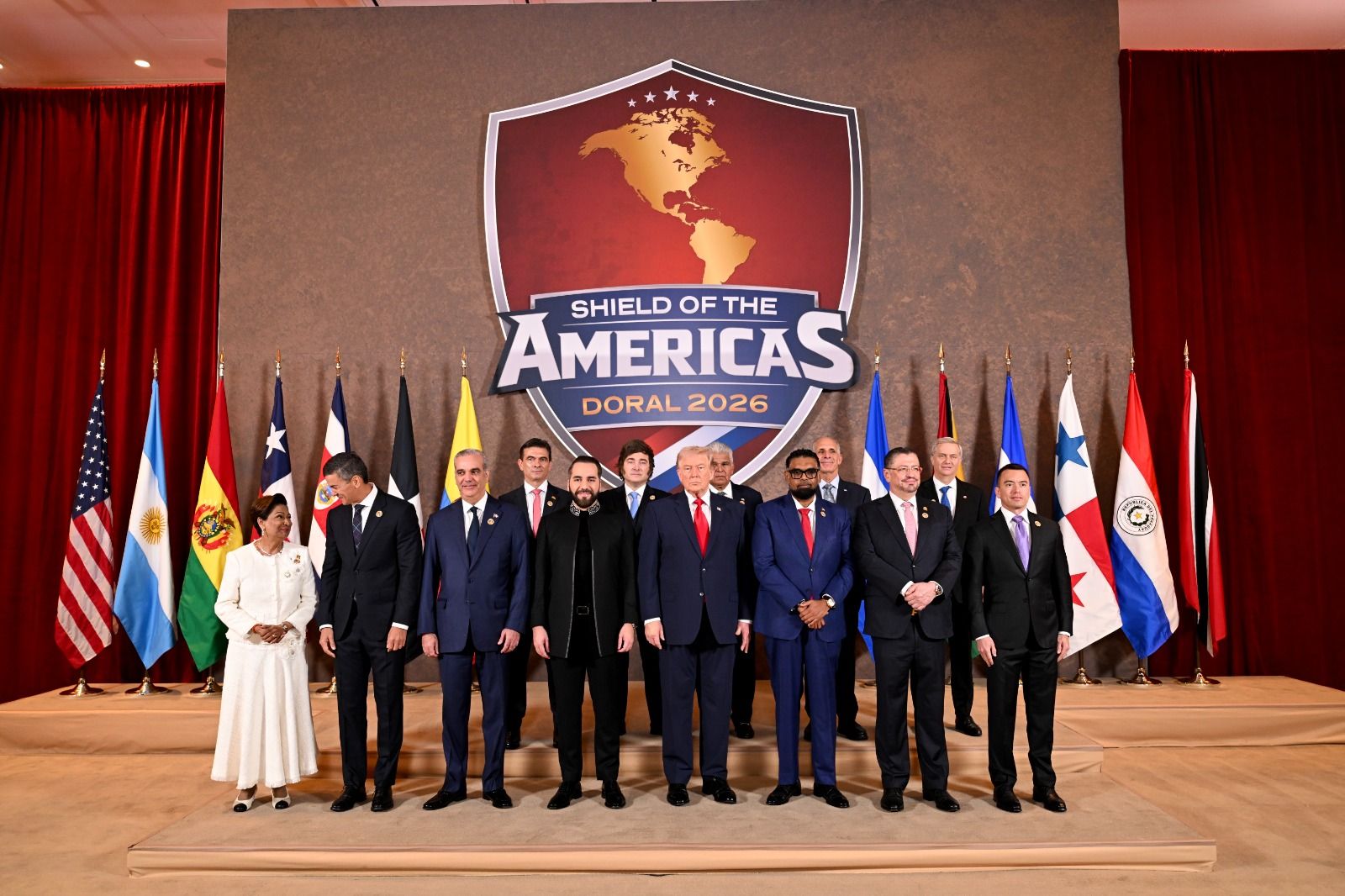
Held at Trump National Doral Miami, the gathering brought together the leaders of 12 right-wing Latin American leaders DONALD and Cast of 12 Disciples at Doral Opera-Ballet
March 7th 2026
U.S. President Donald Trump on Saturday launched the first Shield of the Americas summit in Doral, Florida, where like-minded conservative Latin American and Caribbean leaders convened to unveil a new regional security alliance focused on fighting drug cartels.
He said Cuba was “very much at the end of the line,” claimed Havana wanted to negotiate with Washington and his administration had formally recognized the interim government of Delcy Rodríguez in Venezuela as diplomatic ties were being restored.
At Trump National Doral Miami, the Summit of centrist leaders of Argentina, Bolivia, Chile, Costa Rica, the Dominican Republic, Ecuador, El Salvador, Guyana, Honduras, Panama, Paraguay and Trinidad & Tobago was designed to show that the White House still sees Latin America as a strategic priority even as the war with Iran dominates U.S. foreign policy. After speaking, Trump flew to Dover for the dignified transfer ceremony for six U.S. soldiers killed in Kuwait.
The main thrust of the Summit was a harder anti-cartel line. Trump urged 12 regional governments to use military force against cartels and transnational gangs. The White House released a proclamation tying the summit to a new Americas Counter Cartel Coalition, which includes military representatives from 17 countries, days after joint U.S.-Ecuadorian operations in Ecuador destroyed a FARC camp.
-
- Trump repeated his view that the Cuban government is entering its final phase and seeks an understanding with him and Secretary of State Marco Rubio.
- On Venezuela, the clearest confirmed development is the formal re-establishment of diplomatic and consular ties, announced by the State Department. Rodríguez responded by offering a cooperation agenda based on “mutual respect, equality and international law.”
- Trump’s statement that Washington formally recognized Rodríguez’s government was made public at the Summit, which underscored the Bloc’s ideological alignment: A showcase for right-wing or center-right governments that favor hardline security and migration policies.
- Trump warned against “hostile foreign influence” in the hemisphere, an implicit reference to totalitarian PRC regional footprint.
PRC in VENEZUELA-Danse Macabre
Companies were involved in multiple critical infrastructure sectors, including agriculture irrigation systems, power generation and transmission, ports. and water. Huawei and ZTE have large presences in Venezuelan telecommunications infrastructure. ZTE developed Venezuela’s “Fatherland Card” system, used to track voting patterns, ration food and supplies and monitor social media accounts.
China National Electronics Import and Export Corporation (CEIEC) provided the Maduro regime a commercial version of China’s Great Firewall.
In 2020, U.S. Department of the Treasury’s Office of Foreign Assets Control (OFAC) sanctioned CEIEC pursuant to Executive Order for conducting cyber and surveillance operations against opposition groups in Venezuela.
Sanctioning PRC entities under Venezuela-related programs was rare until December 31, 2025 when OFAC added 4 PRC companies with ties to the oil trade to the Specially Designated Nationals and Blocked Persons (SDN) list, along with 4 vessels owned by or linked to those companies.
Venezuelan oil is estimated to be 4 to 4.5 percent of PRC seaborne imports. If Venezuelan exports were disrupted, PRC can source similar blends of crude oil from Canada, Iran and Iraq.
PRC State-owned China National Petroleum Corporation (CNPC) operates joint ventures with U.S.-sanctioned Venezuelan state-owned Petróleos de Venezuela (PDVSA)
Three PRC firms entered production-sharing agreements with PDVSA in 2024.
PRC became the primary destination for sanctioned Venezuelan oil as other countries curbed purchases in response to U.S. sanctions. PRC used evasion methods similar to those it uses to import oil from other sanctioned countries like Iran and Russia, including transshipment, bartering and “shadow fleet” tankers with opaque ownership.
SUPERSTAR KAMLA CHEERS DORAL OPERA-BALLET
March 13, 2026
The USA and Trinidad and Tobago enjoy cordial relations based on a shared commitment to democracy, mutually beneficial trade and close security cooperation via the Caribbean Basin Security Initiative (CBSI).
By securing a permanent US commitment to the defence of the ACCC alliance, US changed the calculus confronting potential aggressors.
LEADING LADY , Prime Minister Kamla Persad-Bissessar was the STAR TURN at the OPERA BALLET, Shield of the Americas Summit, saying alliance with US President Donald Trump and his Americas Counter Cartel Coalition will strengthen the fight against guns and drugs.
In Parliament on Friday, Persad-Bissessar reported on her visit to the USA, for the historic Summit in Doral, Florida, on Trump’s invitation. She said she stands to be corrected but it was the first time in 50 years that a sitting Trinidad & Tobago Prime Minister had been invited by a US President to a meeting in the USA. The Prime Minister confirmed that she had a direct interaction with President Trump.
“I know some of my friends on the other side are very concerned if I met Trump or did not meet Trump. Let me say it very clearly, during the summit, I had the honour of speaking directly with President Trump and thanking him for his support for Trinidad & Tobago and the region. I reaffirmed the commitment of Trinidad & Tobago to work together in the interests of the people of T&T and the people of our hemisphere.”
Persad-Bissessar thanked Trump, emphasising that the coalition’s “shield” would offer protection to T&T and the wider hemisphere. She outlined the growing threat posed by illegal drugs, firearms and organised gangs, stressing that these are not just local challenges. They are part of a transnational criminal system stretching from South America through the Caribbean Sea into North America and Europe.
She explained that these networks move cocaine, heroin and synthetic drugs through regional waters and ports. In return, illegal firearms and illicit money flow back into communities – consequences especially severe for Trinidad & Tobago.
She said gangs across the Caribbean Sea now operate with sophisticated financing, advanced weapons and international criminal connections. This was a key reason her government strongly supports working with the United States to target narcotics and arms traffickers and dismantle transnational criminal networks.
For decades the region complained about not being heard on the global stage. “This time we were heard. T&T. This time we were seen. T&T. This time we were invited to participate.”
Persad-Bissessar said Trump told the summit about applying “hard power” to defeat threats to security and civilisation. She read details of Trump’s proclamation, which includes dismantling cartels and standing together to prevent malign external influences from destabilising the region. The benefits for Trinidad & Tobago are significant.
The coalition would enable stronger intelligence sharing on criminal cartels operating across borders. Through the partnership, law-enforcement agencies will be able to share real-time intelligence on trafficking routes, gang leaders, financial networks and weapons shipments, allowing security forces to respond more quickly.
She pointed to enhanced maritime and border security. The initiative will support efforts to combat illegal firearms trafficking.
“We sit along some of the world’s busiest drug trafficking corridors. Through joint operations, surveillance support and coordinated interdiction efforts, coalition partners can disrupt shipments before they reach our shores. We don’t make guns in T&T” she said, noting that police have seized weapons of many types and sizes.
A very young former minister once possessed an illegal firearm that had to be surrendered to police. Coordinated enforcement and investigative cooperation among coalition members could help intercept illegal weapons before they reach local communities.
Trinidad & Tobago will also benefit from training, technology and capacity-building initiatives. Police and defence forces will gain access to joint training programmes, advanced technology and international cooperation to strengthen their ability to dismantle gangs, investigate financial crimes and prosecute organised criminal networks.
“The Americas Counter Cartel Coalition now becomes a powerful new instrument in our security arsenal.”
On March 5, Defence Minister Wayne Sturge attended the Americas Counter-Cartel Conference hosted by Secretary of War Pete Hegseth, where 17 countries signed a joint security declaration reaffirming their shared commitment to peace, sovereignty and regional stability.
“T&T sovereignty remains strong and firmly intact. Our participation in the Americas Counter Cartel Coalition reflects our commitment to regional cooperation in tackling transnational crime, while at the same time we maintain full control over our national decisions and policies.”
She emphasised that any use of force would be lawful. ” Any actions undertaken through this collaboration will be guided by law, ensuring that the use of force and all operational measures remain lawful and accountable.” She has a “very good” Attorney General and many lawyers on her side.
She said the trip produced several diplomatic gains through bilateral meetings with senior US officials. She met US Secretary of State Marco Rubio and Deputy Secretary of State Christopher Landau to discuss regional engagement, including developments in Venezuela.
Persad-Bissessar met US Secretary of Energy Chris Wright, which yielded immediate results. “Within hours, energy giant Chevron expressed interest in doing business with Trinidad & Tobago.”
Discussions with US Secretary of Commerce Howard Lutnick focused on US-based companies interested in infrastructure and rehabilitation projects in Trinidad & Tobago. She held talks with US Trade Representative Jamieson Greer on tariffs and their potential impact on energy commodities.
Persad-Bissessar met Latin American presidents and discussed Trinidad and Tobago’s application for associate membership in MERCOSUR with Paraguay’s leadership, to support the economy with more pillars.
Following the summit on March 9, she visited United States Southern Command (SOUTHCOM) and invited Commander General Francis Donovan to visit Trinidad & Tobago. Their discussions focused on strengthening defence cooperation, including greater support in cybersecurity, forensics, ballistics and intelligence.
She concluded: “This trip was not just a diplomatic visit. It was a strategic victory for Trinidad & Tobago. A win for security. A win for our economy. And a win for the future of our nation.”
Maharaja of America gives Maharani of the West Indies his proclamation pen
Prime Minister with US Secretary of State at Caricom

Prime Minister Kamla Persad-Bissessar and Marine Gen. Francis Donovan
DORAL, FLORIDA, UNITED STATES
03.09.2026
Courtesy Story U.S. Southern Command
Trinidad and Tobago Prime Minister Kamla Persad-Bissessar visited U.S. Southern Command (SOUTHCOM) today and met SOUTHCOM Commander Marine Gen. Francis L. Donovan and senior command leaders.
The discussions centered on collaborative efforts to combat Designated Terrorist Organizations in the Caribbean and ongoing initiatives to strengthen the defense partnership between both nations. Persad-Bissessar’s visit highlights the importance of the bilateral defense partnership and the shared commitment to confront the scourge of narco-terrorism in Latin America and the Caribbean.
The U.S. and Trinidad and Tobago maintain a close defense partnership and commitment to Caribbean security. This partnership includes regular training and engagements, such as the longstanding Caribbean-focused Tradewinds exercise, which brings together forces from multiple regional nations to conduct combined training.
Last year, Trinidad and Tobago hosted forces from 25 nations during the Tradewinds 2025 exercise, demonstrating the nation’s role as a leader in regional security.
SOUTHCOM is one of the six geographically focused unified commands with responsibility for U.S. military operations in the Caribbean, Central America and South America, as well as security cooperation with defense and public-security forces in the region.
Prime Minister Kamla Persad-Bissessar met senior officials of United States Southern Command on Monday as part of efforts to strengthen cooperation between Trinidad and Tobago and the United States in the fight against narco-trafficking and regional crime.
At the conclusion of the meeting, the Prime Minister extended an invitation to Donovan to visit Trinidad and Tobago. She said the SouthCom commander indicated that such a visit could take place before the end of the year.
CHANGING THE CALCULUS- VIRTUOSO VARIATIONS
March 9, 2026
Security cooperation between Trinidad & Tobago and the United States took centre stage as Prime Minister Kamla Persad-Bissessar and her delegation met officials from United States Southern Command (SOUTHCOM) on Monday, for talks at the invitation of the US Government.
SOUTHCOM WELCOME
The Prime Minister was accompanied by Ministers Barry Padarath and Nicholas Morris with other members of her team. The high-level meeting focused on strengthening collaboration between the two countries on national and regional security, with particular emphasis on combating narcotics trafficking.
During discussions, she emphasised the need for deeper partnerships to confront criminal activity and protect citizens.The Prime Minister urged expanded technical cooperation with the United States in key areas such as cybersecurity, forensics and ballistics, aimed at strengthening Trinidad and Tobago’s capacity to tackle organised crime.
Officials from SOUTHCOM reportedly acknowledged Trinidad &Tobago’s leadership role in regional security efforts and expressed support for expanding joint initiatives.The meeting also identified several potential projects to further enhance security cooperation between the two countries.Before the conclusion of the discussions, Prime Minister Persad-Bissessar extended an invitation to the Commander of United States Southern Command, Francis L. Donovan, to visit Trinidad and Tobago. The visit could take place before the end of the year. The engagement forms part of ongoing diplomatic efforts to strengthen security partnerships and intensify the fight against transnational crime in the region.
STAR TURN Transcends Boundaries, Restores Confidence & Credibility
March 9, 2026 TTT News
Trinidad and Tobago is once more led with “seriousness, purpose and direction,” after the weekend triumph of Prime Minister Kamla Persad-Bissessar in the USA , strengthening investor confidence and boosting economic growth. The country is “again being regarded with respect, credibility and renewed confidence,” as PM Persad-Bissessar restored high standards of representation of Trinidad & Tobago.
Finance Minister, Davendranath Tancoo says Mrs. Persad-Bissessar placed the country “back in the room, back in serious international conversation, and back in a position to command attention, deepen relationships and create opportunity. The population is well aware of the decade of neglect, drift and underperformance that Trinidad &Tobago endured. It was a period in which too much was allowed to fall apart, too many opportunities were wasted and too much damage was done to economic strength and standing.
That is why the Prime Minister’s diplomacy carries economic weight. It signals that Trinidad & Tobago is no longer content to sit quietly while others compete aggressively for investment, influence and market opportunity. This Government understands that foreign policy must work for the people by supporting growth, investment and national prosperity.”
Public records filed under the United States Foreign Agents Registration Act show that in 2016 a two-year lobbying contract for Trinidad & Tobago in Washington was awarded at a cost of US$2.4 million and was renewed over the years. The country was left with nothing to show for spending public funds and scarce foreign exchange on such services. By contrast, the Prime Minister restored international attention to Trinidad & Tobago through her own brilliant leadership and integrity.
“This country has seen before what happens when Kamla Persad-Bissessar leads with purpose. From 2010, Trinidad and Tobago development reached communities across the land and confidence in national leadership was strengthened.
Under Prime Minister Kamla Persad-Bissessar, Trinidad & Tobago experienced its strongest economic performance, with key indicators reaching peak levels as the country advanced with confidence, growth and opportunity. That is why any suggestion that growth, confidence and national advancement are beyond us can only come from those on the other side, because decline is their legacy. Growth and prosperity are our record. We delivered it before under Kamla Persad-Bissessar, and under her leadership it will return.”
The Minister referred to weekend reports that Chevron signalled interest in talks with Trinidad & Tobago within 24 hours of the Prime Minister’s meeting with the US Secretary of Energy.
This was “a meaningful indication that serious leadership attracts serious attention.” “What we are now seeing is the beginning of the return of a Government that understands that credibility matters, understands that confidence must be earned and is prepared to engage directly, fight for Trinidad & Tobago’s interests, and position the country once again as a serious and respected partner.”
After ten years of “waste, drift and underperformance,” Trinidad & Tobago is resurgent under leadership that inspires confidence at home and respect abroad.
T&T Off EU Blacklist
March 13, 2026
On Friday, the European Union published its updated list of non-cooperative jurisdictions for tax purposes in the Official Journal of the EU. The revised EU Blacklist, approved on February 17th, 2026, shows that Trinidad and Tobago, Fiji and Samoa are not on the list.
The updated list applies from the date of its publication on Friday and is an important step as it directly impacts the scope of application of three different Luxembourg tax measures:
- 1. no tax breaks for interest or royalty payments made to tax havens;
- 2. the requirement to disclose transactions with entities located in non-cooperative jurisdictions in tax returns; and
- 3. the mandatory disclosure rules applicable to certain cross-border arrangements.
Other changes include the Turks and Caicos Islands, removed from the list in February 2024, have been added again. 10 jurisdictions are currently on the EU’blacklist.
FINALE
COMMITMENT TO COUNTERING CARTEL CRIMINAL ACTIVITY
Proclamations
March 7, 2026
BY THE PRESIDENT OF THE UNITED STATES OF AMERICA
A PROCLAMATION
The United States, under my leadership, has demonstrated a sustained commitment towards achieving the dismantlement of cartels and foreign terrorists operating in the Western Hemisphere.
My Administration has designated a number of cartels and transnational gangs as foreign terrorist organizations and has since dedicated unprecedented resources towards their destruction.
These international entities control territories and commerce, extort political and judicial systems, wield arms and field military capabilities, and use assassinations and terrorism to achieve their ends.
In furtherance of our efforts, the Secretary of War established the Americas Counter Cartel Coalition, a pledge from military leaders and representatives from 17 countries demonstrating that the region is ready to operationalize hard power to defeat these threats to our security and civilization. We will address these grave dangers by use of any necessary resources and legally available authorities, together with our partner nations.
NOW, THEREFORE, I, DONALD J. TRUMP, President of the United States of America, by virtue of the authority vested in me by the Constitution and the laws of the United States, do hereby proclaim as follows:
(1) Criminal cartels and foreign terrorist organizations in the Western Hemisphere should be demolished to the fullest extent possible consistent with applicable law.
(2) The United States and its allies should coordinate to deprive these organizations of any control of territory and access to financing or resources necessary to conduct their campaigns of violence.
(3) The United States will train and mobilize partner nation militaries to achieve the most effective fighting force necessary to dismantle cartels and their ability to export violence and pursue influence through organized intimidation.
(4) The United States and its allies should keep external threats at bay, including malign foreign influences from outside the Western Hemisphere.
IN WITNESS WHEREOF, I have hereunto set my hand this seventh day of March, in the year of our Lord two thousand twenty-six, and of the Independence of the United States of America the two hundred and fiftieth.
DONALD J. TRUMP
Chevron interest logical
2026, 03/10
Observers note the Chevron signal by of a return to the T&T energy landscape, following its operations in comparable petroliferous basins of the mainland. – Venezuela, Guyana and Suriname . Energy Minister Dr Roodal Moonilal revealed the US Energy company had shown interest in discussions with T&T, after revival of the industry in recent months.
Chevron had substantial assets in Trinidad and Tobago upstream sector for over two decades. A major player in the Dolphin, Dolphin Deep, and Starfish natural gas fields, it supplied the domestic market and Atlantic LNG. In 2017, Shell bought Chevron assets -its 50% interest in the East Coast Marine Area Block E, Block 5(a), and Block 6, 50% stake in Chevron-operated Manatee gas field and its 50pc stake in LNG marketing and transportation company Trinling which ships and sells LNG worldwide.
Former energy minister Carolyn Seepersad-Bachan said Chevron’s interest could be tied to an agreement in place before US sanctions changed plans for cross-border gas fields, especially the Loran/Manatee.
“As we all know, this reservoir straddles the boundary between the two countries and was originally governed by a unitisation agreement executed in 2010, which facilitated the joint development by Chevron on the Venezuelan Loran side and Shell on the Trinidad Manatee side.
Unitisation is the standard preferred petroleum engineering approach for cross-border reservoirs because it prevents competitive drilling, maximising total gas recovery and avoids the cost of duplication of infrastructure.
However, US sanctions on Venezuela made joint development impractical, and as a result, the field was effectively de-unitised, allowing each country to develop its own share independently.”
Talks could be centred around a new version of that arrangement, but it could be complicated by the progress made by Shell, with first gas from Manatee expected next year.
“Trinidad has already structured the Manatee development independently and would not wish to delay production timelines to facilitate re-unitisation given the urgent need for a new gas supply.
A more realistic pathway may therefore be a phased approach. Trinidad proceeds with Manatee phase 1 independently securing first gas and if US licenses .expands and Chevron becomes more actively involved again in Venezuela, discussions could begin on co-ordinated development of the Loran field.
Over time, both sides could adopt a functional or partial unitisation model where production is coordinated without reopening the full legal unitisation agreement. In that scenario, Trinidad’s Atlantic LNG facilities could potentially act as a tolling hub to process gas from Venezuela’s Loran reserves, maximising the value of the entire cross-border resource while maintaining Trinidad infrastructure as a regional processing centre.”
T&T can Say yes to Chevron for the following reasons-
1. The link with Texaco which Chevron acquired is an asset.
2. Chevron has long experience with an OFAC licence for oil in Venezuela, key to gas for T&T.
3. Shell and BP gained OFAC licences for gas, promising favourable cooperation among IOCs.
4.. Chevron is a key partner with a 30% stake in the prolific, low-cost Stabroek Block where operator ExxonMobil holds 45%, securing long-term production growth and high-quality, low-cost resources, helping sustain cash flow into the 2030s.The investment is a game-changer for Chevron, allowing it to tap into one of the most significant oil discoveries in decades.
5. Guyana is a friendly ally of T&T as the HQ of Caricom and member of Shield of Americas, with experience of collaboration.
6. Amid the current alignment of PRC with Russia and Iran, Exxon and Chevron may acquire the CNOOC share of 25% in Stabroek Block to consolidate their ownership, free from geopolitical risk from Ukraine war in which PRC supports Russia and in Middle East where Iran allows PRC passage to energy sources through the Strait of Hormuz but continues to attack democracies.
T&T, US, VENEZUELA IN HIGH ENERGY PAS DE TROIS STEPS
2026, 03/14
Prime Minister Kamla Persad-Bissessar in Parliament, addressed Trinidad and Tobago’s participation in the Americas Counter Cartel Coalition.
She held meetings with US Secretary of State Marco Rubio and Deputy Secretary of State Christopher Landau in Florida last weekend to discuss further engagement in the region – including developments involving “our neighbour next door, Venezuela.”
” We also met US Secretary of Energy Chris Wright to discuss energy sector co-operation, including gas fields involving Venezuela, as well as interest in refinery and tank farm infrastructure. Our meeting with Secretary Wright produced immediate results. Within hours, energy giant Chevron reached out expressing interest in doing business in T&T.
“We held productive talks with US Secretary of Commerce Howard Lutnick regarding US-based companies interested in infrastructure and rehabilitation projects in TT. With US Trade Representative Jamieson Greer, we discussed tariffs and their potential impact on energy commodities.”
Bilateral discussions were held with Latin American presidents.
“We spoke with Paraguay’s leadership regarding T&T’s application for associate membership in Mercosur. Weo held talks with leaders from Argentina, Chile, the Dominican Republic, and Panama on trade and national security cooperation.”
Members of Mercosur are Argentina, Brazil, Bolivia, Paraguay, Uruguay and Venezuela, currently suspended. Associate members are Chile, Colombia, Ecuador, Guyana, Panamá, Perú and Suriname.
Americas cartel coalition a ‘shield’ for T&T
15 March
Trinidad & Tobago alliance with US President Donald Trump’s Americas Counter Cartel Coalition will strengthen the fight against guns and drugs.
In Parliament , Prime Minister Kamla Persad-Bissessar reported on her visit to Florida for the Shield of the Americas Summit in Doral, on Trump’s invitation.
“…I had the honour of speaking directly with President Trump and thanking him for his support of Trinidad & Tobago and the region. I reaffirmed the commitment of Trinidad & Tobago to working together in the interests of the people of T&T and the people of our hemisphere.”
She outlined the growing threat posed by illegal drugs, firearms and organised gangs, stressing that these were part of a transnational criminal system from South America through the region into North America and Europe.
These networks move cocaine, heroin and synthetic drugs through regional waters and ports. Illegal firearms and illicit money flow back into communities—consequences which are especially severe for Trinidad & Tobago.
Regional gangs now operate with sophisticated financing, advanced weapons and international criminal connections, a key reason her Government strongly supported cooperating with the US to dismantle transnational criminal networks.
For decades, regional leaders complained about not being heard on the global stage. “This time we were heard, T&T. This time we were seen, T&T. This time we were invited to participate,” she said.
Persad-Bissessar said Trump told the Summit about using “hard power” to defeat threats to security and civilisation. She read details of Trump’s proclamation, which included dismantling cartels and standing together to prevent “malign external influences” from “destabilising the region”.
The SOA coalitions benefits for T&T would be significant, enabling stronger intelligence sharing. Law-enforcement agencies would be able to share real-time intelligence on trafficking routes, gang leaders, financial networks and weapons shipments, allowing security forces to respond more quickly.
She noted enhanced maritime and border security: “We sit along some of the world’s busiest drug-trafficking corridors. Through joint operations, surveillance support and coordinated interdiction efforts, coalition partners can disrupt shipments before they reach our shores.”
The initiative would also support efforts to combat illegal firearms trafficking:
“We don’t make guns in T&T,” she said, noting that police have seized weapons of many types and sizes. Coordinated enforcement and investigative cooperation among coalition members could intercept illegal weapons before they reach local communities.
Benefits include training, technology and capacity-building initiatives. Police and defence forces would gain access to joint training programmes, advanced technology and international cooperation to dismantle gangs, investigate financial crimes and prosecute organised criminal networks.
‘Sovereignty intact’
Persad-Bissessar stressed that sovereignty remains intact: “T&T’s sovereignty remains strong and firmly intact. Our participation in the Americas Counter Cartel Coalition reflects our commitment to regional cooperation in tackling transnational crime, while we retain full control over our national decisions and policies.”
Use of force would be lawful. The trip led to diplomatic gains through bilateral meetings with senior US officials. She met US Secretary of State Marco Rubio and US Deputy Secretary of State Christopher Landau to discuss regional engagement, including developments in Venezuela.
Her meeting with US Secretary of Energy Chris Wright yielded immediate results. “Within hours, energy giant Chevron reached out, expressing interest in doing business with Trinidad & Tobago.”
Her discussions with US Secretary of Commerce Howard Lutnick focused on US-based companies interested in infrastructure and rehabilitation projects in Trinidad & Tobago. The Prime Minister discussed tariffs and their potential impact on energy commodities with US trade representative Jamieson Greer .
Persad-Bissessar met Latin American presidents and discussed T&T’s application for associate membership in Mercosur with Paraguay’s leaders. This should develop untapped potential following launch of the Trinidad and Tobago–India Business Federation. TTIBF urged businesses to seize opportunities in energy, pharmaceuticals, agriculture and digital technology as key areas for collaboration with India. An alternative sphere of influence, India’s fourth-largest economy leads commerce in world-class textiles, arts and food.
After the March SOA summit, she visited the US Southern Command, to meet Commander General Donovan. They discussed strengthening defence cooperation, including greater support in cybersecurity, forensics, ballistics and intelligence. She emphasised the trip “…was a strategic victory for Trinidad and Tobago.”
with US Energy Secretary Chris Wright March 2026
with US Trade Representative March 2026
Joint Statement
From:
Prime Minister’s Office, 10 Downing Street and The Rt Hon Sir Keir Starmer KCB KC MP
Published 19 March 2026, Updated 25 March 2026
Joint statement from United Kingdom, France, Germany, Italy, the Netherlands, Japan, Canada and others on the Strait of Hormuz: 19 March 2026
Joint statement from the leaders of the United Kingdom, France, Germany, Italy, the Netherlands, Japan, Canada, Republic of Korea, New Zealand, Denmark, Latvia, Slovenia, Estonia, Norway, Sweden, Finland, Czechia, Romania, Bahrain, Lithuania, Australia, United Arab Emirates, Portugal, Trinidad & Tobago, Dominican Republic, Croatia, Bulgaria, Kosovo, Panama, North Macedonia, Nigeria, Montenegro and Albania on the Strait of Hormuz.
-
- We condemn in the strongest terms recent attacks by Iran on unarmed commercial vessels in the Gulf, attacks on civilian infrastructure including oil and gas installations, and the de facto closure of the Strait of Hormuz by Iranian forces.
- We express our deep concern about the escalating conflict.
- We call on Iran to cease immediately its threats, laying of mines, drone and missile attacks and other attempts to block the Strait to commercial shipping, and to comply with UN Security Council Resolution 2817.
Freedom of navigation is a fundamental principle of international law, including under the United Nations Convention on the Law of the Sea.The effects of Iran’s actions will be felt by people in all parts of the world, especially the most vulnerable.
Consistent with UNSC Resolution 2817, we emphasise that such interference with international shipping and the disruption of global energy supply chains constitute a threat to international peace and security.
In this regard, we call for an immediate comprehensive moratorium on attacks on civilian infrastructure, including oil and gas installations.We express our readiness to contribute to appropriate efforts to ensure safe passage through the Strait. We welcome the commitment of nations who are engaging in preparatory planning.
We welcome the International Energy Agency decision to authorise a coordinated release of strategic petroleum reserves. We will take other steps to stabilise energy markets, including working with certain producing nations to increase output.
We will also work to provide support for the most affected nations, including through the United Nations and the IFIs. Maritime security and freedom of navigation benefit all countries. We call on all states to respect international law and uphold the fundamental principles of international prosperity and security.
Following publication, Canada, Republic of Korea, New Zealand, Denmark, Latvia, Slovenia, Estonia, Norway, Sweden, Finland, Czechia, Romania, Bahrain, Lithuania, Australia, United Arab Emirates, Portugal, Trinidad & Tobago, Dominican Republic, Croatia, Bulgaria, Kosovo, Panama, North Macedonia, Nigeria, Montenegro and Albania confirmed they also joined this joint leaders’ statement.
RECALIBRATING CARICOM LIBERATION
26 March
Prime Minister Kamla Persad-Bissessar says Trinidad and Tobago will reduce its financial contribution to Caricom and opposed reappointment of Caricom Secretary-General Dr Carla Barnett.
Caricom chairman and St Kitts & Nevis Prime Minister Dr Terrance Drew yesterday advised that, during the HoG Summit in St Kitts in February, the “required majority” of Heads of government agreed to reappointment of Barnett as Secretary-General, and her second term of office will begin in August 2026.
Asked if she agreed with this reappointment, the T&T Prime Minister response was “No”.
Asked if she was disappointed in the reappointment, Persad-Bissessar added, “Caricom has been failing for 52 years and will continue to fail for the next 52 years. Trinidad and Tobago is not going to continue funding Caricom at the current levels that we are providing.”
The Prime Minister said Trinidad and Tobago currently provides 22% of the Bloc’s budget, one of the major financial contributors, which aligns with Caricom’s funding formula under which more developed countries pay a larger share based on economic size.
T&T contributes between US$4 million and US$5 million annually to Caricom and provides additional financial assistance through regional development funds, energy-related assistance and trade financing programmes.
Foreign Minister Sean Sobers confirmed that a “self explanatory” letter was sent yesterday to the Caricom chairman, expressing concern about the process of Barnett’s reappointment. Trinidad and Tobago disagreed with the manner of the reappointment and was not part of that exercise.
“I am disappointed because I support the Prime Minister’s position in that we want a better and stronger Caricom that should serve all the people and we will continue working toward that.”
Trinidad & Tobago maintained its allegiance to Caricom in its correspondence. In the letter, Sobers noted that Barnett’s proposed reappointment was not on the provisional agenda for the Fiftieth Regular Meeting of the Conference and was not discussed during the plenary sessions. It noted that the current term of the Secretary-General was due to conclude on August 14, 2026, and formal communication on this had not yet been received.
Sobers stated that during the retreat of heads of government on February 26, 2026 in Nevis, discussions reportedly took place regarding Barnett’s reappointment. He said it was a matter of record that Trinidad & Tobago, Antigua & Barbuda and The Bahamas were not allowed to participate in this retreat as representatives on behalf of their respective heads of government.
Consequently, Trinidad and Tobago was not privy to the deliberations on this matter.
Based on these issues, the minister said “we wish to place on record Trinidad and Tobago’s disagreement with the re-appointment of Secretary-General Barnett.
We believe this was not done in the spirit and letter of Article 24 of the Revised Treaty of Chaguaramas (RTC) that states that the Secretary-General shall be appointed by the Conference, on the recommendation of the Community Council, for a term not exceeding five years, and may be reappointed by the Conference”.
The letter concluded that Trinidad and Tobago remains committed to the revitalisation of the Caricom Secretariat to ensure it is fit for purpose and addresses the needs of the people of the region.
Persad-Bissessar voiced concerns about the Secretariat at the Caricom Summit in St Kitts in February when she addressed the opening ceremony at the first Caricom meeting she attended since her election in April 2025.
Barnett was in the audience when Persad-Bissessar censured the Secretariat for its silence in 2022 when Trinidad & Tobago citizen Brent Thomas was “kidnapped” from Barbados, describing the matter as deeply “unsettling”. The Prime Minister said the former T&T government “coordinated” the “kidnapping” from another Caricom state using an RSS aircraft and the court ruled that Thomas was kidnapped.
As then-opposition leader, Persad-Bissessar said she wrote to the Caricom Secretariat seeking answers but, to date, received no response. The Prime Minister suggested the lack of response could reflect poor management, lax accountability or, more troublingly, that one ceases to be recognised by the Secretariat as a Caricom citizen when not in government.
She said Caricom must be a voice for all citizens—not only governing parties. Persad-Bissessar also made it clear then that, while Trinidad and Tobago remained “vested” in the regional bloc, the country would no longer bind itself to regional political ideologies, foreign policy positions or security frameworks.
Instead, T&T will craft its own foreign and security policies to defend its sovereignty as it sees fit. She signalled that, while T&T supported regional movement in principle, the burden of illegal immigration prevented any further commitment at this time.
Persad-Bissessar exposed the issues with the regional body and chided Caricom’s “unreliability” in defending Trinidad & Tobago from the former regime in Venezuela.
She said it was the United States that supported T&T and extended gratitude to US President Donald Trump.
Tension among Caricom states has been high amid Persad-Bissessar’s strong support for the US military presence in the region and her portrayal of Caricom as an “unreliable partner” over its collective silence when Maduro threatened T&T.
The Prime Minister held talks with US Secretary of State Marco Rubio in St Kitts, following which she was invited to the Shield of the Americas Summit in Florida.
Trinidad & Tobago and Guyana were signatories to a new coalition, comprising 10 Latin American countries, that agreed to collectively protect the hemisphere from drug cartels and external forces. Trinidad & Tobago took action to expand links beyond Caricom and applied for associate membership of Mercosur.
This Southern Common Market is a South American trade bloc established in 1991 by Argentina, Brazil, Paraguay and Uruguay to promote free trade and the movement of goods, people and currency.
ECO- T&T can divert funds for Caricom to
-
- 1. Transfer of CHACACHACARE to USA for a NAVAL BASE with RADAR, following removal of the US RADAR from Tobago, amid escalating fraud, trafficking, kidnap, homicides, invasions, larceny, burglary, robbery and other violent offences.
- 2. REPLACE TTD with USD as PRIMARY CURRENCY.
- 3. ADD an ORDER OF THE WEST INDIES for DIASPORA honours with sashes for men and women.
- 4. Select CHEVRON for all energy projects to boost US links.
- 5. Cancel CNOOC blocks after US military pact citing Force Majeure from Middle East conflict as PRC supports an Axis of |Aggression
Guyana to open OTC 2026 in Houston as investment surges
February 26, 2026 (WO) –
Guyana President Dr. Mohamed Irfaan Ali will deliver the opening address at the 2026 Offshore Technology Conference (OTC), set for May 4–7 at NRG Park in Houston, conference organizers announced.
Ali will officially open OTC 2026 during the conference’s opening ceremony on May 4, joined by a Guyanese delegation that includes Minister of Natural Resources Vickram Bharrat. Organizers said the president’s participation reflects Guyana’s growing role in the global offshore energy sector, following a decade of major deepwater discoveries and rapid production growth with solid economic gains.
OTC leadership noted that Guyana has emerged as one of the world’s fastest-growing offshore oil producers, attracting multibillion-dollar investment and expanding collaboration with international operators and service providers.
The country’s offshore developments have become a focal point for global deepwater activity and technology deployment.
Ali’s address is expected to highlight Guyana’s offshore growth trajectory and the importance of international collaboration as offshore development expands worldwide.
OTC 2026 will bring together energy professionals, operators, service companies and government representatives from more than 100 countries to discuss offshore technologies, project development and emerging market opportunities.