ConocoPhillips says Venezuela reforms fall short for investors
May 21, 2026 (Bloomberg) –
The head of ConocoPhillips said Venezuela’s initial steps to attract foreign oil companies that could help revive production, are falling well short of what’s needed to convince firms to invest. ConocoPhillips’ CEO Ryan Lance spoke with S&P Global Vice Chairman Daniel Yergin at CERAWeek 2026 in Houston, Texas.
ConocoPhillips seeks Venezuela compensation before resuming drilling
Based on what was made public about the proposed contract, Lance said terms appear to hearken back to Venezuela’s past. “It looks a lot like what we had before we got expropriated in 2007.It doesn’t look like it’s anywhere near what it needs to.”
ConocoPhillips deploys team to assess Venezuela oil prospects
Oil industry executives asked the Trump administration to address the issue in talks with Venezuela’s interim government, led by acting President Delcy Rodriguez. US Interior Secretary Doug Burgum, who heads Trump’s National Energy Dominance Council, pressed Rodriguez for changes that will entice foreign investment needed to boost oil output and jumpstart mining .
“Delcy has expressed to me and to others across our administration that they want to be competitive, they want to be able to attract capital.
“They understand that they’re not going to revive their industry unless they can attract capital.”
Ultimately, companies with the ability to invest globally will have leverage in talks with Venezuela, Burgum said, adding he remains “very optimistic. If they don’t like the terms, they’ll say no. That’ll put pressure on Venezuela to get to a spot where they become competitive for capital that can flow to different fields around the world.”
bp inks offshore gas exploration deal with Venezuela
April 29, 2026 (Bloomberg) –
bp Plc and Venezuela agreed on a deal to explore for natural gas offshore as the South American country’s energy revival gathers pace following ouster of Nicolas Maduro.
The memorandum of understanding between bp and Caracas establishes “potential areas for co-operation in material gas and future exploration,” bp said. Venezuela state firm Petroleos de Venezuela SA also announced the pact.
The deal follows an energy conference in Caracas that drew a large turnout from international companies and investors. European oil companies have been particularly keen to advance in Venezuela. Italian major Eni SpA announced an oil project on Tuesday and has a plan to start exporting natural gas with Spain’s Repsol SA starting in 2031.
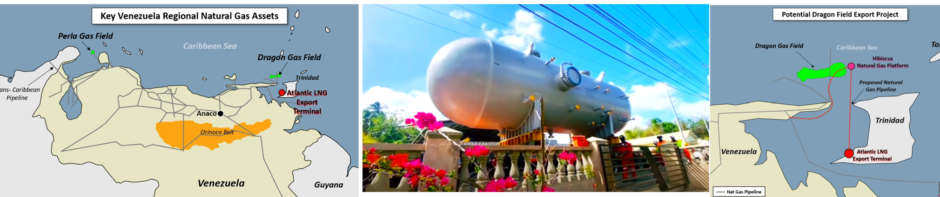
Shell Plc has been advancing the revival of its Dragon project near the Trinidad border, and French major TotalEnergies SE is nearing trading contracts with PDVSA.
bp’s new Chief Executive Officer Meg O’Neill is seeking to boost long-term reserves as it refocuses on oil and gas following a failed push into low-carbon ventures.
BP agreement with Venezuela to develop offshore gas fields
April 30, 2026
BP lifted its estimate of the likely cost of its 2010 Gulf of Mexico oil spill to $40 billion on Tuesday, denting profits, but its underlying performance beat all expectations on higher refining margins and a lower tax rate.
CARACAS, April 29 (Reuters) –
BP will develop Venezuela’s Cocuina-Manakin gas field, on the maritime border with Trinidad and Tobago, and explore joint opportunities in the offshore Loran gas field, the company and government said on Wednesday after signing a memorandum of understanding.
Venezuela recently signed exploration and other deals with international producers, including Italy’s Eni and Spain’s Repsol as it opens its oil industry to foreign investment following the ouster of Nicolas Maduro.
U.S. Sanctions Target Cuba Regime & Elites
U.S. Department of State, May 7, 2026
The US Administration is taking decisive action to protect U.S. national security and deprive Cuba’s communist regime and military of access to illicit assets.
Today, I designated the following actors under President Trump’s Executive Order 14404 of May 1, 2026, “Imposing Sanctions on Those Responsible for Repression in Cuba and for Threats to United States National Security and Foreign Policy”:
- GRUPO DE ADMINISTRACION EMPRESARIAL S.A. (GAESA), pursuant to section 2(a)(i)(A) of E.O. 14404, for operating or having operated in the financial services sector of the Cuban economy.
- ANIA GUILLERMINA LASTRES MORERA (LASTRES), pursuant to section 2(a)(i)(E) of E.O. 14404, for being or having been a leader, official, senior executive officer, or member of the board of directors of GAESA.
- MOA NICKEL SA (MNSA), pursuant to section 2(a)(i)(A) of E.O. 14404 for operating or having operated in the metals and mining sector of the Cuban economy.
These sanctions are part of the Administration’s comprehensive campaign to address the pressing national security threats posed by Cuba’s communist regime and hold accountable the regime and those who provide it material or financial support.
90 miles from the American homeland, the Cuban regime brought the island to ruin and auctioned off the island as a platform for foreign intelligence, military and terror operations. Additional designations can be expected in the following days and weeks.
BACKGROUND
GAESA, a military-controlled umbrella enterprise, is the heart of Cuba’s kleptocratic communist system. Controlling an estimated 40 percent or more of the economy, GAESA is involved in various sectors and is designed to generate income not for the Cuban people, but only for the benefit of its corrupt elites.
While people suffer from hunger, disease and chronic under-investment in critical infrastructure such as its power grid, much of the proceeds of GAESA’s activities are funneled to hidden overseas bank accounts. According to recent public estimates, GAESA’s revenues are likely more than three times the state’s budget and GAESA likely controls up to $20 billion in illicit assets.
Lastres, the Executive President of GAESA, is responsible for the management of GAESA’s illicit assets held internationally.
MNSA, a joint venture of Sherritt International Corporation and Cuban state-owned La Compania General de Niquel, exploited Cuba’s natural resources to benefit the regime at the expense of the Cuban people.
It profits from assets the Cuban regime originally expropriated from U.S. persons and corporations.
SANCTIONS IMPLICATIONS
As a result of today’s sanctions-related actions, and in accordance with Executive Order 14404 of May 1, 2026, “Imposing Sanctions on Those Responsible for Repression in Cuba and for Threats to U.S. National Security and Foreign Policy,” all property and interests in property of the designated persons described above that are in the United States or in possession or control of U.S. persons are blocked and must be reported to the Department of Treasury’s Office of Foreign Assets Control (OFAC).
Additionally, all entities and individuals that have ownership, either directly or indirectly, 50 percent or more by one or more blocked persons are also blocked.
All transactions by U.S. persons or within (or transiting) the United States that involve any property or interests in property of designated or otherwise blocked persons are prohibited unless authorized by a general or specific license issued by OFAC or exempt.
These prohibitions include the making of any contribution or provision of funds, goods, or services by, to, or for the benefit of any blocked person and the receipt of any contribution or provision of funds, goods, or services from any such person. Foreign persons that engage in transactions with persons designated pursuant to E.O. 14404 – or that operate in the energy, defense and related materiel, metals and mining, financial services, or security sector of the Cuban economy, as identified in E.O. 14404 – are themselves at risk of sanctions.
Non-U.S. persons, including foreign financial institutions, should proceed with caution in any dealings with a party sanctioned under this authority.
Actions to return assets to a sanctioned party or transfer them to another jurisdiction for potential use by the target could expose non-U.S. persons to significant sanctions risk. All property and interests in property of persons that are blocked pursuant to the CACR continue to be blocked.
The CACR prohibits persons subject to U.S. jurisdiction from dealing in property in which Cuba or a Cuban national has an interest, unless authorized or exempt. The power and integrity of U.S. government sanctions derive not only from the U.S. government’s ability to designate and add persons to the Specially Designated Nationals and Blocked Persons (SDN) List, but also from its willingness to remove persons from the SDN List consistent with the law.
The ultimate goal of sanctions is not to punish, but to bring about a positive change in behavior. Petitions for removal from the SDN List may be sent to: [email protected]. Petitioners may also refer to the Department of State’s Delisting Guidance page.
State’s action is taken pursuant to Executive Order (E.O.) 14404, which authorizes sanctions on Cuban regime officials responsible for repression and threats to U.S. national security.
This action furthers both E.O. 14380, “Addressing Threats to the United States by the Government of Cuba” and National Security Presidential Memorandum 5 (NSPM-5), which directs the Executive Branch to improve human rights, encourage the rule of law, foster free markets and free enterprise and promote democracy in Cuba .
Cuba Energy Resources
Cuba holds 124,000,000 barrels of proven oil reserves as of 2025, ranking #67 in the world and accounting for about 0.0070% of world oil reserves of 1,765,151,568,000. Proven reserves equivalent to 3 times its annual consumption levels (based on 2024 data) means that, without imports, there would be about 3 years of oil left (at 2024 consumption levels and excluding unproven reserves.) Cuba has ample energy resources from solar, biofuel, wind and hydropower.
Ten rum distilleries managed by state-owned Cuba Ron S.A produce its renowned sugarcane spirits, sold in the UK as a premium product. Rum production is intertwined with production of sugar. A byproduct of refining sugar, molasses is the raw material from which most rums are produced. In the region a long-standing tradition makes rum directly from sugarcane juice. Havana Club Máximo Rum Extra Añejo 50cl Cuba • 50cl • 40% costs £1,786
Maximum pressure
15 MAY
The situation in Cuba is rapidly deteriorating, as fuel reserves dwindle in the U.S. blockade. Extensive blackouts continue while water shortages are due to the lack of power for pumping equipment.
Diplomatic shift: CIA Director John Ratcliffe flew to Havana on Thursday for a meeting with officials from the interior ministry and intelligence services. Reports suggest that the U.S. would “seriously engage” with the government “only if it makes fundamental changes,” but there will be a limited window to open its communist economy and hold “free and fair” elections.
Trump repeatedly warned that Cuba “will be next” in his campaign against hostile regimes in the Western Hemisphere, and leaders don’t have to look far to see what happened in Venezuela.
The “hard power” pivot contrasts significantly with the U.S. approach seen a decade ago. In 2016, President Obama became the first American president to visit Cuba in nearly a century after normalizing relations and waiving its designation as a state sponsor of terrorism, allowing commercial flights and cruise ships to return to Cuba. However, the new campaign is based on security threats and human rights, while expanding America’s sphere of influence for regional dominance.
Investing angle: The Herzfeld Credit Income Fund (HERZ), formerly the Herzfeld Caribbean Basin Fund, trading under ticker CUBA, officially abandoned its focus on Caribbean equities in July 2025 to pivot toward U.S. credit markets and collateralized loan obligations. It was a major signal that Wall Street stopped waiting for the next thaw in relations and is now bracing for a total systemic reset.
Trump will “turnaround” Cuba and extract it from PRC and Russia
Saturday, May 16th 2026
US President Donald Trump said his administration will align Cuba with Washington away from the orbit of China and Russia, in his first public comments since the unprecedented visit by CIA Director John Ratcliffe to Havana in a week marked by contradictory US gestures toward the Cuban regime: the humanitarian offer of USD 100 million accepted by Havana, the judicial pressure on former president Raúl Castro and the opening of a direct channel between US and Cuban intelligence services.
“I think we are going to turn it around,” Trump replied when asked about the possibility of Cuba leaning toward the United States and distancing itself from Beijing.
The president praised the role of Secretary of State Marco Rubio in the Cuban dossier and was confident in limiting the influence of global rivals, hours after he returned from his state visit to Beijing, where he addressed with Xi Jinping a broad agenda that included Iran, Ukraine and the Korean Peninsula.
The Central Intelligence Agency formalized in an official communiqué the details of Ratcliffe’s trip.
The head of the agency traveled to Havana to hold direct talks with authorities of the Interior Ministry and senior officers of the Cuban intelligence services, during which they addressed intelligence cooperation, regional security and the island’s economic situation. The US delegation met Raúl Rodríguez Castro, grandson of former president Raúl Castro and security adviser to the regime and Interior Minister Lázaro Álvarez Casas.
The visit coincides with US reports, on the possibility that the federal justice system will bring a criminal case against Raúl Castro, 94, over the 1996 shootdown of two civilian aircraft of the Brothers to the Rescue organization, in which four volunteers were killed.
The potential indictment, which requires grand jury approval, builds on an investigation that the Florida attorney general announced in March he intended to reactivate.
Since January, Washington maintained an oil blockade on Cuba imposed in the wake of the capture of deposed Nicolás Maduro. The measure triggered an unprecedented energy collapse, with blackouts , shortages of food and fuel and the circulation of internal alerts about activation of “Option Zero,” an extreme rationing plan inherited from the Special Period of the 1990s.
US Aircraft carrier visits Guyana and Suriname
May 28
In the past week, the USS Nimitz, the oldest super aircraft carrier in the U.S. fleet, made calls offshore Suriname and Guyana with American officials lauding the close relations between the U.S. military, the administration and the countries.
It is not clear, however, whether the Nimitz, commissioned in 1975 and slated for retirement in the coming months, is sailing in the Caribbean Sea on a goodwill tour or whether its presence has anything to do with American saber-rattling over Cuba.
On 25 May it visited Trinidad, the closest U.S. ally in the 15-nation Caricom. Officials were flown out to the carrier anchored offshore. In Suriname cabinet ministers, senior military officers, and journalists were on the day trip. In Guyana, President Irfaan Ali, cabinet ministers, advisers and officers visited the vessel.
Officials say that the offshore call can be put in the context of the growing geopolitical importance of Suriname and Guyana, flush with oil, gas, and a slew of other resources, including gold, bauxite, uranium, diamonds and other raw materials.
Since 2019, Guyana has been producing offshore oil led by U.S. supermajor ExxonMobil and its consortium at a current rate of around 900,000 barrels per day. Suriname is preparing for actual production in 2028. Experts said that their super- light crude will always be a hit in the petroleum world. Both sides spoke of the growing relations between governments, the U.S., and the respective militaries.
As Cabinet Ministers Uraiqit Ramsaran, Harish Monorath, and Patrick Brunings listened, Rear Admiral Cassidy Norman said, “You are a very important regional partner and this is a strategically very important moment.
We are interested in continuing to build a partnership with you based on mutual respect, sovereignty, and our shared interests in the region . We focus on cooperation between our countries and security, specifically to ensure stability, predictability, and prosperity in this region.”
Similar sentiments were shared for the Guyana leg on Saturday as well. “The United States and Guyana share a commitment to regional security and prosperity.
The visit of the USS Nimitz demonstrates our dedication to working hand-in-hand with Guyana and our Caribbean partners to address shared challenges and build a safer, stronger hemisphere for all our citizens,” Ambassador Nicole Theriot said.
Ali noted that the trip represented the “greatest honor to join some of the finest men and women in uniform on board the USS Nimitz as we celebrate partnership, friendship, and our collective goal of ensuring a region built on peace, democracy, and the shared values of the members of the Shield of the Americas.
I pray for God’s blessing, guidance, and protection for all our men and women in uniform as we work tirelessly in support of the development, prosperity, and friendship of our two nations.”
Giving an insight of what can flow from such close cooperation, the U.S. mission in Guyana spoke of how joint collaboration can deal with transnational crimes.
“Our partnership extends beyond military exercises. Under the Shiprider Agreement between the United States and Guyana, Guyanese law enforcement officers embark on U.S. law enforcement vessels to assist in conducting counter-drug patrols and pursuing suspected drug traffickers that flee into Guyanese territorial waters — a testament to our collaborative approach to combating transnational crime.”
Officials say no one would be surprised that the Nimitz makes Trinidad and Tobago its next stop. The federation had publicly lined up behind the U.S. in the action against Venezuela earlier this year, while attacking its regional neighbors for either remaining neutral or for demanding that the region remain a zone of peace, free from any superpower military conflict.
Three Trinidad Government ministers boarded a United States military C-2 aircraft on Monday and flew to international waters where they toured the USS Nimitz (CVN-68), one of the most powerful nuclear-powered supercarriers in the US Navy fleet.
Ministers Wayne Sturge, Jearlean John and Saddam Hosein were invited by the US Embassy and Southern Command to participate in a Distinguished Visitor (DV) Day Tour of the USS Nimitz hosted by the Nimitz Carrier Strike Group.
The USS Nimitz , flagship of the US Nimitz Carrier Strike Group is capable of operating globally for extended periods without refuelling. Named after Fleet Admiral Chester W Nimitz, the vessel functions as a floating military airbase.
The Nimitz Carrier Strike Group is a major US naval combat formation supported by guided missile destroyers, cruisers, submarines, supply ships and an embarked air wing of fighter jets, surveillance aircraft and helicopters.
Carrier Strike Groups are regarded as among the world’s most formidable military assets because they enable the United States to project air and naval power globally without relying on land-based facilities.The tour included Narine Charran, Permanent Secretary in the Ministry of Defence; Commodore Don Polo, Chief of Defence Staff; Captain Kemba Hannays, Commanding Officer of the TTAG; and Captain Akenathon Isaac, Commanding Officer of the TTCG.
The delegation toured the carrier and gained insight into the operations of what it described as a “floating airport”, including observing aircraft take-offs and landings and associated safety procedures. Sturge was presented with a commemorative plaque by the captain of the USS Nimitz and presented a plaque on behalf of the Government .
“The delegation appreciated the information and experiences exchanged by both sides and look forward to continued collaboration.”
Sturge confirmed the guests travelled aboard a US military aircraft to the vessel, where he met six Trinidadians serving aboard the carrier and later arranged for doubles to be sent to them following the visit.
“It was amazing to see the capabilities. Met six Trinidadians on board so we sent back some doubles for them seeing that five of them talked about missing it and the other left so long ago and can’t recall ever having had it.”
Sturge marvelled at the sophistication of the USS Nimitz, and its launch system.
“The landing and take off was by catapult which I never quite understood until I experienced it.”
Further information would be shared later, stressing the importance of keeping sensitive national security matters confidential. The USS Nimitz also acknowledged the visit.
“Today USS Nimitz was honoured to welcome distinguished visitors from Trinidad and Tobago while operating in the Caribbean. Their visit reflects the strong ties between our nations and the importance of continued engagement among partners committed to security, cooperation, and stability throughout the region. We were also proud of our Trinidadian-American sailors who were able to join the tour and show off their Old Salt strength!
“To our guests from Trinidad and Tobago, thank you for your friendship and for joining us aboard Nimitz!
“Nimitz is deployed as part of US Naval Forces Southern Command & 4th Fleet’s Southern Seas 2026 which seeks to enhance capability, improve interoperability and strengthen maritime partnerships with countries throughout the region through joint, multinational and inter-agency exchanges and cooperation.”
U.S. waiver for Russian oil cargo transactions
May 18, 2026(WO) —
The U.S. Department of the Treasury extended a sanctions waiver allowing certain transactions involving Russian-origin crude oil and petroleum products loaded prior to April 17, 2026, providing additional flexibility for cargo deliveries amid ongoing disruption in global oil markets.
The Treasury Department’s Office of Foreign Assets Control (OFAC) issued General License 134C on May 18, replacing the previous General License 134B, which expired May 16.
Under the updated waiver, transactions “ordinarily incident and necessary” to the delivery, sale or offloading of Russian crude oil and petroleum products loaded onto vessels on or before April 17 are authorized through June 17, 2026.
The authorization also applies to vessels blocked under existing Russia-related sanctions programs and includes services tied to vessel operations and cargo handling, including docking, anchoring, bunkering, insurance, classification, salvage and emergency repairs.
The waiver does not authorize transactions involving Iran, Cuba, North Korea, certain occupied Ukrainian territories or entities owned or controlled by sanctioned parties in those jurisdictions, according to OFAC.
The move comes as global oil markets continue facing supply pressures tied to Middle East conflict, disruptions involving the Strait of Hormuz and broader volatility across global shipping and crude export flows.
Earlier, Treasury Secretary Scott Bessent said the temporary extension was intended to help “the most vulnerable nations” maintain access to Russian oil cargoes already stranded at sea.
Trump ends PRC visit without substantial agreements but Xi agrees opening Hormuz
May 16th 2026 –
US President Donald Trump concluded his state visit to China of less than 48 hours without substantial announcements on the main points of the bilateral agenda, although he described the encounter as “very successful” and “unforgettable” and said he reached “fantastic” trade deals whose details were not disclosed.
The final day of the trip, held at Zhongnanhai, residence of the Chinese Communist Party leadership, produced as its most visible outcome an offer by President Xi Jinping to help reopen the Strait of Hormuz, closed by Iran since the start of the war in late February.
Trump announced he would assess in the coming days the possibility of lifting sanctions imposed on Chinese companies that purchase Iranian crude, in one of the most significant potential concessions to emerge from the summit.
The US president called his Chinese counterpart an “old friend,” expressed his wish to receive him in Washington, and said both sides reached “a series of important consensuses.” The most geopolitically relevant was the shared view that Iran should not possess nuclear weapons, a common stance on one of the most critical flashpoints in the Middle East.
Xi described the visit as “historic” and “emblematic” and said the leaders set a new course based on a “constructive relationship of strategic stability between China and the United States.” According to the Chinese leader, the agreement covers the maintenance of stable economic and commercial ties and the “appropriate” handling of mutual concerns, alongside a commitment to strengthen coordination on international matters such as Ukraine, the Middle East, and the Korean Peninsula, addressed during Thursday’s sessions.
The main friction point was Taiwan. Xi warned Trump during the first day of meetings that mishandling that issue could push the two countries toward “conflict.” Trump confirmed the topic was addressed “in great detail,” although he declined to specify the substance of the exchanges and said: “I have not committed in any sense.” China’s foreign minister said that Washington “attaches importance to China’s concerns” over the island.
Beijing maintains its sovereignty claim over Taiwan and considers the question, “the most important” in the bilateral relationship. On Trump’s second visit after the 2017 trip in his first term and the first since his return to the White House in January 2025, a business delegation included Elon Musk, Jensen Huang and Tim Cook, underscoring the economic dimension of the summit.
The Summit Was Remarkably Banal
A more confident PRC downplays presidential visits.
Jason Bordoff is founding director of the Center on Global Energy Policy, professor at Columbia University’s School of International and Public Affairs, a former senior director on the U.S. National Security Council and special assistant to former President Barack Obama.
James Palmer is a deputy editor at Foreign Policy
The lack of dramatics on the PRC side was appropriate. Trump’s visit was a snoozefest.
Xi stuck to political banalities, speaking about familiar red lines: Taiwan, democracy and human rights, China’s “path and system,” and China’s “development right,” referring to its ability to move up the global economic ladder without being pushed down by Washington.
He returned to favorite topics. The bilateral relationship must be one of stability, not competition. It must avoid the Thucydides Trap of conflict between an established and a rising power. Together, the United States and China must always be twirling toward the future.
Trump and Xi seemed to agree to little of substance, save some minor concessions over trade.
Expected deals, such as China’s promise to buy Boeing jets, fell short of what was rumored ahead of the meeting, disappointing markets. There was no sign of any movement—or even real discussion—on Iran, Taiwan, Japan, or other areas of geopolitical contention. Trump said Xi had “strongly” promised not to supply Iran with weapons; that means nothing, since any Chinese military aid to Tehran is already under the table.
Yet previous U.S. presidential visits were met with far more fanfare in China’s tightly controlled media, even when little of consequence emerged. Why was Beijing so muted this time around? One reason is unpredictability…
Trump focuses attention on Guyana
May 17, 2026
Bauxite, oil reserves vital to US, China
GEORGETOWN, Guyana —
The U.S. announced that it is turning its attention toward Guyana’s abundant bauxite and other resources for business opportunities at a time when the Trump administration is increasingly eyeing Latin American energy and minerals.
U.S. Under Secretary for Economic Affairs Jacob Helberg held talks this week with top Guyanese officials, including President Irfaan Ali, in the experiencing an oil boom.
The country’s mass oil reserves discovered in the last decade increased Guyana’s geopolitical importance, which has been further amplified by a global energy crisis caused by the Iran war. Its bauxite reserves are critical for producing aluminum.
The Trump administration has more aggressively focused on Latin America’s resources, from pushing to expand oil production in Venezuela after the U.S. operation in January to pursuing cooperation with Brazil over critical minerals.
In a region where energy production seemed to be declining, Latin America is now seeing a reversal of that trend, according to Benjamin Gedan, senior fellow and director of the Stimson Center Latin America program.
“In times of global energy scarcity, there’s a great deal more focus on Latin America as an alternative stable source of supply. And Guyana is the leader of that story.”
The visit comes amid concerns in the U.S. government about the Chinese government and larger companies cashing in on multimillion dollar state contracts at the expense of U.S. firms.
Guyanese officials argued that the U.S. firms have not been as aggressive as the Chinese, who often offer financing and cater to labor needs for large projects.
Helberg told officials that the benefits of the bauxite reserves are already known, so the U.S. will be interested in that sector. Currently, Chinese operator Bosai Minerals is the dominant player in the local bauxite sector.
“Generally speaking, we both understand that Guyana is a country with a lot of natural resources,” Helberg said of the bilateral talks.
The U.S. can assist Guyana in conducting high-tech surveys to determine what other minerals lie under the surface for other developments later on.
The U.S. is looking to learn from past mistakes of allowing China to gain a foothold in the region, according to Jason Marczak, vice president and senior director for the Adrienne Arsht Latin America Center at the Atlantic Council.
While Guyana is likely trying to diversify its trade relationships, including with China, the visit shows that the country remains a strong U.S. partner in the region.
“President Ali in particular is very close to the United States and in general recognizes the importance of the U.S. as a key partner for Guyana,” Marczak said. “That’s reflected by Helberg’s visit to Guyana.”
Guyana’s Foreign Secretary Robert Persaud said that Guyana is interested in attracting U.S. investors to the mineral, oil- and gas-rich country in the coming months.
“The U.S. is our strategic partner and we made that clear to them but we would want value added to bauxite and other products. We are interested in processing and with improvements in energy generation,” he said.
Venezuela, World Bank to define technical cooperation areas after seven years
May 16th 2026
The Venezuelan government and the World Bank agreed in Caracas to work jointly on identifying concrete areas of technical cooperation, in the first high-level encounter since the resumption of relations announced last month, which ended a seven-year pause in institutional contacts.
Acting President Delcy Rodríguez, received at the Miraflores Palace the World Bank’s Vice President for Latin America and the Caribbean, Susana Cordeiro Guerra, Shireen Mahdi, Economic Policy Manager for the region and Óscar Calvo González, Director of Strategy and Operations for Latin America and the Caribbean.
In the official communiqué, both sides “agreed to continue working jointly to define the concrete areas of technical collaboration, for the benefit of the economic and social development of the Venezuelan people.”
This first meeting addressed possible areas of technical assistance and exchanged views on recent economic developments in the country, although the communiqué did not specify timelines or operational mechanisms.
The Venezuelan delegation included Sectoral Vice President for the Economy Calixto Ortega; Economy and Finance Minister Anabel Pereira and the Vice President of Finance of Petróleos de Venezuela (PDVSA), Christiam Hernández.
The simultaneous presence of economic authorities and the state oil company, reflects the weight of the energy issue and of the external debt in the agenda of the international financial reintegration process.
The rapprochement follows a rapid sequence of institutional gestures toward Caracas. The World Bank Group announced in April the resumption of its relations with the Venezuelan government, following the results of the voting process at the International Monetary Fund.
That month, the Washington-based institution formalized the resumption of its ties with Venezuela, a decision adopted in line with views of members representing the majority of the voting power. Both relationships were suspended in March 2019, during the political crisis stemming from Nicolás Maduro’s second term, considered illegitimate by the opposition and by governments that recognized the then head of Parliament, Juan Guaidó, as interim president.
The visit occurred two days after the Venezuelan executive announced launch of a “formal, integral, and orderly” process to restructure the public external debt and that of PDVSA, without specifying the amount.
In March Transparencia Venezuela reported external debt exceeds USD 170 billion. The official communiqué on restructuring stated as its objective “to rebuild the country’s capacity to mobilize financing, attract investment, stabilize the economy, and materially improve the quality of life of every Venezuelan.”
Venezuela circulates draft oil regulations to attract foreign investment
Fabiola Zerpa May 15, 2026 (Bloomberg) –
The Venezuelan government is circulating a draft of regulations as part of its newly enacted oil law, highly anticipated by companies planning to invest in the country’s increased oil production.
A 63-page draft sets details on technical, operational, fiscal and control provisions for companies that work in the country’s oil and gas fields. It specifies standards for private companies’ activities in areas previously monopolized by Petróleos de Venezuela SA, such as oil refining, upgrading and trading. It also abrogates the country’s 1943 oil law and 1969 regulations.
PDVSA has begun circulating a proposed contract to energy companies interested in working in the Latin American nation.
Regulations and contract models were long-awaited by the oil industry after the new hydrocarbons law was enacted in January, not long after the U.S. forcibly removed Nicolas Maduro and allowed Delcy Rodriguez, to assume the presidency. The framework details the extent of Venezuela’s opening to foreign investment and relinquishment of decades of strict state control. A proposed model of contracts to energy companies began circulating among companies in early May.
Clauses of the regulations cover “novel topics” for the oil industry, including “domestic utilization, unitization, data reversion to the state, greenhouse gas effects, and monitoring to name a few,” Miami-based arbitrator and energy specialist Elisabeth Eljuri wrote on Friday. “It seems to suggest that it’s mandatory to implement enhanced recovery and secondary recovery in every project.”
The U.S. is working with Venezuela’s government to bring its economy into the international financial system, after years of isolation under U.S. sanctions. The U.S. Treasury began lifting oil and financial sanctions as part of the three-phase program for Venezuela, which include stabilization, economic recovery and political transition.
US official urges ‘healthy dialogue’ on Venezuela deals
Department of Energy official urges delegates to network and cut deals to open oil and gas sector
Nathanial Gronewold US Correspondent
Houston, 18 May 2026
A top US Department of Energy official urged delegates from Venezuela and the US oil industry to engage constructively during the next two days of discussions on investment opportunities in the OPEC founder.
Geoex MCG wants to talk to upstreamers before 52,000 km survey US seismic player wants E&P players’ input on Venezuela offshore shoot
Iain Esau Africa Correspondent, London, 29 April 2026
Houston-based Geoex MCG wants to talk to oil and gas companies about their priorities before finalising the details of a major new 2D seismic survey offshore Venezuela.
Venezuela seeks compensation from T&T for spill
2026, 05/19
Venezuela’s Foreign Affairs Minister Yván Gil is seeking information about an oil spill originating from Trinidad and compensation for the fallout.
Gil said the spill, from a Heritage Petroleum field, is “extremely serious,” as is “the lack of information” from T&T’ Government and asserted that they do not know the exact origin, volume and type of hydrocarbons in the incident.
“Trinidad and Tobago has an obligation, first and foremost, to immediately report to the Venezuelan government any spill or environmental incident. Secondly, we must have information on the type of product that was spilled and the measures taken to mitigate it,”
He demanded “responsibility for this type of event” and showed satellite images recorded since April 28 showing the spill from Trinidad. Venezuela sent communication statements to the T&T Government to assess the impact and has been “working for several weeks” on this “very worrying issue” with Venezuelan Ministries, the Navy, state-owned Petróleos de Venezuela and the National Institute of Aquatic Spaces (INEA) .
Gil warned of an impact on:
-
- 1,625 square kilometres in
- 12 strategic wetland systems,
- over 500 fishermen and
- 4 Venezuelan national parks.
“There have been operational limitations for the fishing fleet, which generates significant costs and limits marketing. There has been a real economic and environmental impact,” the foreign minister stated. Over 140 fish species were affected, in addition to the mangroves.
He said this was not the first oil spill from T&T that affected Venezuela.
“So far, more than 12 tons of hydrocarbon products have been collected and are being analysed…between 2015 and 2023, more than 876 spills of different types of compounds occurred in the area.”
Energy Minister Dr Roodal Moonilal said, “We are arranging discussions with our Venezuelan counterparts later this week and will sort out all these matters. We have been busy doing the technical and scientific work.”
Two weeks ago, in response to a Venezuelan government communiqué on the oil spill, T&T’s Ministry of Energy released an account confirming that Heritage Petroleum detected an oil spill at its main offshore field at approximately on May 1.
Oil spill trajectory modelling indicated a risk of untreated hydrocarbons potentially entering Venezuelan waters. On 10 May media reported T&T handling of an offshore oil spill came under scrutiny from the Opposition querying delayed disclosure, accountability and potential diplomatic fallout in a sensitive relationship with Venezuela.
Energy Minister Dr Roodal Moonilal sought to downplay the incident, as a minor, quickly contained event, insisting there was no cause for alarm.
A Venezuelan communique alerted the international community to an oil spill from Trinidad which caused environmental damage in the Gulf of Paria and coasts of Sucre and Delta Amacuro. “Evaluations by Venezuelan authorities show severe risks to mangroves, wetlands, marine fauna and strategic hydrobiological resources for food security and the ecological balance of the region. Likewise, impacts have been recorded on vulnerable species and ecosystems of high environmental sensitivity.”
Caracas instructed its Foreign Ministry to request pertinent information and the action plan for the mitigation and containment of the spill, demanding “compliance with the obligations established in international environmental law and the urgent adoption of reparation measures for the damage caused.”
T&T Ministry of Energy in an account of the incident, confirmed that Heritage detected an oil spill at its main offshore field at 7.25 am on May 1, estimated at 10 barrels of oil.
Oil spill response protocols were immediately activated and regulatory agencies, including the ministry, Environmental Management Authority and the Coast Guard, were notified.
Oil spill trajectory modelling indicated a risk of untreated hydrocarbons potentially entering Venezuelan waters. Approval to deploy chemical dispersants was granted at 9.50 am on May 1, with dispersants applied 6 to 8 nautical miles from the maritime border.
Visual assessments, drone surveillance and vessel inspections found no visible hydrocarbons remaining on the sea surface.
The source of the leak was secured and repaired on 1 May, with the affected installation returning to service on May 2. Daily inspections since show no recurrence. The Ministry would collaborate with authorities locally and abroad to provide additional information required.
It is “committed to working with its counterparts in the Bolivarian Republic of Venezuela to develop a structured framework to manage any incidents of this nature which may arise in the future along our shared border.”
Minister Moonilal maintained there was no significant environmental impact, characterising the incident as “a minor event that was dealt with in 48 hours. The situation was contained quickly and effectively.”
He said inherited infrastructure problems were a contributing factor. Dilapidated infrastructure and ageing pipeline installations increased the likelihood of leaks, following “years of PNM neglect”.
Former energy minister, Stuart Young accused the Government and Heritage of attempting to conceal “a significant environmental incident.”
He questioned the effectiveness of existing monitoring mechanisms, noting that the previous administration made significant investment in an oil-spill radar detection system designed to identify spills in the Gulf of Paria. The system was functioning fully up to the time the PNM left and asked if it remains operational under the current administration.
Analyst Dr Shane Mohammed said the most troubling aspect was the apparent failure to communicate promptly and asked why authorities did not announce the spill on May 1, noting that transparency was paramount.
Venezuela issued an “aggressive” communique before T&T where ministers have individual and collective responsibility to inform the Prime Minister and the population. Even if response measures were underway, the absence of early communication risked creating an impression of secrecy or negligence.
Errors in judgment or delay in transparency could unnecessarily complicate diplomatic relations when the Government is strengthening ties with Venezuela.
“My issue here is the delicacy of the relationship between Trinidad and Tobago and Venezuela. This is a highly sensitive, time-bound and emotionally charged geopolitical environment, especially in matters relating to energy security and cross-border cooperation. We cannot afford to drop the ball. We have to take into consideration the geopolitics ; it’s very delicate. We have to tread carefully.”
Trinidad and Tobago and Venezuela share an oil spill contingency plan which could be invoked by either party if there was imminent danger. It details preparedness and mitigation plans, including agency roles and responsibilities, cleanup response decision and operations, public relations.
Venezuela is plagued by spills, leaks and dilapidated infrastructure. In 2016- 2021 the Political Ecology Observatory documented nearly 200 oil spills
EDITORIAL
2025 -1 October
Venezuela’s Orinoco Delta, a biodiversity hotspot, is degraded by crude oil leaks, endangering communities and wetland ecosystems.
River pollution and oil contamination underscores Venezuela’s environmental crisis, where mismanagement and extractive industries accelerate the decline of ecosystems, demanding urgent conservation efforts. In the Caribbean Basin of fast-flowing rivers, source of urban water supplies, widespread river pollution from oil spills poses severe ecological risks
2024- September 6 – Oil spill spreads across Venezuela’s Caribbean coast
A massive oil spill spread off Venezuela’s Caribbean coast since mid-August, across 225 square kilometers. After 18 oil spills this year, authorities were silent. The new spill of fuel oil could be one of the largest in Venezuela’s history. Fishing and tourism were suspended.
On August 30, the slick , 50 km long, spread east over 150 km away.
2023 had an average of 6 oil spills a month but none was reported since 2016.
2022 had 86 oil spills and natural gas leaks
2021 77 incidents were recorded.
Norway Joins Pax Silica Initiative
May 6, 2026
On May 6, the United States welcomed the decision by the Kingdom of Norway to join the Pax Silica initiative. As a member of Pax Silica, Norway will play a leading role to develop diversified critical mineral supply chains.
Norway’s Ambassador to the United States, Anniken Huitfeldt, signed the Pax Silica Declaration in Washington, D.C., officially acknowledging Norway’s participation in the initiative. The United States and Norway affirmed their commitment to continue expanding market access for industry and advanced technological value chains.
Norway is the fourteenth Pax Silica signatory, joining Australia, Finland, India, Israel, Japan, Philippines, Qatar, Republic of Korea, Singapore, Sweden, the United Arab Emirates, the United Kingdom, and the United States.
[ The Netherlands is a non-signatory partner in Pax Silica, making a total of fifteen countries in all ]
Pax Silica is a positive-sum partnership of economies committed to safeguarding competitiveness and prosperity.