United Oil & Gas completes second stage of Jamaica exploration
23 February 2026
United Oil & Gas announced on Monday that it has completed stage two of its surface geochemical exploration programme offshore Jamaica and started stage three piston coring operations on the Walton-Morant licence, marking what it described as the critical phase of the campaign.
The AIM-traded company said seabed heat-flow measurements under stage two had now been successfully completed and would contribute to future geological modelling. Data from the earlier stage one high-resolution multibeam echosounder survey had been integrated with existing seismic datasets, resulting in the identification of multiple seabed features of interest and the selection of 42 optimal piston core locations for the next phase.
Stage three piston coring was now underway, with up to 42 cores planned, primarily within the Walton Basin and close to the Colibri, Streamertail and Oriole prospects, where existing 3D seismic and supporting data indicate potential hydrocarbon migration. Select locations in the Morant Basin would also be cored.
The programme was designed to recover seabed sediment samples for geochemical analysis to test for thermogenic hydrocarbons, which, if identified, would provide direct physical evidence of an active petroleum system offshore Jamaica.
Piston coring operations were expected to take around one week, subject to weather conditions, after which samples would be shipped to Houston, Texas for laboratory analysis. The firm said the surface geochemical exploration programme was a key step in further de-risking the Walton-Morant licence and advancing technical evaluation and commercial discussions.
Chief executive Brian Larkin said, “The completion of heat-flow measurements and commencement of piston coring marks a major step forward in our Jamaica exploration programme. The integration of the acquired data has allowed us to optimise coring locations in the Walton Basin, including near our key Colibri, Streamertail and Oriole prospects, as well as at key locations in the Morant Basin. “Piston coring is the defining phase of this programme, providing the opportunity to physically confirm the presence of thermogenic hydrocarbons offshore Jamaica.”
TotalEnergies plans Suriname drilling ahead of GranMorgu first oil
French supermajor plans to spud a new wildcat in Block 58 this year
Fabio Palmigiani
South America Correspondent Rio de Janeiro 3 March 2026
TotalEnergies plans to drill one exploration well in Block 58 offshore Suriname to start commercial production later this year.
Eco (Atlantic) Oil & Gas results for periods ended 31 December 2025
02 March 2026
Eco (Atlantic) Oil & Gas, the oil and gas exploration company focused on offshore Atlantic Margins, announced unaudited results for the 3 and 9 month periods ended 31 December 2025.
Highlights:
Financial
-
- •The Company had cash and cash equivalents of US$2.9 million and no debt as at 31 December 2025, before a capital raise of US$10 million completed on 29 January 2026.
- •The Company had total assets of US$19.9 million, total liabilities of US$1.3 million and total equity of US$18.7 million as at 31 December 2025.
- •On December 4, 2025 Eco signed a binding Framework and Options Agreement with Navitas Petroleum LP (“Navitas”) for the Orinduik Block offshore Guyana and Block 1 CBK offshore South Africa as well as future oil and gas cooperation for the entire portfolio and new ventures (the “Framework Agreement”).
As part of the Framework Agreement, Navitas paid Eco Atlantic US$2 million to enter into an exclusive option agreements to farm-in to the Orinduik Block and Block 1 CBK.
Post-period end
-
- •On January 29, 2026, Eco raised US$10 million at the then market price with new Israeli based institutional investors.
- •On February 19, 2026 the trading of the common shares in the capital of Eco migrated to the London Stock Exchange’s SETS trading platform (“SETS”), enabling new and existing international institutional investors to trade Eco’s shares on a continuous basis.
- •Further to the Company’s announcement on January 13, 2025, a total of 3,700,000 Restricted Share Units (“RSUs”) issued to certain directors and officers of the Company have now vested and automatically will be converted into common shares in the capital of the Company (“Common Shares”) (the “RSU Conversion Shares”).
South Africa
Block 1 CBK
-
- •As part of the Framework Agreement, Navitas was granted the Block 1 CBK Option agreement, giving it the right to execute a farmout agreement to farm-in to Block 1 CBK offshore South Africa such that, on exercise, Navitas will make a US$4 million payment to Eco and become the Operator of the block with up to a 47.5% working interest, subject, inter alia, to customary government and regulatory approvals.
- •Eco’s remaining working interest, amounting up to 47.5%, assuming the exercise of the option with OrangeBasin Energies (Pty) ltd. will be carried by Navitas for the work programme, the value of the carry being capped at US$7.5 million net to Eco.
- •In honour of the late Colin Brent Kinley, Eco Atlantic’s Co-Founder and former Chief Operating Officer, who passed away on November 5, 2025, Azinam South Africa Limited (“Azinam SA”), the Operator of Exploration Right 12/3/362, in agreement with its Joint Venture Partner, renamed Block 1 Offshore South Africa to “Block 1 CBK” effective 17 November 2025.
- •On 19 November 2025, the Petroleum Agency of South Africa granted the Assignment and Transfer of a 25% participating interest from the local JV partner Tosaco Energy (Pty) Ltd to OrangeBasin Energies (Pty) ltd., a B-BBEE-rated South African entity.
Block 3B/4B
-
- •Throughout 2025, Eco and its JV partners continued to advance the licence work programme and preparations for the drilling campaign, including selection of the initial drilling target, detailed well planning, and procurement of long-lead items in anticipation of drilling permit approval.
- •Third-party legal proceedings around environmental authorisation in Block 5/6/7 have delayed the Department of Forestry, Fisheries and the Environment’s decision on the Block 3B/4B Environmental Authorisation, a delay which remains outside Eco’s control. The Company, with legal and regulatory advisers and in coordination with Joint Venture partners, continues to maintain engagement with relevant stakeholders and awaits further direction from the Department of Mineral Resources and Energy.
- •The Company is due to receive additional US$11.5 million from Block 3B/4B JV partners upon milestones in accordance with previously signed farm out agreements announced March 6, 2024.
Namibia
Eco continued to explore options to optimise its portfolio in Namibia, as the Company shifted its geological focus to deeper proven plays in the country.
-
- •Eco farmed out its entire Working Interest, in PEL 98 (Block 2213 “Sharon Block”) to an arms-length wholly Namibian-owned company, Lamda Energy (Pty) Ltd (“Lamda Energy “) pending government approval.
- •Eco has continued to receive considerable interest in its licenses in Namibia and is in the process of assessing options to further progress its exploration work programmes amid a potential farm-out.
Guyana
As part of the Framework Agreement, Navitas was granted the Orinduik Option giving it the right to execute a farmout agreement to farm-in to the Orinduik Block offshore Guyana such that, on exercise, Navitas will make a US$2.5 million payment to Eco and become the Operator of the block with an 80% working interest, subject, inter alia, to customary government and regulatory approvals.
•Eco’s remaining 20% working interest, assuming exercise of the option, will be carried in respect of the work to be performed in the Orinduik Block, which may include drilling the first exploration well or performing an appraisal programme over the existing Jethro-1 and Joe-1 heavy oil discoveries. The Orinduik carry is capped at US$11m net to Eco and excludes mobilisation costs, if any.
Post-period end
-
- •As announced on January 14, 2026, Eco, together with Navitas, is engaged in ongoing, constructive discussions with the Ministry of Natural Resources (“MNR”), Government of Guyana, regarding the continuation of Eco’s appraisal and exploration programme on the Orinduik Block area.
- •To this effect, the MNR and Guyana Geology and Mines Commission are in receipt of the relevant joint submissions from Eco Atlantic and Navitas. Eco Atlantic and Navitas continue to pursue the most efficient and value-accretive path forward that will be acceptable to the Ministry.
Falkland Islands
Post-period end
•On January 12, 2026, Navitas signed a non-binding Memorandum of Agreement with JHI Associates Inc (“JHI”), in which Eco has a 6.6% interest, for a farm-in to acquire a 65% Working Interest in the PL001 North Falklands Basin Licence, which is adjacent to Navitas’ operated Sea Lion Development. Eco expects that the parties will reach a definitive agreement in March 2026.
Corporate Presentation
Eco also announces that a new Corporate Presentation has been published on its website and is available at the following link : https://www.ecooilandgas.com/investors/results-presentation/
Gil Holzman, President and Chief Executive Officer of Eco Atlantic, commented:’This period saw Eco deliver a number of important strategic and financial milestones that have transformed our business and further strengthen our platform across the Atlantic Margins.
Most notably, we are now in a Strategic Partnership with Navitas, which includes option agreements over both Orinduik and Block 1 CBK. This represents a significant validation of the quality of our portfolio and, on exercise, will provide near-term capital alongside meaningful carried exposure across key assets. We look forward to deepening our collaboration with Navitas further as we explore options to maximise the potential of our world-class assets.
‘In South Africa, we were pleased to see progress at Block 1 CBK, renamed in honour of the late Colin Kinley, with the approval of the 25% interest transfer to OrangeBasin Energies, reinforcing our commitment to local partnerships. While we wait to hear back from the South African Government on the environmental permitting for Block 3B/4B, we remain confident that a solution to progress the project will be found and the JV will continue its drilling preparations.
‘In Guyana, we continue to work constructively with Navitas and the Government to advance the Orinduik block in a manner that is in alignment with all stakeholders and value-accretive for our investors. We look forward to providing further updates as we progress the development of our highly prospective acreage in the country.
‘As part of its ongoing efforts to maximise shareholder value across its assets, Eco has shifted its strategic focus in Namibia towards proven deepwater plays. In doing so, Eco was able to secure licence extensions across its licences while also optimising its portfolio through the farmout of its interest in PEL 98. We are making significant headway in our farmout negotiations for our other acreage offshore Namibia and look forward to being able to update investors as these negotiations progress further.
‘Post period end, the successful US$10 million private placement and our migration to SETS have helped to further enhance our financial flexibility and market accessibility. With a strengthened balance sheet, high-quality partners, and multiple catalysts across our jurisdictions, Eco is well positioned as we move into the rest of 2026 and beyond.’
Source: Eco (Atlantic) Oil & Gas
Caricom reaffirms support for Guyana’s sovereignty, territorial integrity
February 28, 2026
Guyana continues to enjoy the unequivocal and unwavering support of the Caribbean Community (Caricom) as the regional bloc reaffirmed its calls for the judicial settlement of the decades-long border controversy between Guyana and Venezuela. This commitment by regional leaders was one of the outcomes of the recently concluded 50th Meeting of the Caricom Heads of Government in St Kitts and Nevis.
At a closing press conference on Friday, Caricom Chairman, Prime Minister Terrence Drew of St Kitts, described the four-day conference as a resounding success as he provided an update on key outcomes of the meeting, including the renewed support for Guyana’s sovereignty and territorial integrity.
“Heads of Government received an update on the latest developments regarding the Guyana-Venezuela controversy pending before the International Court of Justice (ICJ). Heads of Government reaffirmed their full support for the ongoing judicial process as the means of resolving the controversy.
Finally, and in accordance with international law, they reiterated their unequivocal and unwavering support for the maintenance of the sovereignty and territorial integrity of Guyana,” Prime Minister Drew said in his statement.
Venezuela is laying claims to more than two-thirds of Guyana’s landmass – the entire Essequibo region and a portion of the country’s Exclusive Economic Zone (EEZ), where over 11 billion barrels of oil equivalent (boe) have been found and oil operations are currently ongoing offshore.
Over the years, the Spanish-speaking nation has been increasing its aggression towards Guyana, including as recently as last year – something that Caricom has always rejected and expressed support for Guyana.
Back in 2018, Guyana approached the ICJ, seeking a final and binding settlement of the 1899 Arbitral Award, which establishes the boundaries with neighbouring Venezuela.
The world had first established its jurisdiction to hear the border case in December 2020. The written phase of the case concluded last year after Guyana filed two written pleadings on the merits of the case, and Venezuela also filed two – the last being in August 2025.
It was revealed earlier this month that the ICJ has set May 4 for the commencement of oral arguments on the merits of the case. This will be followed by the court’s deliberations and issuance of its final judgement, which will be binding on both countries under international law.
Guyana has already declared its steadfast commitment to the peaceful resolution of this border controversy with Venezuela in accordance with international law through the ICJ. The Guyana government has also indicated its confidence in a favourable ruling, likely for some time this year.
In addition to Caricom, Guyana’s defence of its sovereignty and territorial integrity has similarly enjoyed the widespread support of the international community, which President Dr Irfaan Ali recently acknowledged.
“I want to recognise members of the diplomatic community, and I want to thank them for their steadfast support for our country, our sovereignty, and our territorial integrity,” the Guyanese Head of State said during his Address to the Nation on Sunday last at the flag-raising ceremony to celebrate Guyana’s 56th Republic Day Anniversary.
According to President Ali, Guyana is backed by history and international law as it continues to defend its sovereignty and territorial integrity against Venezuela’s spurious claims.
“On the world stage, when it comes to the defence of our territory, we’ve assembled an able and capable team to argue the validity of the 1899 Arbitral Award before the International Court of Justice. Let no one be mistaken; history and international law are on our side. Our borders are sacred, and we will defend them,” the Commander-in-Chief of the Armed Forces in Guyana declared in his address last Sunday.
He further reminded that the valiant Guyanese men and women in uniform are on the borders, standing vigilantly to ensure that the Republic is safe and secure. Their capability is boosted with unprecedented resources from the government.
“As a collective unit – the Guyanese people – we thank our men and women in uniform. We thank them again and again for this selfless service. Know that your home, your land, and your brothers and sisters hold you up. Hold you up every day in strength, honour, and dignity. While we still have much work to do on the security front, the indisputable reality is that our Republic is not just growing wealthier; it is growing safer, proving that development and security are two sides of the same sovereign coin.”
President Ali attended the now-concluded Caricom Meeting, at which he held a series of engagements.
Guyana to eliminate artificial barriers,
expands relationship with Trinidad
February 28, 2026
GEORGETOWN, Guyana, (DPI) – Guyana is signalling a more expansive and strategically grounded approach to its bilateral relationship with Trinidad and Tobago, positioning trade, food security, and regional integration alongside energy cooperation as important pillars of engagement between the two nations.
While energy remains a critical component of discussions President Dr Mohamed Irfaan Ali made it clear that Guyana’s development trajectory has historically delivered significant economic opportunities to Trinidad and Tobago, well before oil and gas discovery. On the sidelines of the 50th Regular Meeting of the Conference of Heads of Government of CARICOM in St Kitts and Nevis, the president reminded that Trinidad and Tobago has been one of Guyana’s strongest trading partners for decades. Trinidadian distributors have long maintained a solid presence in the local market, while contractors there played key roles in some of Guyana’s most transformative infrastructure projects.
He noted that companies such as Dipcon Engineering and Seereram Brothers were involved in major national undertakings long before Guyana’s petroleum sector emerged.
From the onset of oil and gas production, Trinidad’s private sector again benefitted from participating freely in Guyana’s expanding energy ecosystem without restrictive barriers. The relationship must not be narrowly defined by hydrocarbons.
“There is a position that the bilateral meeting must only focus on energy,” the president indicated, adding that while energy security remains important for the region, Guyana’s priorities extend further. Food security, expanded market access and smoother trade flows are now high on the agenda.
“I believe that the time has come for those artificial barriers to be removed and the bureaucracy to be removed so that we can facilitate trade in a more efficient way and we can facilitate the movement of goods in a more efficient way.”
President Ali highlighted that deeper integration must be guided by constant evaluation and strategic decision-making that safeguards national interests while advancing regional economic viability.
“Wherever and however, we can integrate for the benefit of the region and benefit of our countries, we will do that,” he affirmed, noting that such integration must ultimately serve the people of both nations.
Guyana has consistently maintained an open investment climate within CARICOM, welcoming private sector participation from across the region on equal footing with local investors.
Time for T&T to remove trade barriers with Guyana
February 28, 2026
President Dr Irfaan Ali engaged Guyanese diaspora in St Kitts
President Dr Irfaan Ali renewed calls for the removal of “artificial barriers” and bureaucracy surrounding trade with Trinidad and Tobago. For years, the Guyanese private sector as well as the Guyana Government have bemoaned restrictions that hinder free trade to some Caribbean countries, such as the Twin Island Republic.
Speaking with reporters on the side-lines of the 50th Caribbean Community (CARICOM) Heads of Government Meeting in St Kitts and Nevis earlier this week, President Ali said it is now time to address this matter in the interest of expanding trade between the two nations.
“A major issue [is] us getting our goods into Trinidad without the bureaucracy and without the type of delays that we face. And I believe that the time has come for those artificial barriers to be removed and the bureaucracy to be removed so that we can facilitate trade in a more efficient way, and we can facilitate the movement of goods in a more efficient way.”
President Ali’s remarks come as he is expected to have bilateral talks with Trinidadian Prime Minister Kamla Persad-Bissessar in the near future. The two Caribbean leaders are expected to meet US President Donald Trump in Miami next month. While no date has been set for the Guyana-Trinidad bilateral meeting, the Head of State indicated that trade, food security, regional integration and energy are among key topics that he will prioritise during those talks with PM Persad-Bissessar.
“A position has been painted that that bilateral meeting must only focus on energy… But I think that the bilateral must be far broader than energy,” he posited.
The Guyanese leader went on to remind that Trinidad has been one of Guyana’s strongest trading partners for decades. He said Trinidadian distributors have long maintained a solid presence in the local market, while contractors there played key roles in some of Guyana’s most transformative infrastructure projects. He noted that companies were involved in major national undertakings long before Guyana’s petroleum sector emerged.
Energy talks
President Ali said, “I look forward to our bilateral being very progressive and future-driven [looking at] how we expand trade. And the fact is that Guyana has had an open relationship with CARICOM. The entire private sector in CARICOM is welcome on the same playing field as Guyanese to invest and to work in Guyana.”
“We have had many discussions here at CARICOM. We were able to talk a bit about how we see the energy sector evolving, the type of relationship that can be built and the connectivity that can be built… Of course, energy is an important component of those meetings – energy that leads to the energy security of the region,” he asserted.
Guyana’s commitment to the energy security of the Caribbean was reinforced by President Ali during his engagements with regional leaders on the side-lines of the CARICOM Meeting in St Kitts.
On Thursday, the Guyanese Head of State met Jamaican Prime Minister Andrew Holness to discuss continued cooperation in energy, agriculture, investment, technology transfer, regional security and infrastructure development.
President Ali had discussions on continuing the strong partnership on energy and food security as well as cooperation towards regional connectivity with his Surinamese counterpart, President Dr Jennifer Geerlings-Simons.
President Ali on Friday met with the Guyanese diaspora in St Kitts, telling them about Guyana’s ongoing development trajectory as well as current collaborations between Guyana and St Kitts.
He also spoke of the many investment opportunities for persons who may want to return to Guyana to live or invest, encouraging them to seize these chances. Moreover, several issues were also raised by members of the Guyanese community – many of which were addressed on the spot. St Kitts and Nevis Prime Minister Dr Terrance Drew and Guyana’s Minister of Public Service, Government Efficiency and Implementation Zulfikar Ally were also at the meeting with the diaspora members.
Guyana deepening ties with Suriname, Jamaica
February 27, 2026
In an effort to unlock greater opportunities for citizens, Guyana will continue to strengthen collaboration with Suriname and Jamaica in trade, energy, food security and technology.
On the sidelines of the 50th Regular Meeting of the Conference of Caribbean Community (CARICOM) Heads of Government in St Kitts and Nevis, President Dr Mohamed Irfaan Ali met Jamaica’s Prime Minister Andrew Holness and Suriname’s President, Dr Jennifer Geerlings-Simons separately .
Guyana and Jamaica discussed stronger cooperation in energy, agriculture, investment, technology transfer, regional security, and infrastructure development, according to President Ali’s official social media page. He also affirmed Guyana’s continued support for the people of Jamaica as it recovers from the devastation caused by Hurricane Melissa.
The Guyanese leader also pledged to strengthen the historical partnership between the two nations. PM Holness thanked the Guyana government for its support and said that Guyanese soldiers deployed in Jamaica to assist with rebuilding efforts in St Elizabeth and Westmoreland stands as a powerful demonstration of Caribbean unity in action.He emphasised that partnerships with Guyana are key to strengthening resilience and unlocking greater prosperity for the people of the two nations.
President Ali and President Geerlings-Simmon advanced talks on energy and food security, and cooperation towards regional connectivity. Minister of Public Service, Government Efficiency, and Implementation, Zulfikar Ally, and Guyana’s Ambassador to CARICOM, HE George Wilfred Talbot, were present at both meetings.
Ali to attend ‘Shield of the America Summit’ in Florida March 7
.
March 5, 2026
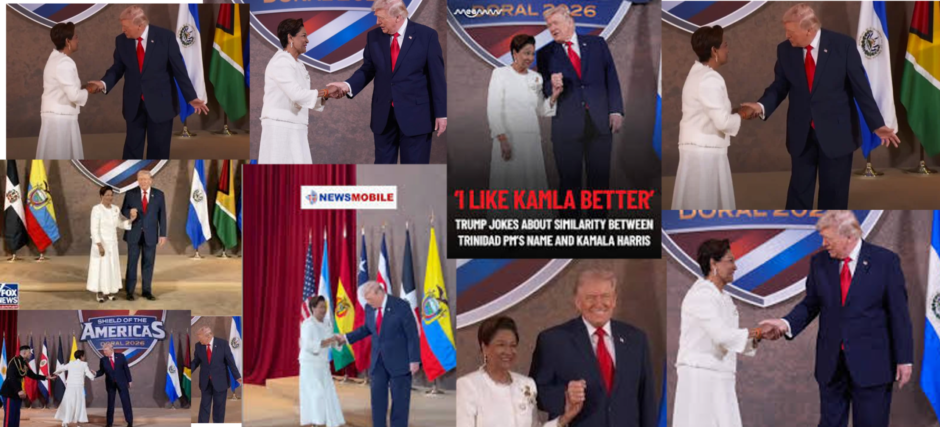
President Dr Mohamed Irfaan Ali is set to represent Guyana at the historic “Shield of the Americas” Summit hosted by United States President Donald Trump in Doral City, Florida, on March 7. The summit brings together heads of state from 12 countries across Latin America and the Caribbean to strengthen cooperation on security, migration and the war on drug cartels.
President Ali and Trinidad and Tobago Prime Minister Kamla Persad-Bissessar are the only two Caribbean leaders attending the event. Leaders from Argentina, Bolivia, Chile, Costa Rica, the Dominican Republic, Ecuador, El Salvador, Honduras, Panama and Paraguay are among those expected to attend.White House press secretary Karoline Leavitt has said that the summit is intended to strengthen cooperation among governments and to address common regional challenges.
Guyana to lead Caribbean economic growth, despite declining oil price
27 February 202
Guyana is forecast to lead the Caribbean’s sub-regional growth in Latin America and the Caribbean, although the price of crude is projected to decline to an average of US$60 per barrel, according to the World Bank. The just-published flagship report titled “Global Economic Prospects” says in the Caribbean, subregional growth is set to increase to 5.2 percent in 2026 and 6.6 percent in 2027, “driven by Guyana’s ongoing oil boom.” Excluding Guyana, the subregion is projected to grow by about 2.9 percent in 2026 and 3.7 percent in 2027, supported by tourism and related services.
The World Bank says oil prices are expected to decline from an average of US$69 per barrel in 2025 to US$60 per barrel this year. The Guyana government estimates the price would be US$59 per barrel, and domestically, overall growth is projected to be 16.2 percent, and growth in the non-oil economy is projected to be 10.8 percent.
The bank attributed declining oil prices to weakening of global trade and a slowdown in some major economies are also expected to weigh on demand for energy and industrial commodities. Crude oil prices, that international financial institution (IFI) says, are projected to fall as demand softens and the Organisation of the Petroleum Exporting Countries and other affiliated oil producers (OPEC+) boost crude oil supply, with oil markets envisaged to face a substantial excess of supply to outpace demand.
The World Bank also says prices of industrial metals are set to be cushioned somewhat by green energy demand, partly offsetting muted growth of industrial and manufacturing activity. The report also says global oil consumption is expected to grow by about 0.7 million barrels per day (year-on-year) in 2026—roughly the same pace as last year and about half of the pre-pandemic average.
Taken together with increased OPEC+ oil production in 2025 and United States shale, oil markets are anticipated to experience growing imbalances over 2026, with substantial excess supply.
Touching on neighbouring Venezuela, the World Bank says it is too early to assess the macroeconomic implications of recent events there. Since the US’ military’s ousting of President Nicolás Maduro in early January, the American government has been directing much of Venezuela’s oil sales at market prices. Relevant laws have been amended aimed at making Venezuela a friendly investment climate for major oil companies to again potentially invest billions 0f dollars in the coming years.
Earlier , US Secretary of State Marco Rubio told Caribbean Community (CARICOM) leaders that Venezuela was now using its oil revenues to pump into government payroll and improve health care. Mr Rubio also envisages Venezuela playing an important role in Caribbean energy security.
Gimenez clashes with Jamaica leader over Cuba at CARICOM
Miami Herald, February 26, 2026 from Saint Kitt and Nevis
As leaders arrived here to placards urging them “not to forget Cuba”, they were caught between mounting pressure from the USA over ties to Havana and constituents who relied on Cuban doctors and scholarships to build healthcare systems and professional careers.
So when Jamaica Prime Minister Andrew Holness took the podium on Tuesday, he was navigating not just a room where some governments are outspoken defenders of Cuba, but a region acutely aware of shifting geopolitical headwinds.
“We must address the situation in Cuba with clarity and courage,” Holness said, setting the tone ahead of a visit by U.S. Secretary of State Rubio, whose presence was welcomed but prompted unease among the heads of governments of the CARICOM holding its annual meeting.
Holness noted Cuba is their neighbor, and its doctors and teachers are embedded in the region. “But today, the Cuban people face severe economic hardship, energy shortages, and growing humanitarian strain. A prolonged crisis in Cuba will not remain confined to Cuba. It will affect migration, security and economic stability across the Caribbean basin. It is therefore important that we carefully consider this matter and take collective action.”
That suffering serves no one, least of all Jamaica, close to two countries facing the region’s most volatile crises: Cuba and Haiti. Making clear Jamaica supports democracy in Cuba,
Holness’ measured tone, which sought to balance the U.S. and Caribbean concerns, did not go far enough for Miami Republican Rep. Carlos Giménez, accusing Holness and his Jamaica Labor Party of covering up for a “moribund dictatorship” as he condemned the prime minister’s statement.
Giménez found it “lamentable that the JLP would cover up for the moribund dictatorship in #Cuba, when the Castro regime repeatedly intervened in #Jamaica’s politics to exacerbate partisan tensions & undermine the JLP! Jamaica will face the consequences.”
Chief of staff, Rey Anthony, defended the congressman’s position, meant “to highlight the contrast between the prime minister of Jamaica’s speech and that of the prime minister of Trinidad and Tobago, who did not mince words when it came to the regime.
Tthe congressman had tweeted congratulations to the prime minister of Trinidad and Tobago “for her strong stance, both against Venezuela and Cuba.”
Trinidad & Tobago PM Kamla Persad-Bissessar also addressed the opening ceremony.
Giménez wanted to “draw a contrast between those two positions and highlight the one that you know we encourage.”
Holness said that his speech made clear where Jamaica stood on Cuba, and how Caribbean leaders could facilitate a transition as U.S-Cuba talks get under way. Now was not the time for rhetoric, Holness said,
“but for responsible statecraft, even as we encourage humanitarian relief.
“Jamaica stands firmly for democracy, human rights, political accountability and open, market-based economies. We do not believe that long-term stability can exist where economic freedom is constrained and political participation is limited. Sustainable prosperity requires openness to ideas, to enterprise, to investment, and to the will of the people.”
https://www.miamiherald.com/news/nation-world/world/americas/article314849622.html#storylink=cpy
RADAR REMOVAL
US aircraft in Tobago for high-tech equipment
March 18, 2026
ON THE TARMAC: A US military aircraft arrived in Tobago before noon yesterday to collect the military radar at the Airport. American personnel were seen disembarking.
A US military aircraft landed in Tobago yesterday to reportedly transport the US-installed AN-TPS-80 Ground/Air Task Oriented Task Radar (G/ATOR) from the island.
The US Marine Corps KC-130J, originated from Roosevelt Roads in Puerto Rico and returned there after its visit to Tobago.The powerful air defence system disappeared from the spot it formerly occupied at the ANR Robinson International Airport this week, 4 months after the US warships entered the Caribbean Sea and began a campaign of boat strikes preceding the ouster of Nicolas Maduro on 3 January.
Trinidad and Tobago Government spent the last four months explaining its presence as a counter drug trafficking effort, installed at the request of Prime Minister Kamla Persad-Bissessar.
As international media reports US surveillance and communication losses amid the brewing Middle-East conflict, former military commander and head of the marine National Coastal Surveillance Radar Centre, Lt Norman Dindial, says he believes the system has been repositioned by the US, to support its ongoing war in Iran. He believed the radar’s movement is evidence that the system was never placed on the island, to do as the government claimed.
“It shows that it was not supposed to be used or was not used for drug interdiction or finding drug boats. We know what the radar is and its capability. It is a $50 million piece of equipment in our territory doing nothing. It has already concluded its mission and that mission, I believe, was to help with the incursion in Venezuela.”
Late last November, open-source intelligence trackers identified the military equipment at the Tobago airport amid a succession of US military flights to the island and following a high-profile meeting between Prime Minister Kamla Persad-Bissessar and General Dan Caine, chairman of the US Joint Chiefs of Staff.
In the lead up to Operation Absolute Resolve, the government’s explanation of the system’s location miles off Venezuela’s northern coast evolved in real time, from a vague acknowledgement of the US presence, to a full-throated defence from Persad-Bissessar, who claimed that the country’s existing radar system had been compromised and that the US radar would contribute to the safety of the country’s seas and skies.
“It shows that it was really never here for drug and maritime purposes. It goes to show you that the credibility has taken a nosedive from the story they are trying to spin that they requested this radar and knowing it was not for that, having the police service saying it used the radar to find drugs in the Caroni Swamp, which it cannot do,” Dindial said.
As US Operation Epic Fury, in conjunction with Israeli forces, seeks regime change in Iran, it was likely that the radar had been moved to strengthen assets in the Gulf.
“At present the Iranians have taken out all the sensors…There is a gap in the sensory aspect over there and the US military is repositioning its assets. That air defence system they had in South Korea has been repositioned into Jordan right now to help with the counterfire mechanisms.
You have this radar doing absolutely nothing and the US has already spent millions on this war in Iran. This radar we had was mobile and could be dismantled and transported and reassembled easily,” he said.
The New York Times reported that Iranian strikes had damaged communication and radar systems on at least seven US military sites across the middle east. Analysing satellite images, the Times said damage on or close to mechanisms used to track incoming ballistic missiles, satellite dishes and radomes had been noted.
“The targeted locations appear to indicate Iran was aiming to disrupt the U.S. military’s ability to communicate and coordinate. Iran attacked the U.S. military’s communication capacity last June, when it struck a Qatari base it hit again over the weekend. Strikes potentially affecting these systems also occurred on US military facilities in Bahrain, Kuwait, Saudi Arabia and the United Arab Emirates.”
The G/ATOR was first seen in Tobago in late November, days after Chairman of the US Joint Chiefs of Staff, General Dan Caine, travelled from Washington to the US Southern Command military build-up, and to Port of Spain. In the aftermath of that visit, at least five US military aircraft were seen making their way to and from the ANR International Airport, including US Air Force Boeing C-17A Globemaster III, and Lockheed Martin C-130J Super Hercules aircraft. The aircraft appeared, according to flight tracking data, to originate from the US Marine Corps Air Station in Cherry Point, North Carolina.
As the flights were publicised, Prime Minister Kamla Persad-Bissessar was asked about the US presence and noted that US Marines were in Tobago to help with “a roadway and install a radar. In December, the Prime Minister siad she had personally made a request to the US Embassy for a US-supplied radar as a “temporary solution” for the country’s poor surveillance capability. She denied that the US placed the system in Tobago to monitor escalating tensions with Venezuela, prior to Maduro’s ouster.
By Mid-December the Trinidad and Tobago Police Service (TTPS) claimed that the system had generated intelligence that led to a coordinated overnight operation at the Caroni Swamp, during which $171 million in “creepy” marijuana was seized. It offered no details on how the radar was used to provide this intelligence. No arrests were made after the seizure.
A representative from manufacturer Northrop Grumman said the radar was not designed to track “maritime or ground targets” but helps in identifying and destroying a target.
In January, Minister of Defence Wayne Sturge claimed that the drug flow to the country had been slowed, as a result of the installation. Sturge later said the radar would be used for the “foreseeable future. I can’t give a definitive timeline. And the reason why we need it, we already have a radar centre but our radar systems are somewhat limited.
“The radar system provided by the US work with drone technology and satellite communications . So it offers a lot more than what we have. And that is needed at this point to achieve certain objectives, because the Coast Guard fleet is not what it should be. So we need assistance, in terms of detection, which would help us with the limited fleet we have to respond in a timely manner and intercept.”
War in Iran, Pain in the Caribbean
March 22, 2026
Sir Ronald Sanders Ambassador of Antigua and Barbuda to the United States and the OAS, and Chancellor of the University of Guyana.
The war in the Middle East is already consuming the Western Hemisphere. Attacks in Iran and the Gulf are being justified, by some, on the grounds that Iran’s record on terrorism, nuclear ambition, and regional meddling leaves the “free world” with no choice but to act militarily.
The Sub-continent has every reason to take that record seriously. But for small, import dependent states in this hemisphere, an additional set of questions demands urgent attention:
-
- who is paying the economic and social price for this war? and
- what is it doing to the rules that are meant to protect small states?
A war fought there, a bill paid here
The conflict has already pushed up oil prices, freight rates, and insurance premiums for shipping through the Strait of Hormuz, one of the world’s most critical corridors for oil and liquefied natural gas.
For the West Indies importing most of what they consume, every additional dollar on a barrel of oil, and every extra cent on a container or tanker, quickly appears on electricity bills, food prices, and public‑transport fares.
Many states import a large share of their goods from the USA. As American producers face higher fuel, fertiliser, logistics, and financing costs, those increases are passed on in the prices of exports to Caribbean states. Our region is therefore not only directly exposed to world oil and freight markets; it is also importing US‑embedded costs in the form of more expensive food, manufactured goods and inputs.
For most countries in the Hemisphere, including the US itself, the war has meant tighter supply chains, higher shipping and war risk insurance costs. Only a narrow group of oil and gas exporters have enjoyed a short-term windfall from elevated prices.
Guyana and Trinidad and Tobago are among the few that gain higher hydrocarbon revenues, but even they remain exposed to volatility, shipping risk, and the broader slowdown that higher energy prices bring.
Security narratives and international law
Public argument over this war has been dominated by two types of narratives. One focuses on sovereignty and international law: whether one or two powerful nations may bomb another sovereign state on the basis that it might develop nuclear weapons that could one day be used against them, even without an imminent attack or a mandate from the UN Security Council.
The other is increasingly cast in ethnic and religious terms, with social media flooded by Islamophobic and sectarian rhetoric that reduces complex realities to a clash of civilisations and obscures sober discussion of law and proportionality.
The region should not turn a blind eye to Iran’s conduct. The regime’s long standing repression at home, including the grave violations of the rights of women and dissenters, and its support for armed groups and destabilising activities abroad, are matters of legitimate concern to all states, including ours. Nor should any country’s aggression against its neighbours be excused or ignored.
At the same time, arguments in some quarters, which catalogue Iran’s support for Hezbollah, Hamas and other networks in the Middle East and Latin America and then treat this as sufficient justification for open‑ended military action, raise profound concerns.
Similarly, Israel’s declared aims require scrutiny. By his own account, Prime Minister Benjamin Netanyahu does not seek only to neutralise discrete threats. He has spoken of “crushing” and “weakening” Iran’s regime, of delivering “crushing blows” to its security apparatus, and of creating “optimal conditions” for a future toppling of the regime, even as he acknowledges that actual regime change would depend on the Iranian people.
These statements point not just to self defence, but toward an effort to leave Iran substantially weakened, with long‑term implications for regional balance and for the principle that one or two powers should not decide by force, the political future of others.
Accepting the seriousness of Iran’s record, and recognising the genuine security concerns of other states, does not mean accepting that powerful states may unilaterally wage preventive war outside clear self‑defence or Security Council authorisation. For small countries, the restraints in the UN Charter on the use of force are vital; they are the first line of protection.
Fractured global and regional leadership
Institutions that should help guide global opinion have done so only partially. The UN Security Council managed to condemn specific Iranian attacks in the Gulf and urge an immediate halt to hostilities and the protection of civilians. But deep divisions among its permanent members exist. Some are simultaneously profiting from higher oil prices and easing of sanctions related to their own past violations of international law.
Regional organisations in the Americas have likewise fallen short. The Organisation of American States (OAS) has not discussed a member‑state‑negotiated position on this war and has no collective view. CARICOM issued earlier statements on Middle East escalation and some governments have spoken nationally on the latest developments but there is no unified position on the conflict equivalent to a clear, common line adopted by Heads of Government. In practice, public opinion is being shaped less by regional guidance than by global cable news and polarised social media feeds.
Caribbean countries, individually and collectively, have virtually no military leverage and limited economic power, yet they are deeply exposed to the conflict’s fallout. Tourism‑dependent economies face higher jet‑fuel costs, potential softening of travel demand, and tighter airline margins.
Import‑dependent economies confront rising energy and food prices, more expensive US‑sourced goods, and growing fiscal pressure as governments try to protect households from inflation while servicing already heavy debt burdens. For many, the war has arrived as higher bills, fragile supply chains, and renewed threats to growth and social stability.
Ideally, CARICOM should respond clearly and collectively. A unified stance could:
-
-
- defend de‑escalation and immediate ceasefire;
- insist on respect for the UN Charter’s rules on sovereignty and the use of force;
- urge protection and reopening of critical sea lanes; and
- draw attention to the disproportionate economic burden the war places on small, vulnerable states that had no say in the decision to fight.
-
In practice, such unity is unlikely. Recent developments exposed divisions within CARICOM. Some member states see the US as their principal security partner and a crucial economic lifeline in trade, investment, remittances and tourism.
Small states are acutely aware of how shifts in US visa policy, travel restrictions, and migration enforcement can affect their societies, and recent episodes of visa and travel pressure reinforced the perception that foreign‑policy choices can carry real costs. In this environment, many governments will hesitate to support any collective position.
A measured Caribbean stance
Even without full regional consensus, Caribbean states can exercise leadership by articulating a firm stance grounded in their own interests and values. Such a stance would rest on a clear defence of international law and sovereignty, opposing unlawful uses of force by any country, and insisting that concerns about security, nuclear proliferation, or terrorism be addressed, as far as possible, within the framework of the UN Charter.
It would maintain a consistent call for de‑escalation and diplomacy, prioritising ceasefire, restraint, and the resumption of negotiations on nuclear issues and regional security, while underlining the urgent need to keep vital shipping lanes open and safe.
It would insist on economic justice for vulnerable economies, showing how the consequences – such as energy price spikes, freight costs, imported inflation, and potential recessions in tourism origin markets – are hurting societies that had no voice in the decision to fight, and pressing for tailored financial support and shock‑absorbing mechanisms.
And it would reject ethnic and religious polarisation, acknowledging human‑rights abuses and security threats without embracing narratives that stigmatise entire peoples or faiths, drawing on the Caribbean’s own history to advocate for a discourse rooted in rights, law, and shared humanity.
For small states in this hemisphere, the path forward lies in principled, measured diplomacy: engaging all major actors, avoiding gratuitous offence, but speaking clearly about the need for de‑escalation, respect for the Charter, and protection of societies that are otherwise left to bear the war’s distant but very real costs.
To say nothing protects no one.
Sir Ronald Sanders Ambassador of Antigua and Barbuda to the United States and the OAS, and Chancellor of the University of Guyana.
St Vincent now CAF shareholder
…Regional small states get tailored financing
March 4, 2026
The Development Bank of Latin America and the Caribbean (CAF) approved the incorporation of St Vincent and the Grenadines as a Series C shareholder country, further extending the reach of the bank’s development financing to the Caribbean.
CAF executive president, Sergio Díaz-Granados, said, “St Vincent and the Grenadines is joining a development bank that understands the realities of Caribbean small states and the development challenges of multi-island states, in particular.
We are indeed pleased to deepen our partnership with St Vincent and the Grenadines and are committed to providing practical, tailored financing solutions so that the government can deliver on its promise to the communities in the various islands.
CAF is continuing to deepen its engagement in the region to support climate-resilient infrastructure, productive transformation, as well as sustainable and inclusive growth. We are pleased to welcome St Vincent and the Grenadines into our CAF family of shareholder countries.”
The decision to admit St Vincent and the Grenadines was taken during CAF’s board of directors meeting here, when the board also approved US$1.130 billion for new operations across the region in areas ranging from water security, citizen security, response capacity to natural disasters and debt management.
The meeting also marked Trinidad and Tobago’s handover of the chairmanship of the board of directors to Uruguay. As a result of its approval, St Vincent and the Grenadines will be able to access CAF’s agile and flexible development financing instruments, technical cooperation, and knowledge programmes designed to respond to the specific needs of small island developing states.
This latest incorporation follows recent approvals by CAF board for Dominica, St Lucia, Haiti and St Kitts and Nevis, all of which are at different stages of completing their incorporation process.CAF said these decisions reflect its continued commitment to channelling agile and flexible financing to all Caribbean Community (Caricom) countries as the bank fulfils its mandate to advance regional integration and sustainable development in Latin America and the Caribbean.
Since establishing its Regional Office in 2022, CAF has more than tripled its shareholder countries from the Caribbean.
At the same time, CAF continues to channel increased grant resources and investments across areas such as water security, energy transition, digital transformation, heritage tourism, technical and vocational education, private sector development and the blue and green economy.