Shield of the Americas Bolsters Regional Security
7 March 2026
Secretary Rubio and Special Envoy Kristi Noem deliver remarks at a working lunch at the Shield of the Americas Summit at Trump National Doral in Miami, Florida, March 7, 2026. (Official State Department photo by Freddie Everett)
On March 7, Secretary Rubio joined President Trump to welcome leaders of 13 countries committed to freedom, security and prosperity for our hemisphere. President Trump addressed the assembly, stating that their cooperation would make the countries represented at the meeting “safer, stronger, richer and more successful than ever before.”
The Secretary commended counterparts from across the hemisphere for their shared commitment to disrupting destabilizing crossborder cartel networks. “Together with our partners, the U.S. will transform the Western Hemisphere. This historic coalition of nations will work together to advance strategies that stop foreign interference in our hemisphere, criminal and narco-terrorist gangs and cartels, and illegal and mass immigration. ”
-
Marco Rubio, Secretary of State
-
Kristi Noem, Secretary of Homeland Security
-
Trump National Doral Miami Miami, Florida
March 7, 2026
SECRETARY RUBIO: I want to welcome everybody. Bienvenido. Thank you for coming and being a part of this very important initiative. It’s a critical initiative. Obviously, we start with a strong focus on security, but there is so much more here. And as you’ve seen from – so much more we can work together on, and as you’ve seen from the cabinet members that are here today.
Again, on behalf of the President – he is currently on his way to Dover Air Force Base to receive, sadly, the remains of the six Americans who lost their lives in the operation against Iranian terrorism. And so he apologizes for not being able to join us for this lunch, but he knew you would understand. But he is very excited about this initiative, and I am personally very excited to be part of this with each of you today.
It’s a top priority for us, and while there are clearly a focus on the security of the hemisphere, as you can see from the representation in our Cabinet, from Trade to Commerce to Energy to Treasury. And there is also a focus very strongly on the opportunities we have to work together economically, but you can’t have economic progress without security.
And as evidence of the President’s strong commitment to this initiative, so that this is not just going to be something where we meet one time and have conversations and we meet once a year and put out a paper, we wanted it to be an issue of action. He has appointed Secretary Noem as the special envoy dedicated to this relationship. And you will see a lot of her; she’ll be very involved with each of you at a personal level, and on a daily and weekly and monthly level, to ensure that what we talk about here today and the work we do together continues on, and we can build upon that.
So, I want to turn it over to our envoy, who will be doing this, and she’ll be running our program. And again, thank you really, truly, for joining us in this what I think is a very historic gathering of allies and friends, as I said in my comments earlier today.
SECRETARY NOEM: Well, thank you, Secretary Rubio. I appreciate all of you being here today and for making this a priority. First of all, I offer thanks to our President, who had the vision to bring all of you, as world leaders, here to have the conversation on not just protecting your countries, but also protecting your neighbors and the Shield of Americas becoming a real vision.
This is intended to be a group that works together to make sure that we’re each defending our own sovereignty, we’re each defending our own security and economic prosperity, but then also continuing to build on these relationships to ensure that we can do that in a way that’s effective, defeating the enemies that we have amongst us in the cartel organizations, which our country has designated as Foreign Terrorist Organizations.
But then also by adding that security element, we have an opportunity then to have economic prosperity that blesses all of our people.So, I do want to thank the President for creating this and for giving me the honor and the opportunity to serve as a special envoy to this region, to the Western Hemisphere. This Shield of Americas will be a powerful example to the rest of the world about what’s possible. There is nothing like this happening today anywhere else in the world, and the way that we cooperate on our shared ideals of freedom and of democracy and safety and security will be a shining light to all of those who wish to be more like all of us.
So, my background is I’m a farmer and a rancher that served in government, in Congress, as governor, and then as Secretary of Homeland Security. In the last year as Secretary of Homeland Security, we have focused on securing our border. We have transformed our country from one that was being invaded by enemies, millions of them that were coming in unvetted, that we didn’t know who was there and who wished to harm us.
We’ve secured that border. We’ve focused on removing public safety threats. And over three million people have been deported or removed from our country in the last year.Secure borders has changed everything for our country. It’s allowed us an opportunity to focus on business and investment relationships with other countries and has ended the crisis that our country was going through in the years previous to President Trump’s leadership.
So that is something that we recognize, that now that America is secure and our borders are secure, that we want to focus on our neighbors and to help our neighbors with their borders and challenges that they have, so that they may have the security that we enjoy.
I’ve looked forward to meeting many of you. Many of you I’ve met throughout the last year and spent time with. I know President Bukele was probably, I think, the first world leader I had the chance to visit with. We partnered on security in El Salvador and appreciate the way he’s brought peace to El Salvador and prosperity is following. That’s been a great example.
Also went to Chile and spent some time and enjoyed that as well. We focused on – under the Department of Homeland Security, we have cybersecurity operations and experts, and we worked there with embedding some cybersecurity experts and have that opportunity to continue to build on that if that’s some of the challenges that you may have.
I spent some time in Argentina with President Milei as well and appreciated his focus on economic prosperity and how we could work together on that.
And of course, Ecuador has been very strong partners with all of us. We’ve worked on not just security and fighting cartels but also making sure the drug trafficking is being addressed and we can build those relationships.
I’ve been in many of your other countries working with your presidents and leaders and hope to continue to build on that so that we could have candid conversations about what to do in the future.
Our objectives are going to be to destroy the cartels, to go after these narcoterrorists that are destroying our people, killing our children and our grandchildren. We’re also going to keep our adversaries at bay. Those adversaries that wish to change our way of life and our values that are outside of our hemisphere, we want to ensure that we’re continuing to keep them out of our hemisphere and focus on building alliances amongst ourselves and our strengths.
We have worked and are proud of the Department of War with the conference that many of you just attended the last few days, and we’ll continue to do that. We want our hemisphere to be safer, to be more sovereign, and to be more prosperous, and looking forward to working with you on all of that.
The first objective will be not just on sovereignty but also migration control, that we will work on economic prosperity. We’ll have and – reverse these harmful foreign influences that have come into many of our businesses, our technologies, and we’ve seen infiltrate different areas of our way of life.
That will be my objective every day. I will, when the press leaves, give you all my personal cell phone number so that you can reach me at any time that you may need something, and we’ll work together to continue to make sure that our relationship is a shield to the Americas, that this will be a Western Hemisphere that is better, safer, more prosperous, and more free because of the leadership that all of you provide.
So, thank you to Secretary Rubio for hosting this and having the vision to bring us all together. I think this will be something that for years to come will bring more security to our nations.
SECRETARY RUBIO: All right. Well, thank you.
US formalizes recognition of Delcy Rodríguez as Venezuela’s authority
March 12th 2026
Before a federal court in New York , the U.S. government formally recognized Delcy Rodríguez as the Venezuelan authority empowered to act on behalf of the state, giving legal effect to the diplomatic shift toward Caracas announced last week.
The move appears in a “statement of interest” filed on March 10 in response to a court order on who legally represents Venezuela in ongoing litigation in U.S. courts. According to the documentation, the filing relies on a letter signed by State Department official Michael G. Kozak and says Washington recognizes Rodríguez as the “sole” head of state capable of acting for Venezuela in those proceedings.
The step does not amount to an election or unconditional backing but it does establish the US government’s official position for judicial purposes in civil and criminal cases involving the Venezuelan state and assets tied to PDVSA.
Days after Washington and Caracas announced the restoration of diplomatic and consular relations, which had been broken since 2019, the State Department said the aim was to support a peaceful transition toward a democratically elected government while encouraging political reconciliation, stability and economic recovery.
The new channel opened after Maduro’s ouster in January and Rodríguez’s subsequent installation as interim president. The political groundwork for this shift had been developing since early March. Rodríguez, already acting as interim president, had defended “diplomatic dialogue” with Washington after the relaunch of bilateral ties.
That marked a contrast with the earlier U.S. stance: since 2019, Washington had rejected Maduro’s legitimacy and for a period recognized Juan Guaidó as interim president before shifting to backing the 2015-elected National Assembly as the last democratic institution still standing.
The immediate reach of the recognition is primarily legal. In U.S. courts, determining who speaks for a foreign state decides who can appoint lawyers, answer lawsuits, defend assets and take procedural decisions. The filing in New York therefore strengthens Rodríguez’s camp in representing Venezuela in ongoing U.S. litigation, a particularly sensitive issue in cases involving sanctions, human rights claims, terrorism and state-owned assets.
The move, however, does not settle the wider controversy. Washington’s broader strategy combined engagement with Rodríguez and legal pressure on her circle, including a draft corruption and money-laundering indictment used as leverage.
That dual track suggests the recognition is not full normalization or political endorsement, but a pragmatic arrangement to manage the transition and the legal and diplomatic interests of both countries.
Chevron, Shell near first big oil production deals in Venezuela since Maduro’s capture
Mar. 10, 2026 By: Carl Surran, SA News Editore
Chevron and Shell are close to securing the first big oil production deals with Venezuela since the U.S. capture of President Maduro in January.
1.) Chevron and Venezuela’s energy authorities agreed on preliminary terms to expand the company’s largest oil project, Petropiar, in the Orinoco Belt. The deal would give Chevron the rights to produce from the Ayacucho 8 area located south of the Petropiar area, a large block with proven oil resources, and would allow the company to make a substantial increase in the extra-heavy oil it produces and exports, the report said. Chevron wants to secure a reduced royalty rate for the new area and other tax and trade incentives offered to companies under Venezuela’s new legislation to develop greenfield oil and gas areas, according to the report.
Chevron and state-owned PDVSA produced ~90K bbl/day of upgraded Hamaca crude and 20K bbl/day of vacuum gasoil at Petropiar last month, Reuters said, citing a PDVSA document. The project could turn Chevron into the biggest private producer in Orinoco, which holds more than 75% of Venezuela’s total crude reserves.
2.) Shell signed preliminary oil and gas deals with Venezuela last week; the details were not made public, but Reuters said the company aims to develop the Carito and Pirital fields in the coveted Monagas North region, which are among the few areas in the country that can produce light and medium crude and natural gas. The Punta de Mata area, which includes Pirital, Carito, and the nearby El Furrial field, produced 94K bbl/day of crude and 1.03B cf/day of gas last month, the report said.
SHELL SIGNS EXPLORATION AGREEMENTS IN VENEZUELA
March 6, 2026
As energy barrels continued their record roll, Shell signed agreements with the Venezuelan government covering onshore and offshore exploration for oil and natural gas, after a meeting between Venezuelan Interim President Delcy Rodriguez and US Interior Secretary Doug Burgum earlier this week. They are expected to pave the way for development of the offshore Dragon gas project, which suffered setbacks in recent years amid shifts in US policy and sanctions. Venezuela’s legislature passed a package of reforms in January 2026 aimed at boosting investment in the oil and gas sector.
The Dragon field lies in Venezuelan waters near the maritime border with Trinidad and Tobago and is estimated to hold reserves of up to 99.1 bcm (3.5 tcf) of gas. The project is expected to supply Trinidad’s Atlantic LNG facility, which has been producing at below nameplate capacity due to gas shortages and plans to begin decommissioning Train 1 in Q4 2026.
Along with BP, Shell owns equity in Trains 2, 3 and 4 at the plant, which together contribute approximately 5.5 million tonnes per year of liquefaction capacity in each company’s portfolio. Both companies supply feed gas to the facility and receive tolling revenues from the project. Energy Minister Roodal Moonilal said on Thursday that gas exports from the Dragon field to Trinidad are scheduled to begin in Q3 2027.
Shell signs oil and gas exploration deals with Venezuela
March 5: Carl Surran, SA News Editor
Shell signed agreements with Venezuela’s government that span offshore natural gas and onshore oil and gas opportunities.
Shell also signed technical and commercial agreements with Venezuelan engineering company VEPICA, with KBR and Baker Hughes. Venezuelan state channel TV FANB said the new agreements “reaffirm that Venezuela continues to be a safe and reliable destination for foreign investment.”
Shell’s long-running Dragon offshore gas project in Venezuela suffered setbacks in recent years as U.S. policy toward Venezuela grew more hostile; in February, the company said oil and gas exploration licences issued by the U.S. would allow it to proceed with the project.
Venezuela’s Rodriguez appoints Paula Henao as oil minister
March 12, 2026 Arundhati Sarkar SA News Editor
Venezuela’s acting president, Delcy Rodríguez, appointed a new hydrocarbons minister as the U.S. steers the oil sector recovery under a new energy law following the ouster of Nicolás Maduro.
She named oil engineer Paula Henao to replace her as head of the ministry. Rodríguez managed the ministry for less than two years as vice- president before becoming interim president in January.
The changes are aimed at boosting oil and gas output and foreign investment following a $100 billion reconstruction plan for the industry proposed by Trump shortly after Maduro’s arrest. The development comes as majors Chevron and Shell are reportedly close to securing big oil production deals with Venezuela, home to the largest proven oil reserves.
Exxon ‘interested in going back’ to Venezuela if conditions are right
March 03, 2026: Carl Surran, SA News Editor
Exxon Mobil expects to send a technical team to Venezuela in a few weeks after working through logistical and security arrangements, and the company could be “interested in going back” if the right investment terms are in place, Senior VP Jack Williams said Tuesday.
Reuters reported.“We know the resource pretty well. We had a very successful operation there,” Williams told the Morgan Stanley Energy & Power Conference in New York, referring to the company’s 2007 expropriation of its assets in the country.
Exxon improved its technology for working with heavy oil resources over the years since leaving Venezuela, “so I think we can do even better than we were before, in terms of the technology toolkit that we can bring.”
The company’s vast scale and geographical footprint provide a buffer against any operational disruptions from the conflict in the Middle East.
“We have assets all over the world. We have upstream, downstream, we have a big trading operation, we operate a large long-term charter fleet, so we can move feed and we can move products around the world to optimize around this situation,” Williams said, adding that oil and LNG markets are “very well supplied,” providing some support.
Exxon has the most exposure among the oil majors to Qatar’s suspension of liquefied natural gas exports, RBC analyst Biraj Borkhataria said Tuesday in a note.
US eases Venezuela sanctions to boost world oil supply with optimal speed
2026, 03/18
US companies will be allowed to do business with Venezuelan state-owned oil and gas company after the Treasury Department eased sanctions, with some limitations, on Wednesday. The Treasury issued a broad authorization allowing Petróleos de Venezuela S.A, PDVSA, to directly sell Venezuelan oil to U.S. companies and on global markets, a massive shift after Washington for years largely blocked dealings with Venezuela’s government and its oil sector.
The White House said Trump would waive, for 60 days, Jones Act requirements for goods shipped between U.S. ports to be moved on U.S.-flagged vessels. The 1920s law, designed to protect the American shipbuilding sector, is often blamed for making gas more expensive. The waiver highlights the increased pressure on the US administration to ease soaring oil prices as the USA, with Israel, wages war with Iran without a foreseeable end date. Global oil prices have since spiked as Iran halted traffic through the narrow Strait of Hormuz, a critical thoroughfare for one-fifth of the world’s oil from the Persian Gulf to customers worldwide.
The Treasury licence is designed to incentivize new investment in Venezuela’s energy sector and is intended to benefit both the USA and Venezuela, while boosting the global oil supply.
Since the ouster and arrest of Nicolás Maduro during a U.S. military operation in January, President Trump has said the U.S. would effectively “run” Venezuela and sell its oil.
The U.S. licence provides targeted relief from sanctions but does not lift the penalties altogether. The licence allows companies that existed before January. 29, 2025, to buy Venezuelan oil and engage in transactions that would normally be banned under American sanctions, reopening trade for a major oil producer to global markets. There are some limits.
Payments cannot go directly to sanctioned Venezuelan entities such as PDVSA, but must be sent instead to a special U.S.-controlled account. In other words, the U.S. will allow the oil trade but will control the cash flow.
Deals involving Russia, Iran, North Korea, Cuba and some PRC entities are not allowed.
Transactions involving Venezuelan debt or bonds are not allowed.
The licence is expected to give a massive boost to Venezuela’s oil-dependent economy and encourage companies that have been apprehensive to invest. The decision is part of the US administration’s phased-in plan to turn around Venezuela.
Critics of the acting Venezuelan government argue that the move rewards Venezuela’s leadership -– all loyal to Maduro and the ruling party -– while repression, corruption and human rights abuses continue.
Many public sector workers survive on $160 per month, while the average private sector employee earned about $237 last year, when the annual inflation rate soared to 475%, according to Venezuela’s central bank, and sent the cost of food beyond what many can afford.
With 20% of world oil reserves, the largest, Venezuela powered what was once Latin America’s strongest economy. Corruption, mismanagement and US economic sanctions drove a structural decline in production from 3.5 million barrels per day pumped in 1999, when Maduro’s mentor, Hugo Chávez, took power, to less than 400,000 barrels per day in 2020, rising to 966,000 bpd in 2025.
The US Treasury Department under the first Trump administration locked Venezuela out of world oil markets when it sanctioned PDVSA as part of a policy punishing Maduro’s regime for corrupt, anti-democratic and criminal activities. That forced the government to sell its remaining oil output at a discount , about 40% below market prices, to buyers in PRC and other Asian markets. Venezuela started accepting payments in Russian rubles, bartered goods or cryptocurrency.
The new licence does not allow payments in gold or cryptocurrency, including the petro, which was a crypto token issued by the Venezuelan government in 2018.
As the US administration seeks ways to boost world oil supplies during the Middle East war, the White House said the Jones Act waiver would “mitigate the short-term disruptions to the oil market” and “allow vital resources of oil, natural gas, fertilizer and coal to flow freely to U.S. ports.”
WASHINGTON (AP)Courtesy Fugro
Rodríguez reforms Venezuelan military leadership
March 20th 2026
Venezuela’s acting president, Delcy Rodríguez, executed a sweeping restructuring of the National Bolivarian Armed Forces (FANB) leadership. The changes, announced less than 24 hours after the appointment of Gustavo González López as the new Defense Minister replacing the veteran Vladímir Padrino, mark a significant shift in Caracas’ power structure following months of institutional attrition.
New strategic leadership The most significant overhaul takes place at the Strategic Operational Command (CEOFANB), the military’s main operational body. Rafael Prieto Martínez assumes leadership, replacing Domingo Hernández Lárez, who held the position since 2021. Prieto, who previously commanded the military structure of the Guayana mining and border region, will be accompanied by Jesús Villamizar as second-in-command.
Ruben Darío Belzares was appointed commander of the Army; Royman Hernández Briceño, of the Aviation; Jorge Agüero, of the Navy; Juan Sulbarán, of the Bolivarian National Guard, and Nayade Lockiby Belmonte will lead the Militia.
Internal pressure and geopolitical context: The outgoing leadership faced severe internal criticism following the unprecedented US military intervention which culminated in the capture of Nicolás Maduro.
International analysts believe inability of the top brass to repel the raid coupled with Padrino’s nearly 12-year tenure at the ministry, generated widespread unrest among the ranks. The reshuffle follows the surprise visit to Caracas by the head of the US Southern Command, General Francis Donovan. Amid a transitional landscape, the restructuring driven by Rodríguez and González López seeks to reconfigure operational control over an Armed Forces compelled to adapt to the new political realities.
Rodríguez pledges legal certainty to investors while Machado attends CERA Week
Thursday, March 26th 2026
Rodríguez’s appearance came one day before Nicolás Maduro’s hearing at a New York court
Venezuela’s interim president, Delcy Rodríguez, participated via videoconference on Wednesday at the FII Priority investment forum in Miami, where she assured American, Saudi, and Latin American investors that her government is advancing reforms to guarantee “legal certainty” for investments in the country.
“It is important that investors know that, regardless of political transitions or restrictive contexts, there are laws in Venezuela that allow a serious return on their investments,” Rodríguez said from Caracas.
She highlighted an ongoing reform process aimed at diversifying the economy beyond hydrocarbons, with growth in sectors such as construction, banking, mining, and manufacturing.
Rodríguez cited the recently enacted hydrocarbons law and the introduction of national and international arbitration mechanisms for dispute resolution. She directed a message to President Donald Trump, expressing gratitude for both governments’ willingness to build a constructive bilateral diplomatic agenda after years of strained relations.
Rodríguez’s appearance came one day before Nicolás Maduro’s hearing at a New York court, where he is on trial after the United States captured him on January 3. Rodríguez made no reference to the circumstances of her rise to power following the U.S operation.
A Venezuelan diplomatic delegation led by Félix Plasencia will travel to Washington to establish a permanent presence. He will serve as the counterpart to U.S. envoy Laura Dogu, who has been stationed in Caracas for nearly two months.
The FII Priority forum, the “Davos of the desert,” backed by Saudi Arabia’s sovereign wealth fund expects President Trump’s participation on Friday.
Opposition leader María Corina Machado spoke from Houston at the CERAWeek energy conference, where she courted investors and pledged that Venezuela would honor its contracts if “fair and free” presidential elections are held. Machado proposed creating an independent body to manage hydrocarbons without state intervention.
Eni working on joint venture opportunities to develop Venezuela oilfields
Italian major has interest in two oil licences in Latin American crude-rich country
Davide Ghilotti Breaking News Editor 26 February 2026
Eni is exploring joint venture opportunities to boost oil production in Venezuela, chief executive Claudio Descalzi told analysts on Thursday.
US-Venezuela relations
March 5
The United States and Venezuela’s interim authorities agreed to re-establish diplomatic and consular relations.
This step will facilitate joint efforts to promote stability, support economic recovery, and advance political reconciliation in Venezuela. Engagement is focused on helping the Venezuelan people move forward through a phased process that creates the conditions for a peaceful transition to a democratically elected government.
The United States remains committed to supporting the Venezuelan people and working with partners across the region to advance stability and prosperity.
US highlights Venezuela’s mineral wealth
March 4th 2026
US Interior Secretary Doug Burgum said that opportunities for cooperation between Washington and Venezuela “have no limits,” during a visit in Caracas focused on mining and access to critical minerals. Burgum met acting President Delcy Rodríguez and US representative in Venezuela Laura Dogu at Miraflores palace, as Venezuela’s National Assembly prepares a reform of the main mining law in force since 1999.
Highlighting the petrostate’s mineral potential, the agenda included contacts with executives from foreign mining companies and discussions around supply chains for critical minerals used across technology and energy industries.
Burgum said US mining-related companies are “eager” to begin operating in Venezuela and underscored its “mineral riches. The opportunities for collaboration and synergy… have no limits.”
The proposal includes provisions allowing foreign firms to exploit gold, diamonds and rare earths, as part of an effort to attract investment and provide greater regulatory certainty. Rodríguez urged accelerating the reform, aimed at broadening the legal framework to develop the sector with domestic and foreign capital.
Washington seeks to expand US investment in Venezuela mainly in oil, gas and minerals — after the US ouster of Nicolás Maduro in January and Rodríguez’s subsequent rise as interim leader. In that context, Rodríguez publicly thanked President Trump for his willingness to work on a bilateral agenda and cited a message from the US president: “Oil is starting to flow.”
Burgum is expected to meet oil and gas companies on Thursday to discuss expansion and investment projects.
Venezuela to grant Repsol and Chevron more exploration and production blocks
February 28, 2026
Venezuela plans to grant more oil exploration and production blocks to Repsol and Chevron to help foreign operators rebuild the its energy sector.
Officials in Caracas are ready to award the new blocks. The aim would be to give US and European companies greater access to vast reserves to revitalize an industry that deteriorated over the last decade and reduce the influence of PRC China and Russia.
Venezuela’s National Assembly approved reforms to the hydrocarbons law in January 2026, granting private firms, including foreign companies, more autonomy and control over oil projects. Some oil majors remain cautious, citing unpaid debts, past nationalizations and political uncertainty despite vast reserves.
The US administration issued licences allowing a select group of Western energy companies to resume oil and gas operations in Venezuela, marking a significant shift in sanctions policy as Washington seeks to revive the oil-dependent economy. The permits authorize bp, Chevron, Eni, Repsol and Shell to engage in transactions with state-run Petróleos de Venezuela SA (PDVSA) under contracts governed by US law and reviewed every 90 days.
Chevron, operating under a restricted licence, will be allowed to expand its footprint. Other firms had permissions revoked as pressure mounted on Caracas. Some key developments and companies involved are:
- Chevron Corp: As the only major US company currently pumping oil in Venezuela, Chevron is expanding its operations, including five onshore and offshore projects and is expected to receive new, more productive oil blocks.
- Repsol SA and Eni SpA: The Europeans hold significant interests particularly the Cardon IV joint venture, a major offshore gas project (Perla field).
- Shell and bp: The UK companies are authorized to operate in Venezuela and are engaged in plans to develop the offshore Dragon gas field.
Despite these developments, the sector faces challenges due to years of underinvestment, dilapidated infrastructure, and an uncertain operating environment, with experts projecting that full recovery will take several years.
Venezuela cancels Halliburton asset sale after US intervention to support oil sector restart
February 27, 2026 Bloomberg
Venezuela cancelled an auction of assets seized from Halliburton Co. after the US administration intervened to stop the sale, as President Donald Trump seeks to smooth the return of US oil companies to the OPEC founder. US authorities pressed Venezuela to cancel the auction after Halliburton met and raised the issue with Trump in January. The action is expected to clear the path for the Houston-based company’s return to Venezuela where Trump seeks to lift oil output.
The President and his team are working closely with the interim government to restore Venezuela’s oil industry to benefit the American and Venezuelan people.
Halliburton shut down its primary operations in Venezuela in 2020 after the US tightened sanctions on the regime. Local workers filed a suit against the company the following year seeking unpaid benefits. In December, a Venezuelan court ordered the sale of equipment, including trucks, power plants, forklifts, haulers, loaders, tower lights and cranes, valued at nearly $6.6 million, according to a notice in a national newspaper. Halliburton then filed a lawsuit against Venezuela at the World Bank’s international arbitration court.
U.S. Energy Secretary Chris Wright traveled to Venezuela earlier this month and met acting President Delcy Rodriguez. “We spoke very candidly today about the tremendous opportunities in front of us and some of the problems and challenges, and we committed to work together and move ahead to solve them,” Wright said.
In the same week, a Halliburton team visited facilities in Zulia and Monagas states, where they hold assets still under their control. Chief Executive Officer Jeff Miller said last month the company was ready to quickly restart work once it obtained U.S. government approval and payment protections.
“I’m excited about the tremendous opportunity for Halliburton in Venezuela,” Miller told investors during a conference call. “We can mobilize in weeks.”
PDVSA, African Energy Chamber sign MoU to boost oil and gas investment
February 27, 2026
Venezuela’s state oil company PDVSA and the Ministry of Hydrocarbons signed a memorandum of understanding with the African Energy Chamber (AEC) aimed at strengthening cooperation and investment across the oil and gas value chain.
The agreement, signed in Caracas during a working visit by AEC representatives, establishes a framework for collaboration in upstream development, refining, technical training and joint investment promotion. Under the MoU, the parties will explore joint studies on crude and natural gas market dynamics, share technical expertise in exploration and production and evaluate opportunities in refining, infrastructure rehabilitation and commercialization.
The agreement also calls for exchanges on regulatory best practices and coordinated outreach activities, including seminars and training programs. A joint working group will be formed within 60 days to define work plans, identify specific projects and oversee implementation. Focus areas are expected to include exploration, commercialization and technical capacity building. The agreement reflects Venezuela’s efforts to broaden international energy engagement as it seeks to stabilize and expand hydrocarbon production, while the AEC positions the partnership within South–South energy cooperation.
With talks underway with Havana, Trump touts a “friendly takeover” of Cuba
Friday, February 27th 2026 –
U.S. President Donald Trump said on Friday that his administration is holding talks with Cuba and suggested the process could lead to a potential “friendly takeover” of the island, portraying Havana as facing acute economic and supply strains.
“Maybe we’ll have a friendly takeover of Cuba,” Trump told reporters,adding that Secretary of State Marco Rubio is managing the contacts “at a very high level,” according to Reuters.
The remarks came amid heightened bilateral tensions after a maritime incident off Cuba which said a Florida-registered speedboat carrying 10 people sought to infiltrate the country and exchanged fire with Cuban forces; four were killed and six wounded.
Trump framed the moment as potentially involving economic bargaining and domestic political interests. He argued that a deal could be “very positive” for Cuban exiles in the US who want to return to the island, a key constituency in Florida. Trump emphasized Cuba “has no money” and is “in big trouble,” saying the country wants U.S. help.
In parallel, Washington has tightened energy-related pressure on Cuba. The White House published an executive order on Jan. 29 declaring a national emergency with respect to Cuba and authorizing trade measures tied to oil supplies from third countries, as part of what the administration frames as a national-security approach.
Havana has not publicly confirmed the scope of direct talks with the Trump administration. The speedboat episode and Trump’s comments add uncertainty over the near-term direction of U.S.-Cuba relations as Cuba faces fuel constraints and a prolonged economic downturn.
T&T continues business with Cuba
2026, 03/01
Despite Cuba’s economic difficulties, Trinidad and Tobago Manufacturers Association continues to include the Spanish-speaking Caribbean island as a potential market of 11 million people for trade with T&T. Over recent decades as Cuba opened a mixed economy, business and trade ties between Cuba and T&T have grown. despite a 64-year-old trade embargo, inflation, shortages and electricity blackouts .
T&T’s private sector continues to show interest beyond short-term challenges to longer term goals.
TTMA members view Cuba as a country of opportunities.
“Some of these companies are working with private entities in Cuba, so payment challenges are not common; most companies engage in cash payment in advance to avoid payment problems. Economic challenges will have a domino/rippling effect. Thankfully thus far, the few companies that trade with Cuba continue to do so at this time. However, it is anticipated that if the situation worsens, the trade is likely to be impacted,”
“With regard to Cuba being a country to do business with, someTTMA members continue to seek out opportunities for themselves, and Cuba is an attractive market (11 million and over 2-3 million tourists per annum). There are challenges dealing with the government, the major purchaser, namely, US currency availability, they want long credit time etc. Trading with the private sector, which has been happening more and more in the recent past, is the better option. But the Government is the largest purchaser, so tapping into that market is lucrative. However, you have to get over the challenges . Having Republic Bank there helps, but is not a panacea for all the problems. And of course, the Helms-Burton Act remains a problem.”
In June 2025, the TTMA posted photos of a visit by a business delegation from Cuba, which the TTMA described as a fruitful meeting. to strengthen trade and business ties between the countries.
The Cuban representatives met key manufacturers including Kaleidoscope Paints, Blue Waters Products, RHS Marketing, Rotoplastics and more during their short visit to T&T.
According to exporTT, Trinidad and Tobago participated in the 41st Havana International Fair (FIHAV 2025), from November 24–29 at the Expocuba fairgrounds in Havana, Cuba.
“As one of the Caribbean’s leading multi-sector trade expos, FIHAV provided an important platform to showcase a wide range of locally produced goods and services, highlighting our strengths in energy services, manufacturing, food and beverage, creative industries and trade facilitation.”
Aligned with global priorities such as renewable energy, digital transformation, Artificial Intelligence, logistics and sustainable development, Trinidad and Tobago’s presence reinforced its position as a reliable regional partner and a competitive destination for trade, investment and tourism.
“Through engagements at FIHAV 2025, Trinidad and Tobago continues to deepen regional trade relations, support private-sector growth and promote the innovation and quality that define our national brand.”
According to the Ministry of Trade and Industry news release dated June 5, 2024 T&T, generally a net exporter to Cuba, exported a diverse portfolio of products to the country in 2022. Top exports included energy and non-energy products such as anhydrous ammonia, toilet tissue, glass bottles and aerated waters. In 2022, T&T imported ten products from Cuba, including non-energy products such as chlorine, iron containers, cigars, rum, electric water heaters and vehicle parts.
The Cuban Embassy in Port-of-Spain thanked T&T for solidarity during a “difficult” time .
While Caricom traditionally voted against the embargo against Cuba, the present T&T Government criticised Cuba’s political and economic system.
At the Caricom Heads of Government meeting in St. Kitts and Nevis, Prime Minister Kamla Persad-Bissessar accused Cuba of having a “dictatorial regime” and said she supports a capitalist economic system. “T&T will not support a dictatorship in Cuba or anywhere else…for us in T&T, we must have capitalism.”
Former trade minister, Vasant Bharath, said whether one agrees or disagrees with Cuba’s political system, T&T’s relationship with Havana has never been about importing ideology, it has always been about practical cooperation grounded in solidarity. Since 1972, when Caricom first established diplomatic relations with Cuba despite external pressure, T&T upheld a simple principle, that T&T’s foreign policy must reflect Caribbean interests. That principle guided decades of engagement rooted in mutual benefit with economic and other types of cooperation between the two countries.
“Trinidad and Tobago has historically been one of Cuba’s key regional partners under Caricom’s trade and cooperation framework. Cuban medical professionals supported healthcare systems across the region, filling critical shortages in rural and specialist care and providing indispensable assistance during crises such as the COVID-19 pandemic. Cuba offered scholarships, disaster relief support and technical training that strengthened our region’s human capital and agricultural sector.”
At the same time, the humanitarian consequences of the embargo are undeniable.
“Restrictions affecting fuel, medicine and financial transactions have severe impacts on ordinary Cuban families. Caricom’s consistent vote at the UN against the embargo reflects opposition to measures that inflict hardship on civilians, not endorsement of any political model. None of this negates the geopolitical realities.”
The USA remains T&T’s largest trading partner and a critical source of investment and US sanctions legislation carries extraterritorial implications that can create legal and financial risks for local businesses.
“Engagement with Cuba must therefore be transparent, carefully structured and compliant with international obligations. The question before us is not communism versus capitalism. It is whether Trinidad and Tobago will continue to exercise a mature, independent foreign policy that balances principle with pragmatism or will we become just an appendage to the US.”
A responsible approach recognises that engagement with Cuba serves tangible regional interests. It allows Caricom states to engage Cuba constructively on governance, transparency and reform through dialogue rather than isolation.
“Leadership requires seriousness. It requires resisting the temptation to trivialize complex issues for political applause. T&T should continue its relationship with Cuba, strategically and responsibly whilst safeguarding national interests and upholding Caricom’s longstanding commitment to sovereign decision-making. Small states navigate powerful currents not with slogans, but with steady hands. That is the standard of leadership our region deserves.”
[ Cuba can use biofuel ethanol from sugarcane and maize along with solar and wind power to meet energy needs. Cigars are not essential for T&T where high dependence on food imports of 85% cost USD 750 million, a major driver of inflation with top imports of wheat, prepared foods, cheese and poultry. All Caricom states are blessed with fertile soil, tropical temperatures, ample rainfall and agriculture expertise in UWI and IICA, based in Trinidad which was once self-sufficient in food. ]
PM–Trump meeting could shift T&T–US ties
2026, 03/09
Planning, Economic Affairs and Development Minister Kennedy Swaratsingh says Prime Minister Kamla Persad-Bissessar’s meeting with U S President Donald Trump at the Shield of the Americas Summit could affect relations between Trinidad & Tobago and the United States.
The meeting signals a phase of cooperation involving security, energy and trade and could support economic resilience, national security and the country’s role in energy, trade and logistics. The summit focused on responses to organised crime, migration and geopolitical competition in the hemisphere.
Public safety and national stability are requirements for development, economic growth and investor confidence. Investor decisions in manufacturing, energy and logistics depend on issues involving crime and stability. Cooperation on regional security and international partnerships can influence investor confidence and the country’s standing for foreign direct investment.
Swaratsingh said the summit included discussions on energy. Prime Minister Persad-Bissessar held talks with the US Secretary of Energy on energy security and opportunities in Trinidad & Tobago. She met trade and commerce officials of the United States, Trinidad & Tobago’s largest trading partner. Stronger ties could affect exports of manufactures, tourism from the USA market and cooperation in digital services and technology. Engagement with the USA could also support creative industries, business process outsourcing, renewable energy and financial services. The summit and the Prime Minister’s meeting with President Trump signal the potential for deeper cooperation between Trinidad & Tobago and the United States.
PM defends Trump partnership; says security pact will benefit Caricom
2026, 03/09
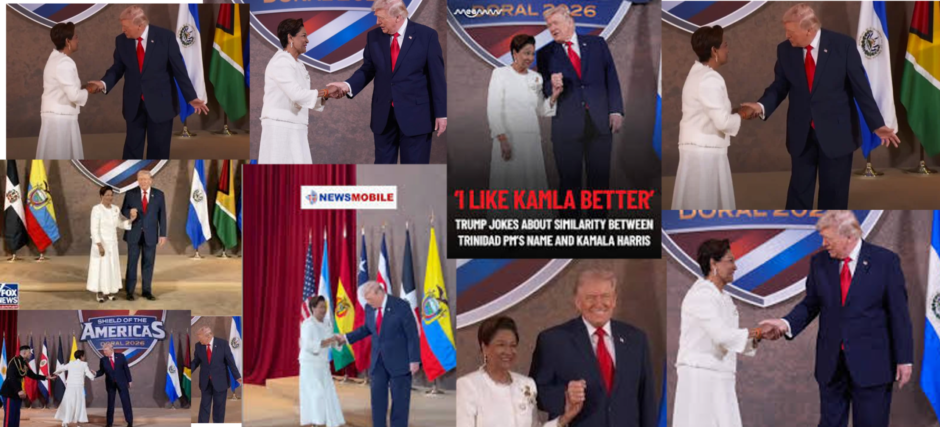
US President Donald Trump greeted Prime Minister Kamla Persad-Bissessar for a photo-op at the Shield of the Americas summit in Doral, Florida on Saturday. The Prime Minister is seeking to reassure that the recently formed military alliance between Trinidad & Tobago, Guyana and the US administration will ultimately benefit all of Caricom.
Speaking to Trinidad & Tobago diaspora in Florida following the Shield of the Americas Summit, Prime Minister Kamla Persad-Bissessar defended her partnership, describing the US President as a brave and visionary leader. At an event in her honour at Joy’s Roti Delight in Lauderhill, Persad-Bissessar said she must acknowledge the “great USA” and sought to defend the “different stance” her government has taken on foreign policy since being elected into government.
Her decision to join the America’s Counter-Cartel Coalition (ACCC), a US-led regional military and security alliance, would be, “In the very best interest of the entire Caricom, the whole region. That’s the work we are doing.”
Persad-Bissessar heaped praise on the US President, lamenting that the region is plagued by “Real bad people. Evil people. Criminals are now the ones in the palm. We are elected free with fair elections but e criminals run with their corrupt ways and influence officials wherever they may be, because of fame, some are motivated by money. How much you will eat? How much you will wear? How much money do you really need? What you need is safety and security.
We had the distinct honour to really meet President Trump. He’s a very brave man. He’s a very courageous man because he’s doing what needs to be done, not only for USA but for the world. He must have a vision. He has it.”
In commending the US President, Persad-Bissessar acknowledged that President Trump receives his share of criticism but she, too, is no stranger to scrutiny.
“There are many people saying not good things about him and there are many people saying very good things about him and there are many people saying very good things about me and there are some people who are not saying some good things about me. But again, safety, security. That’s the priority .”
ACCC: Opportunity or repeat of history?
2026, 03/10
The Americas Counter-Cartel Coalition (ACCC), announced at the Shield of the Americas Summit in Doral, Florida, signals a bold attempt to confront the hemisphere’s decades-long struggle against powerful transnational drug cartels.
Led by the United States, the ACCC seeks to coordinate intelligence, run joint operations and promote multilateral cooperation. For Trinidad & Tobago—a longtime corridor for cocaine and other illicit goods—the coalition may provide new operational tools. Yet, the limited regional focus and checkered history of US-led anti-drug efforts raise doubts about success.
Decades of US “war on drugs” interventions, often characterised by militarised enforcement, unilateral action and high-profile arrests ultimately failed to dismantle cartel structures. Sporadic crackdowns and seizures created temporary disruption but did not prevent traffickers from adapting, shifting routes or exploiting weak regional coordination. The lesson is clear: without sustained, integrated regional engagement, enforcement alone cannot overcome well-established criminal networks.
The ACCC aims to change that by embedding Trinidad & Tobago alongside Guyana, Panama and Costa Rica, in a framework for intelligence sharing, joint maritime patrols and coordinated operations. In theory, this could enhance local law enforcement capacity, provide technical support in financial investigations and improve situational awareness of cartel activity. For Trinidad and Tobago, this intelligence-driven, proactive approach could finally shift the balance in a decades-long fight.
Yet, there is a glaring limitation: the coalition currently appears confined to nations aligned politically with the Donald Trump administration in the USA. Major players, many of which control key trafficking routes or possess critical enforcement capacity, remain outside the coalition. Without broader regional inclusion, traffickers can simply redirect shipments through unaligned territories, undermining the ACCC’s effectiveness. History has shown that cartels exploit gaps and inconsistencies in regional coordination; a coalition limited by political alignment risks reproducing past failures under a different banner.
There are also important sovereignty considerations. Participation in a US-led initiative carries the risk that Trinidad & Tobago may be drawn into operations or priorities that do not perfectly align with national interests. Transparency and civil oversight will be essential to ensure public trust, particularly as maritime patrols and intelligence operations increase on domestic soil. The petrostate must strike a balance between operational gains and the preservation of autonomy, governance and respect for civil liberties.
Trinidad & Tobago now has a choice. Full engagement with the ACCC could bolster ability to disrupt cartel operations, while carefully negotiated participation could safeguard national interests. Without a genuinely inclusive regional coalition, the ACCC may only achieve partial successes—temporary seizures and arrests that leave the underlying networks intact. To break the cycle of failure that has defined the hemisphere’s drug wars for decades, coalition leaders must expand beyond political alignment, integrating all countries critical to regional security.
Ultimately, the ACCC presents a rare opportunity for Trinidad and Tobago to enhance its security capabilities and counter entrenched criminal networks. Whether it succeeds—or becomes another chapter in the hemisphere’s long history of drug policy failure—will depend on the coalition’s ability to move beyond political selection and build a truly inclusive, intelligence-driven regional strategy. The stakes could not be higher.
UNODC can collaborate with ACCC.
United Nations Office on Drugs and Crime mission is to contribute to peace and security, human rights and development by making the world safer from drugs, crime, corruption and terrorism by Stopping deadly and illicit drugs. Giving organized criminal groups no place to hide. Protecting people from online scams and cyber fraud. Keeping trafficked weapons and criminal proceeds from fuelling more crime, terrorism and conflict. Promoting lofty lifestyles based on consefvative traditions and values.
President Donald Trump holds the “Commitment to countering cartel criminal activity” document at the “Shield of the Americas” Summit , March 7, 2026.
Trump forms new coalition ‘to destroy the sinister cartels and terrorist networks’
JESSICA A. BOTELHO | The National News Desk Sat, March 7th 2026
President Donald Trump on Saturday welcomed leaders from across Latin America for the “Shield of the Americas” Summit in Florida, where he signed a proclamation to counter cartel criminal activity across the Western Hemisphere.
Trump said the summit was convened to bring together like-minded allies in the region to promote freedom, security, and prosperity amid efforts to stop narco-terrorists and drug trafficking cartels.
Trump said, “On this historic day, we come together to announce a brand new military coalition to eradicate the criminal cartels plaguing our region. “We’re calling this military partnership the Americas Counter Cartel Coalition.”
Trump said “the heart of our agreement” is a commitment to using lethal military force “to destroy the sinister cartels and terrorist networks” once and for all. “We’ll get rid of them,”
He also encouraged the leaders to take military action against cartels and transnational gangs that pose an “unacceptable threat” to the hemisphere’s national security.
“The only way to defeat these enemies is by unleashing the power of our militaries. We have to use our military. You have to use your military.”
Citing the U.S.-led coalition in the Middle East, the Republican president said that ”we must now do the same thing to eradicate the cartels at home.”
The leaders of Argentina, Bolivia, Chile, Costa Rica, the Dominican Republic, Ecuador, El Salvador, Guyana, Honduras, Panama, Paraguay and Trinidad & Tobago participated in the gathering.
“All of the nations in this room share the same priorities: security, prosperity, free commerce, and the rule of law. That’s why together, we’re also forming the Shield of the Americas, a new organization to advance these shared priorities in our hemisphere.” Department of Homeland Secretary Kristi Noem, who Trump ousted from her position and appointed as the special enjoy for the new coalition of nations, joined them.
Secretary of State Marco Rubio, Department of War Secretary Pete Hegseth, Treasury Secretary Scott Bessent, were also there.
Officials characterized the summit as a historic coalition aimed at reinforcing regional partnerships and advancing coordinated strategies to confront shared security challenges.
The gathering came just two months after Trump ordered a U.S. military operation to capture Venezuela’s then-president, Nicolás Maduro.
“We went right into the heart and took him out,” Trump said at the summit.
(Photo by Roberto Schmidt/Getty Images)
DORAL, FLORIDA – MARCH 07: U.S. President Donald Trump (C) stands with (L-R) Kamla Persad-Bissessar, SC, MP, Prime Minister of the Republic of Trinidad and Tobago, Santiago Peña, President of the Republic of Paraguay, Luis Abinader, President of the Dominican Republic, Rodrigo Paz Pereira, President of Bolivia, Nayib Bukele, President of El Salvador, Javier Milei, President of Argentina, José Raúl Mulino, President of Panama, Mohamed Irfaan Ali, President of Guyana, Nasry “Tito” Asfura, President of Honduras, Rodrigo Chaves Robles, President of Costa Rica, José Antonio Kast, President-elect of Chile, and Daniel Roy Gilchrist Noboa Azín, President of Ecuador, during a group photograph at the start of the “The Shield of the Americas Summit ,“ a gathering with heads of state and government officials from 12 countries in the Americas at the Trump National Doral Golf Club on March 7, 2026 in Doral, Florida.
The White House describes the gathering as a landmark summit aimed at reshaping regional alliances and reinforcing U.S. influence in the Western Hemisphere. (Photo by Roberto Schmidt/Getty Images)