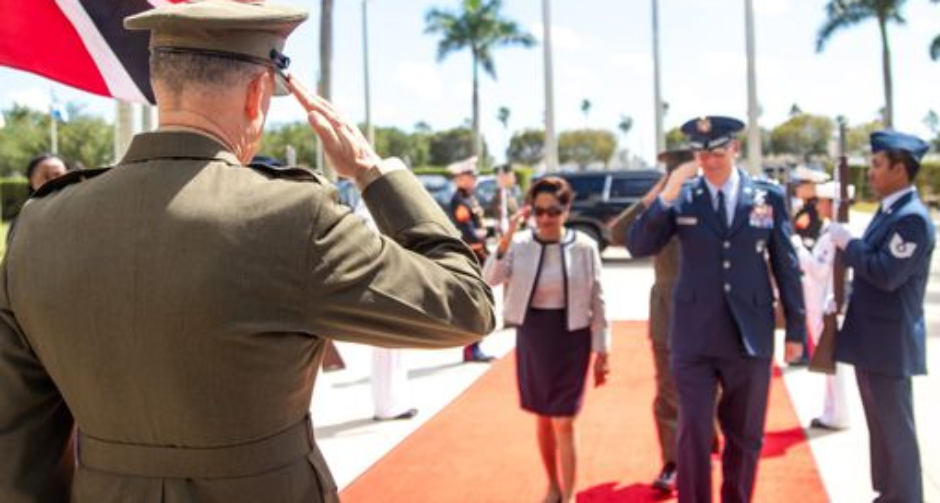
Pax Petrolifera reigns from Liberation Day
January 3 2026
US works to ease Venezuela oil sanctions and aid companies’ entry: report
Vladimir Afanasiev European Correspondent 28 January 2026
Washington works on general licence to allow long-term operations for foreign investors
The US is preparing to remove extra bureaucracy and provide additional stability for companies willing to invest in rebuilding Venezuela’s oil and gas industry, following the US removal of Nicolas Maduro . The US is working to issue a general licence that would lift some sanctions on Venezuela’s energy sector and permit US and international investors to work in the country without having to obtain an individual operating licence, according to Reuters , citing unnamed sources.
The proposal is a change from the established practice of individual licences that are issued for a limited time and have to be renewed. The change may become instrumental in establishing the comprehensive framework for foreign participation in Venezuela’s energy industry, providing assurances to long-term investors that may have to wait for years before seeing their investments paid back.
The large number of individual licence applications to the US government slowed progress on President Donald Trump’s plan to expand exports and accelerate investment into Venezuela.
The US recently received applications from some international partners and customers of state-owned PDVSA seeking individual licences to boost their production and exports. Companies include US supermajor Chevron, Spain’s Repsol, Italy’s Eni, Indian private sector giant Reliance Industries and major oilfield service providers.
In a conference call, Halliburton chief executive Jeff Miller said his phone was “ringing off the hook” since the US began trying to pry open Venezuela’s oil industry. Miller said Halliburton could “scale up fairly quickly” in Venezuela because it still has a footprint in the country and can easily move equipment there. Another provider, SLB, can “rapidly ramp up” its oil and gas activities in Venezuela if the right licence and payment guarantees are enacted, chief executive Olivier Le Peuch said.
Chevron and another Indian state-owned player, Oil & Natural Gas Corporation, were among the oil companies that reportedly met with Venezuela’s interim President Delcy Rodriguez earlier this week, as she stepped up efforts to revise her nation’s hydrocarbon legislation.
Venezuela is subject to over 400 various sanctions and restrictions, some so broad that one executive worried in a White House meeting that even requesting necessary technical information from PDVSA may be treated as a violation, according to the New York Times, citing an analysis of US Treasury Department data.
(Copyright)
US EXIM Bank ‘very focused’ on helping oil companies invest in Venezuela
Two critical goals are restoring flow of Venezuelan barrels on global market and improving local conditions for international companies to return, says EXIM chairman
Davide Ghilotti
Breaking News Editor Firenze 30 January 2026,
The US Export-Import Bank is actively supporting the administration in creating the conditions for international companies to be comfortable investing in Venezuela, its chairman said. With the Western hemisphere as the epicenter of transoceanic economic conflict , the industry is responding to support Venezuelan oil revival.
ExxonMobil perspective regarding Venezuela
12 January 2026
ExxonMobil Chairman and CEO Darren Woods delivered the following remarks at a White House meeting of industry executives hosted by President Donald Trump today to discuss the future of the oil and gas industry in Venezuela.
Thank you, Mr. President, I appreciate the invitation and the opportunity for the entire industry to show up and provide perspective. Frankly, we’ve been unresponsive to the press regarding Venezuela. I guess today’s the opportunity to address the press directly with respect to questions that have been asked of ExxonMobil.
First and foremost, obviously, is the interest that we have in Venezuela. I think one of the reasons why we see many industry players here is we’re in a depletion business for a product that is in great demand and will be in demand for many, many decades to come.
As a depletion business, the biggest challenge we have is finding resources. There’s an opportunity in Venezuela with all the resources there. We don’t have that challenge of finding; we have the challenge of developing those resources. So I think it’s in the best interest of these companies and, frankly, society as a whole for the industry to be interested in understanding what the opportunity here represents.
I’ll share a philosophy that ExxonMobil has when we enter countries—because we do business all around the world, in different regimes—we take a very long-term perspective. The investments that we make span decades and decades. So, we do not go into any opportunity with a short-term mindset.
There’s a value proposition that we have to meet. It has to be a win-win-win proposition. Obviously, it has to be a win for the company and our shareholders, generating a return for the investments we make. It has to be a win for the government. The resources are an important source of revenue that support the people of the places that we do business. And it has to be a win for the people. We have to be wanted there— and to be a good neighbor. And those three things ensure a stable, long-term platform for the large investments that we make for the long term.
With respect to Venezuela in particular, we have a very long history in Venezuela. In fact, we first got into Venezuela in the 1940s. We’ve had our assets seized there twice. And so, you can imagine to re-enter a third time would require some significant changes from what we’ve historically seen here and what is currently the state.
If we look at the legal and commercial constructs—frameworks—in place today in Venezuela, today it’s uninvestable. Significant changes have to be made to those commercial frameworks, the legal system, there has to be durable investment protections and there has to be a change to the hydrocarbon laws in the country.
We’re confident that with this Administration and President Trump working hand-in-hand with the Venezuelan government that those changes can be put in place. And with respect to the Venezuelan government—that perspective—we don’t have a view on. We haven’t talked to the Venezuelan government and obviously we have yet to assess the people’s perspective with respect to ExxonMobil entering the country.
In the short term, there are things that can be done while these longer-term issues are being worked. For us, we haven’t been in the country for almost 20 years. We think it’s absolutely critical in the short term that we get a technical team in place to assess the current state of the industry and the assets to understand what would be involved to help the people of Venezuela get production back on the market.
With the invitation of the Venezuelan government and with appropriate security guarantees, we are ready to put a team on the ground there. We also have an integrated set of capabilities—from production to refining to trading—and I think we can be of assistance to getting Venezuelan crude to market and realizing market price to help again with the financial situation in Venezuela.
So that’s the short-term perspective that I have. Thank you, Mr. President, for the work that you’ve done to secure not only the national security but the energy security of the region. And thank you Secretary Rubio, Secretary Wright, Secretary Burgum, for your leadership in this matter. Thank you.
Source: ExxonMobil
Venezuela approves overhaul to national hydrocarbon law
….to allow more outside private investment in oil industry
Robert Stewart North America Energy Correspondent Baton Rouge 29 January 2026
Venezuela’s National Assembly approved an overhaul of the oil industry that would allow foreign companies more control over their operations and lower their royalty rates. The legislation gives foreign companies a stronger grip over their operations, relegating state-owned PDVSA to secondary status.
It also gives local authorities the ability to reduce royalties and taxes paid to the Venezuelan government. After US forces removed Nicolas Maduro and stabilized the country’s oil industry, Venezuela elevated Maduro’s vice president, Delcy Rodriguez, to acting president and she has sought greater foreign investment in oil production amid pressure from the White House.
Her brother, National Assembly speaker Jorge Rodriguez, urged lawmakers to support the reform as part of efforts to attract foreign investment.
The US on Thursday eased sanctions on Venezuela’s oil industry, allowing US companies more latitude to tap into the OPEC founder’s massive reserves. However, the US Treasury Department is preventing deals with businesses affiliated with Russia, PRC, Iran, North Korea and Cuba.
The White House pressured US oil companies to enter Venezuela and spend hundreds of billions of dollars to revive its industry. Some expressed reticence at returning, while others called the country an opportunity.
Two major US operators, ExxonMobil and Chevron, will release their fourth quarter earnings Friday and are likely to address Venezuela in calls with analysts. Chevron, the only US operator to stay in Venezuela since US sanctions were enacted in 2019, said it can increase its production there in about two years, while ExxonMobil chief executive Darren Woods has called the country “uninvestable” at the moment.
(Copyright)
BP, Shell seek US licences for Venezuela gas fields near Trinidad
January 28 Reuters
Summary
-
-
- Shell seeks licence for Loran-Manatee discovery
- BP seeking to develop Cocuina-Manakin field
- Trinidad & Tobago hopes for first gas from Dragon field in 2027
-
Shell and BP are seeking US licences to extract natural gas from fields in Venezuela, Trinidad and Tobago energy minister Roodal Moonilal said on Wednesday. Trinidad is Latin America’s largest liquefied natural gas exporter and one of the main exporters of ammonia and methanol.
The island aims to develop offshore fields in Venezuela and on the maritime border to counter declining reserves and secure supply for its petrochemical industry. Gas projects progressed slowly amid frequent U.S. policy changes towards Venezuela.
Under Nicolas Maduro, Venezuela last year suspended energy-development cooperation with Trinidad and Tobago, including joint natural gas projects in the works. Following removal of Maduro, the U.S. is accelerating developments in the petrostate’s petroleum sector.
Companies need U.S. licences to develop projects because of US sanctions on Venezuela’s energy industry.
SHELL, BP SEEK LICENCES
On the sidelines of the Indian Energy Week conference, Moonilal told media Shell is seeking a licence to develop the Loran-Manatee discovery. The field holds some 10 trillion cubic feet of natural gas, with 7.3 tcf on Venezuela’s side and the remaining 2.7 tcf in Trinidad.
BP is seeking a licence to develop the Cocuina-Manakin field, whose Venezuelan sector belongs to the idled gas offshore project Plataforma Deltana which has 1 trillion cubic feet of proven gas reserves.
Moonilal said, “The United States is an ally and a very strong friend trying to reform, so we would help the companies when it comes to supporting their applications.”
DRAGON GAS
In October Washington granted an authorization for Shell and Trinidad & Tobago to develop the Dragon gas field offshore Venezuela close to the maritime border, a project aimed at supplying Trinidad with Venezuelan gas. Moonilal hopes to start production in the fourth quarter of 2027 and expects Dragon gas field to produce 350 million cubic feet of gas per day.
Touchstone senses opportunity in Venezuela
January 27, 2026
President and chief executive officer of Canada-based oil and gas company Touchstone Exploration, Paul Baay says despite geopolitical tensions, there remains significant opportunities in Venezuela. At the Energy Chamber of T&T Energy Conference 2026 , Baay said the perceived risks also create potential advantages. T&T proximity to Venezuela and the similar geology could help expedite exploration and development.
“You talk about it being tricky here, but it’s actually the opportunity, too. Once you’re here and you’re in place, there are some real economies of scale that we can apply in what we want to do. I think it is going to be an interesting opportunity; but like everything, it is going to take a little longer than anybody would like. We stay focused in Trinidad because we’ve got a very big foothold here; so we’re not trying to lose focus here and go somewhere else.”
“I am optimistic about it because as a smaller producer that can take a bit more risk, I think it is a pretty interesting opportunity. The trick is going to be timing and taking advantage of that.
We’re still trying to figure that out ; but if you look at the LOA (Lease Operatorship Agreements) properties we have on the southern part of the island with our partner Heritage, those are mature fields that we can go in—workover fields—bring them back on production and increase production. That’s the kind of model we can take with Venezuela, for instance.”
As for bridging the gap of unemployment within the sector, the company had to downsize a bit last year due to the poor performance of a well.
“We’ve downsized in the last year and that is a result of some of the wells not performing as well as we originally thought, so we had to make those adjustments. But as we start to ramp up here with the new acquisition we’ve done, and as we do more drilling, we use more local content—which is also a tricky term in Trinidad, because local content can be ‘local content’ and ‘local local content’ right down to the neighbourhoods we operate in.
As we move out of an area and into another, there is a perception that some of the jobs are lost, but generally, they get picked up wherever we’re moving to.”
Baay said one of the major recent developments at the company has been the completed drilling of the Central Block, about which he was excited, despite the slow start; he predicted a busy 2026.
US returns seized tanker to Venezuela amid policy shift
January 30th 2026:
oil Tanker M/T Sophia t
The USA this week returned oil tanker M/T Sophia to Venezuela, reflecting a broader shift in U.S. energy policy toward Caracas amid efforts to normalize commercial ties, after several high‑profile seizures of vessels tied to Venezuelan oil shipping.
US Coast Guard and military forces seized the Panama‑flagged M/T Sophia on January 7, when it was carrying Venezuelan crude and was designated a “stateless, sanctioned dark fleet motor tanker” by U.S. authorities, alleging lack of safety certification and sanctions violations.
Officials said the decision to return the vessel and potentially its cargo, aligns with an evolving U.S. approach to Venezuela that seeks to balance enforcement with a regulatory framework intended to facilitate orderly Venezuelan oil exports. The return follows at least seven vessel seizures since late 2025, part of an operation targeting ships alleged to be evading sanctions and operating without proper maritime certifications.
Returning the Sophia is seen as a signal that some logistical and regulatory frictions are being addressed as Washington aims to stabilize export flows.
In Caracas, the interim government led by acting President Delcy Rodríguez welcomed the return, noting it may help reduce uncertainty in maritime crude trade.
“It is essential to establish clear norms that prevent arbitrary detentions of Venezuelan vessels in international waters or U.S. jurisdictions,” a Venezuelan official said.
Energy and maritime policy analysts say the vessel’s return should be read in the context of a broader U.S. strategy shift, which included preparing general licences to ease some sanctions and boosting U.S. refinery access to Venezuelan crude after years of tight restrictions. A Miami‑based maritime expert said,
“The message behind returning the tanker is that Washington wants to stabilize oil trade routes and reduce the frictions that have marked recent years. However, regulatory risk remains and ship operators will continue to monitor future detentions closely.”
Legal experts also caution that the vessel’s return could affect ongoing maritime disputes and potential compensation claims from shipowners affected by prolonged detentions.
The involvement of international insurers and the International Maritime Organization (IMO) may become relevant if such incidents escalate.
US curbs oil sanctions onVenezuela after Maduro ouster
Treasury’s OFAC allows US companies to enter Venezuela under strict conditions
Robert Stewart
North America Energy Correspondent
Baton Rouge
29 January 2026
The US has eased its oil sanctions on Venezuela, weeks after it removed the petrostate’s ruler Nicolas Maduro and regulated the petroleum industry, according to the Treasury Department.
The Treasury Office of Foreign Assets Control issued Venezuela General Licence 46, which allows US companies to produce, export, transport, market, sell or store “Venezuelan-origin oil”.
OFAC established a list of provisions for companies wishing to tap Venezuelan oil, including a requirement that any contract with Venezuela or state-owned oil company PDVSA must be governed by US laws.
OFAC also blocked any Venezuelan oil deals with people or businesses based in Russia, Iran, North Korea and Cuba and it restricted deals with businesses organised in Venezuela but owned by a person or business headquartered in PRC.
Anyone wishing to sell Venezuelan oil to a country other than the US must give a report detailing the volumes and payments involved in the transaction. The OFAC notice declared that any payments to sanctioned individuals must be sent to Treasury Department-run accounts called Foreign Government Deposit Funds.
It also prohibited deals with sanctioned oil tankers. OFAC also blocked contract payment terms “that are not commercially reasonable” or involve debt swaps or payments in gold or digital currency.
The White House also exhorted US companies to re-enter the OPEC founder and revitalise its production. Companies expressed varying degrees of enthusiasm over investing in the country, citing security and payment issues as primary challenges.
The only US producer to remain in Venezuela since sanctions were levied in 2019 is Chevron. Operators ExxonMobil and ConocoPhillips left the country after their assets were seized in 2007.
(Copyright)
Venezuela gas reserves offer new opportunities for T&T
2026, 01/27
Venezuela Ambassador to T&T Alvaro Enrique Sanchez Cordero, attended the opening of the Energy Conference yesterday.
With Venezuela’s vast gas reserves and T&T’s underused energy infrastructure creating a powerful regional opportunity, cross-border energy cooperation was a topic of discussion at the T&T Energy Conference.
Mala Baliraj, chair of the Energy Chamber of T&T, acknowledged the potential opportunities in her speech.
“There are two projects listed on this map where the major factor delaying execution is beyond Trinidad and Tobago’s direct control, namely the Shell/NGC investment in the Dragon field in Venezuela and the bp/NGC investment in the Manakin/Cocuina cross-border field. Recent changes in Venezuela might offer new hope that these two projects can move toward implementation.
“These two projects also need to be seen in a wider context. Venezuela holds massive gas reserves, in the region of 200 trillion cubic feet. Many of these are in non-associated gas fields in the east of the country, including offshore in both the Patao, Mejillones, Río Caribe, and Dragón complex to the northwest of Trinidad and the Plataforma Deltana area off Trinidad’s southeast coast.”
Given the proximity of these resources to existing Trinidad gas infrastructure, it made “excellent sense for both Trinidad and Venezuela to use Trinidadian infrastructure.”
bpTT president David Campbell agreed that this is an optimal scenario. “We are talking a lot about Venezuela, but cross-border generally the industrial logic says, discover undeveloped resources in a place where perhaps people are less confident to invest right next to our underused resources, Atlantic, Point Lisas and so on.
There’s an obvious logic that can be made to work. So yes, I see the potential for growth in both those areas. We also, of course, are always interested in exploration more widely in other countries. Our kit is already fully depreciated and available; that is very competitive in comparison to building a new plant nearby.”
Touchstone Exploration’s Paul Baay also was optimistic about the opportunity presented by Venezuela but admitted there were some logistical points to be ironed out.
“I am optimistic about it. .. for us smaller producers that can maybe take a little more risk, I think it’s a pretty interesting opportunity. The trick is going to be timing, how you take advantage of that? We’re still trying to figure that out .”
Day two of the Energy Conference will take place today .
US: “Our relationship with Delcy Rodríguez’s government is productive and respectful”
January 28th 2026 –
U.S. Secretary of State Marco Rubio said that Washington is not considering “any military action” in Venezuela, as he testified before the Senate Foreign Relations Committee to outline the US administration’s strategy following removal of former president Nicolás Maduro earlier this month.
“I can assure you with complete certainty that we are not preparing, do not intend, and do not expect to take any military action in Venezuela at any time,” Rubio said, describing relations with the interim authorities led by Delcy Rodríguez as “productive and respectful,” while stressing that “there is still a lot of work to be done.”
The remarks struck a more restrained tone than a written statement Rubio submitted to the committee the previous night, in which he warned that the US was prepared to use force if cooperation from Caracas fell short.
In his oral testimony, Rubio softened that language while noting that President Donald Trump, as commander in chief, “never rules out options” during specific security threats. The hearing followed the action in which U.S. forces removed Maduro and his wife, Cilia Flores, in a law-enforcement operation targeting alleged narcotics trafficking.
Rubio argued that the mission did not amount to an occupation or an act of war and therefore did not require prior congressional authorization, a position that drew scrutiny from lawmakers.
Rubio told senators that Washington made more progress in recent weeks than initially expected, including opening talks aimed at reducing the influence of Iran, PRC and Russia in Venezuela. “For the first time in twenty years, we are having serious conversations” on these issues, he said, adding that there are elements within Venezuelan society that favor restoring ties with the US.
The U.S. roadmap for Venezuela unfolds in three phases: stabilization, recovery and transition. The initial phase focuses on restoring critical infrastructure, particularly in the oil sector, long the backbone of Venezuela’s economy.
That would be followed by broader economic recovery and, eventually, a political transition leading to “free and fair” elections — a process Rubio acknowledged could take years.
He is optimistic about reopening the U.S. embassy in Caracas in the near future, saying the only American military presence currently in Venezuela consists of Marine guards protecting the diplomatic compound.
Financing for the process is partly linked to oil revenues: Washington has sold Venezuelan crude worth around $500 million, with part of the proceeds transferred to Caracas and the remainder held in a controlled account.
After the hearing, Rubio met behind closed doors with opposition leader María Corina Machado. Afterward, Machado called for a “real transition” and said the release of political prisoners is an “absolute priority.”
According to figures compiled by the Venezuelan rights group Foro Penal, over 300 detainees were released in recent weeks, while around 700 people remain imprisoned for political reasons.
Venezuela’s interim leader announces general amnesty for political prisoners
January 30th 2026
Delcy Rodríguez said she will push a “general amnesty law” covering political prisoners and instructed that the draft be sent to the Asamblea Nacional de Venezuela, to be debated and approved next week. The announcement was delivered at an event held at Tribunal Supremo de Justicia de Venezuela, as reported by El País.
“I am announcing a general amnesty law and I am instructing that this law be brought before the National Assembly to promote peaceful coexistence in Venezuela.” She also urged Venezuelans to reject “violence or revenge” and said the decision had been discussed with Nicolás Maduro.
The law would aim to erase criminal cases for those covered and expand beyond recent releases that did not always amount to full freedom. Some detainees freed in recent weeks remained under precautionary restrictions, including travel bans and limits on public statements—measures families and lawyers argue leave former prisoners vulnerable to re-detention and pressure.
Rodríguez said the draft would exclude serious common crimes such as homicide and drug trafficking. Rodríguez also announced plans to repurpose El Helicoide—a detention complex associated with state security services—into a community site offering social and sports services, and pledged a new push against corruption within the justice system.
The announcement follows weeks of incremental releases following Maduro’s removal from power. Associated Press reported that Rodríguez, in one of her first public briefings after the change, vowed to continue freeing detainees while rights advocates called for transparency, due-process guarantees and published lists of beneficiaries.
While Venezuela used selective pardons in recent years, notably in 2020, a broad amnesty would represent a larger legal step with wider judicial consequences. Recurring gaps between official government claims about the number of people released and figures verified by independent observers, reinforce demands for verifiable lists and external monitoring.
In the final accounting most frequently referenced by families and defense teams, Foro Penal reported hundreds of releases since early January and said hundreds more political prisoners remain in custody, alongside thousands under judicial restrictions.
Rodriguez meets Repsol, Chevron amid oil law overhaul for investment
January 27th 2026
Venezuela’s acting president Delcy Rodriguez met representatives of oil companies including Repsol, Chevron and Shell in Caracas to discuss a hydrocarbons law reform proceeding through the National Assembly, as the government seeks to attract private and foreign investment.
The meeting at PDVSA facilities forms part of a mandatory public consultation phase after the bill cleared its first legislative debate. Rodriguez said the draft is a “sovereignty-respecting” framework aimed at turning Venezuela into a “giant producer” of hydrocarbons with private investment.
Authorities expect to secure a “significant flow” of international and domestic capital, as the government seeks to reset rules for investment and boost output.
Chevron representative Mariano Vela said it was “ready to continue contributing” expertise and technology to build a more competitive oil and gas sector in Venezuela.
Rodriguez defended a successful model of productive participation contracts and said 29 such contracts are currently in place, instruments the government links to the 2020 anti-blockade law designed to navigate international sanctions.
Amid a broader, fast-moving political and diplomatic backdrop, a new channel between Washington and Caracas was shaped by US President Donald Trump’s stated interest in Venezuelan crude and oil sales arrangements. Rodriguez said $300 million had entered Venezuela from an initial $500 million crude sale agreement.
Rodriguez tried to project domestic control while signaling openness to investors. On Monday, she said Venezuelans “do not take orders from any external actor” and that “this government obeys the people”.
Associated Press described Rodriguez as treading a line between sovereignty rhetoric and a pitch to expand foreign participation in the oil sector, as the US administration aims to influence management of Venezuelan oil revenues. The reform push is unfolding alongside scrutiny over political detentions and releases. Human rights groups questioned the pace and totals of prisoner releases; an AFP report said NGOs verified only a fraction of the releases claimed by the government.
The bill’s next stage is a second, article-by-article debate, where amendments may still be introduced. For Rodriguez’s government, the objective is to lift investment and production while keeping state ownership of reserves intact. For critics and investors, the key test will be whether the new rules deliver legal clarity, transparency and enforceable guarantees in a country still marked by sanctions, institutional strain and deep political polarization.
Tanker transports Venezuelan Heavy Oil to Louisiana
January 25, 2026
A crude tanker chartered by Trafigura sailed from Venezuela’s Jose port to Louisiana Offshore Oil Port (LOOP), LSEG data and documents showed, the first cargo exported directly to the U.S. as part of a 50-million-barrel supply deal agreed this month between Caracas and Washington. Trading houses Vitol and Trafigura received the first U.S. licences to load and export Venezuelan oil as part of the deal.
They have since shipped cargoes to storage terminals in the region and from there they have been marketing and selling the crude to refiners worldwide.
Liberia-flagged tanker Gloria Maris, carrying 1 million barrels of Venezuela’s Merey heavy crude, is the first sent by the traders directly from Venezuela to a U.S. port since the deal began.
A smaller tanker, Barbados-flagged Volans, departed from Jose with 450,000 barrels of Venezuelan crude to the Bullen Bay terminal in Curacao. The traders shipped between 10 million and 11 million barrels of Venezuelan oil as part of the supply deal so far and are preparing to begin exporting fuel oil as well.
Before Venezuela can reverse output cuts made during a U.S. blockade of sanctioned tankers, it needs to drain most of the over 40 million barrels it accumulated in storage since last month.
U.S. to fast-track oilfield repairs to lift Venezuela output
January 23, 2026 – Bloomberg
The U.S. is in talks with Chevron and major oilfield service companies on plans to quickly revive oil production in Venezuela through targeted repairs and equipment upgrades, rather than a full-scale industry rebuild,.
Under the approach, service providers including SLB, Halliburton and Baker Hughes would focus initially on repairing damaged infrastructure, rehabilitating older wells and replacing outdated equipment.
Officials said those measures could lift Venezuela’s crude output by several hundred thousand barrels per day in the near term with limited capital investment. The strategy aligns with the US administration’s goal of rapidly increasing crude supply following the January removal of Nicolás Maduro, while generating cash to support longer-term reconstruction.
Venezuela currently produces less than 1 million bpd, far below its historical peak of nearly 4 million bpd in the 1970s.
“There’s some low-hanging fruit that you could probably squeeze some life out of once again,” said Tom Liskey at Enverus.
Chevron plans to initially leverage existing infrastructure in its joint ventures with state-owned Petróleos de Venezuela SA , Vice Chairman Mark Nelson said earlier. The company expects to raise production from its Venezuelan operations by about 50% over the next 18 to 24 months, up from roughly 240,000 bpd today.
Oilfield service companies signaled readiness to return quickly if U.S. approvals are granted. Halliburton CEO Jeff Miller said the company could mobilize within weeks, while Baker Hughes CEO Lorenzo Simonelli noted the firm has the largest installed base of artificial lift and rotating equipment in the country. In the near term, activity would likely center on workovers, artificial lift repairs and power generation upgrades at existing fields, rather than new drilling.
Analysts say longer-term development , including new wells and reservoir expansion , would require sustained political stability, regulatory reform and significant investment.
Despite Venezuela’s vast reserves, decades of underinvestment, environmental liabilities and deteriorated infrastructure remain major hurdles. Industry leaders raised concerns over worker safety and payment security and U.S. officials indicated they do not plan to provide on-the-ground security guarantees.
Still, service companies view Venezuela as a potentially significant market as U.S. shale activity slows. Citi estimates that a return to historic activity levels could eventually support billions of dollars annually in drilling, completion and production services.
Venezuela’s oil revival confronts invisible challenge
Satellite images show oil and gas facilities emitting large volumes of methane
The largest methane plume detected in Venezuela last year came from an area in the Orinoco Belt operated by Bitumenes Orinoco, which emitted 7.74 tonnes per hour of methane, according to asset observation platform Kayrros.from NASA/JPL-Caltech’s EMIT instrument onboard the ISS
Rebecca Conan
European energy correspondent
London 22 January 2026
Reboot of Venezuela’s ailing upstream business encounters obvious hurdles including politics, security, regulatory risk and crumbling infrastructure but a major invisible one is methane.
Venezuelan Oil sold to Europe
Bloomberg January 22, 2026
Europe is set to receive some of its first shipments of Venezuelan oil in almost a year after traders rolled out offers worldwide to sell cargoes at the behest of the US administration.
The Poliegos is on its way to load Venezuelan oil and deliver it to a port in Italy. Owner of the cargo. is energy trader Vitol Group, which with Trafigura Group was enlisted by the US to sell Venezuelan oil. Crude tanker Folegandros is scheduled to sail from Venezuela to deliver barrels to Repsol SA’s oil refinery in Cartagena, Spain.
The crude, scheduled to arrive in Europe in February, is part of the US plan to shore up the Venezuelan economy after three decades of mismanagement, underinvestment and corruption. The pace and scale at which output and exports are restored will be an important detail in an oil market dealing with a large supply excess, with global prices near $60 a barrel. After removal of strongman Nicolás Maduro, US officials enlisted Vitol and Trafigura to help sell as much as 50 million barrels of oil, with proceeds earmarked to help rebuild the Venezuelan economy. The shipments would market the first visible exports of Venezuelan oil to Europe since April, when the Vitol-backed Saras SpA took 1 million barrels of Merey 16 oil to the Sarroch refinery in Italy.
The traders are quickly moving Venezuelan barrels as the US prepares to issue a general licence easing sanctions and allowing more trading companies and refiners to buy directly from state oil company Petroleos de Venezuela SA. Trafigura and Vitol have taken 12 million barrels of Venezuelan oil in under 3 weeks, about one-fourth of the volumes contracted with the US. Currently en route to Venezuela, the Poliegos will load 1 million barrels crude by the end of the month and sali toward Augusta in Italy. The port, a hub for the Mediterranean, is sometimes cited as a destination for vessels that ultimately head somewhere else.
Oil-law reform to open Venezuela to private firms
January 23rd 2026
Venezuela’s National Assembly approved, in a first reading, a reform to the Hydrocarbons Law that would expand private participation in crude production and marketing, an important shift from the long-running “mixed-company” model in which the state held majority stakes.
The bill still requires a second reading before it can become law. According to the text and the rationale presented in parliament, the reform would allow privately owned companies domiciled in Venezuela to take part in “upstream” activity through contracts with the state, while also enabling producers to market crude directly. The draft also adds provisions allowing disputes to be handled in Venezuelan courts or through mediation and independent arbitration mechanisms.
A politically sensitive element is the state take linked to output. The proposal lowers the applicable percentage to 15% in certain cases when mixed ventures operate, while maintaining other thresholds for private operators—changes that opposition lawmakers argue are being rushed through without adequate debate. Opposition figures broadly backed the idea of attracting investment and restoring output, but they challenged the process. Lawmaker Stalin González wrote online that his caucus had not received the bill ahead of the session.
Henrique Capriles called for an open discussion: “We would like to know the scope of the new energy agreements and what they want to change in the law. Let’s not be afraid of an oil debate in this country.”
The legislative push comes amid heavy pressure on Venezuela’s oil sector and rising interest from companies and trading houses. It has been described in talks in Washington as competition among firms seeking a role in marketing crude exports and accessing stockpiled volumes.
In parallel, Delcy Rodríguez’s government tried to signal political autonomy in its dealings with the US. “If I had to visit Washington… I would do it standing, walking, not crawling,” Rodríguez said, framing upcoming diplomacy as a sovereignty test amid sensitive negotiations in parallel to opposition leader María Corina Machado’s visit to the White House.
The second legislative debate will determine whether the government can lock in an opening that potential investors still tie to legal certainty and political risk—factors that, after past expropriations and long-running disputes with international oil companies, remain central to any long-term bet on Venezuela.
Career diplomat Laura Dogu is new US envoy for Venezuela
January 22nd 2026 –
The US named veteran Foreign Service officer Laura Dogu as its new mission chief for Venezuela, a step that aligns with broader signs of a tentative diplomatic reset, including discussions about reopening embassies and plans for Venezuelan acting president Delcy Rodríguez to visit Washington.
Reuters reported the appointment after an update posted through the US representation handling Venezuela from Bogotá, where the State Department’s Venezuela Affairs Unit operated since diplomatic ties were severed in 2019.
Dogu is a career diplomat with over 30 years of service, including stints as US ambassador to Honduras and Nicaragua, alongside senior roles linked to national security and interagency coordination. As chargé d’affaires, she effectively becomes Washington’s top diplomatic point-person on the ground in the absence of an ambassador and amid a still-fragile bilateral channel.
The White House indicated Rodríguez is expected to visit Washington “soon”. President Donald Trump publicly backed the government led by Rodríguez, saying his administration is “working very well” with Caracas.
Under US Treasury sanctions, Rodríguez sought to frame a Washington trip as a posture of strength, saying that if she were to go, she would do so “on her feet, walking — not crawling.”
The opposition has pushed back. María Corina Machado said Rodríguez does not represent Venezuelans and characterized the arrangement as part of a “complex phase.”
Energy policy is central to the evolving relationship. AP reported Trump urging oil executives to invest in Venezuela and suggesting the US would “run” the country for an unspecified period during the transition, underscoring how hydrocarbons have become a core lever in Washington’s approach. Reuters detailed economic moves in Caracas after the US operation, with oil flows and external financing featured prominently.
Dogu’s appointment appears designed to give structure and continuity to that mix of political engagement and energy-driven bargaining, as both sides test whether an improvised channel can evolve into a more formal diplomatic track.
Possible role for Machado as U.S. tightens Venezuela oil crackdown
January 21st 2026 –
US President Donald Trump said Venezuela opposition leader María Corina Machado could be brought into the transition process “in some way,” marking a notable shift in tone as Washington balances political messaging with day-to-day coordination in Caracas.
“We’re talking to her. Maybe we can get her involved in some way. I’d love to be able to do that,” the President told a White House press conference marking the first year of his term.
Machado continues a high-profile round of meetings in Washington, including with Cuban-American Republican lawmakers and diplomatic interlocutors, as she presses for international backing focused on political prisoners and human-rights conditions as prerequisites for any credible transition. The opening toward Machado sits alongside Trump’s parallel insistence that his administration is “working very well with Venezuela,” language widely read as a reference to operational coordination with the interim authorities in Caracas—particularly on energy and enforcement measures surrounding oil flows.
On Tuesday, U.S. military forces intercepted another tanker in the Caribbean Sea. U.S. Southern Command apprehended the Motor Vessel Sagitta “without incident” in support of the Department of Homeland Security, framing the move as part of the “quarantine” against sanctioned vessels operating in defiance of U.S. restrictions.
The seizure underscored Washington’s determination to ensure “the only oil leaving Venezuela” is oil that is “properly and lawfully” coordinated.
Machado has used her Washington trip to argue that incremental releases do not amount to freedom in Venezuela and that any transition must begin by dismantling the state’s coercive apparatus.
She stressed that “being released from prison is not the same as being free,” and urged pressure for broader releases and guarantees.
Taken together, developments highlight an emerging dual-track approach: the White House is publicly entertaining a role for the opposition figure while maintaining working channels with the interim authorities to manage security and oil enforcement. The administration has not specified what “involving” Machado would mean—symbolic consultation, a formal political mandate, or a substantive executive function—but Trump’s statement alone reshapes expectations in Washington about who may be empowered to represent Venezuela in the next phase
U.S. Seizes Seventh Venezuela-Linked Tanker
January 20, 2026
The U.S. military seized a Venezuela-linked tanker in the Caribbean Sea, marking the seventh such apprehension since the start of President Donald Trump’s month-long campaign to control Venezuela’s oil flows. US Southern Command, overseeing nearly a dozen warships and thousands of troops in the region, said it apprehended the Motor Vessel Sagitta “without incident.”
“The apprehension of another tanker operating in defiance of President Trump’s established quarantine of sanctioned vessels in the Caribbean demonstrates our resolve to ensure that the only oil leaving Venezuela will be oil that is coordinated properly and lawfully.”
Trump has focused his foreign policy in Latin America on Venezuela and said the U.S. plans to control Venezuela’s oil resources indefinitely as it seeks to rebuild the dilapidated oil industry in a $100 billion plan.
The vessels intercepted in the past have been either under U.S. sanctions or part of a “shadow fleet” of ships that disguise their origins to move oil from major sanctioned producers — Iran, Russia or Venezuela.
Venezuela frees opposition leader’s son-in-law, signals thaw with USA
January 23rd 2026
Venezuelan authorities released Rafael Tudares, son-in-law of opposition figure Edmundo González Urrutia, in one of the most politically charged prisoner releases since the installation of an interim administration led by Delcy Rodríguez.
Tudares’ wife, Mariana González, said he returned home after “380 days of an unjust arbitrary detention,” alleging he endured “enforced disappearance” during his imprisonment.
Family accounts say the lawyer, not known as a political activist , was detained in January 2025 while taking his children to school and later faced a 30-year sentence on “terrorism” charges.
González Urrutia, now in exile in Spain and described by parts of Venezuela’s opposition as the rightful winner of the 2024 presidential election, welcomed the release but framed it as only one case among many. In a public message, he argued that numerous detainees remain behind bars “for political reasons,” without due process and that their continued detention constitutes an ongoing rights violation.
The release comes amid a rapid sequence of moves aimed at stabilizing the economy and rebuilding ties with the USA. Venezuelan lawmakers gave initial approval to a bill that would open the oil sector to private investors, rolling back restrictions tightened during the Chávez era, a reform presented as central to President Donald Trump’s demands and to attracting hard currency and investment.
Diplomatic signaling has advanced. The White House has been exploring the re-establishment of formal diplomatic relations with Caracas, including the possibility of reopening embassies, following years of severed ties. Multiple Americans detained in Venezuela were released, an episode Washington linked to direct engagement with the interim authorities.
Tudares’ case had become emblematic in opposition circles because of its familial link to González Urrutia and because relatives said he was swept into the post-election crackdown. Families and activists described a climate of repression following the disputed 2024 vote, including detentions and prosecutions that lacked basic judicial safeguards.
The release came with limits. Recent releases have often been granted under conditional or procedural benefits rather than full exoneration — a distinction that keeps legal pressure on former detainees and leaves broader questions about political imprisonment unresolved. For the opposition, the focus now shifts to whether the government will extend releases beyond high-profile names and whether any legal pathways emerge for detainees to regain full freedom, not just leave prison.
Venezuelan oil reaches Sub-continental ports in post-sanctions trade shift
Bloomberg January 20, 2026
Tankers have begun discharging Venezuelan crude at Caribbean islands, publicly signaling their activity marking a new trade order after U.S. exerted control over the oil industry. Two vessels delivered about 2.5 million barrels of Venezuela’s Merey crude to storage tanks on Saint Lucia and Curacao, staging posts for broader exports. Other tankers are set to bring more Venezuelan oil to different destinations, including the Bahamas.
The US administration tapped trading giants Trafigura Group and Vitol Group to market Venezuelan crude and is encouraging U.S. majors to invest in the country to revive its battered oil industry. The shipping market is being shaken up by the intervention, with freight rates surging for some routes. Some dark fleet tankers laden with Venezuelan crude turned on their transponders as they prepare to offload their oil, while ships that stayed clear of the trade return to participate.
The Volans, an Aframax sanctioned by the U.S. and UK , with a Vitol, cargo , unloaded about 600,000 barrels at Curacao on Jan. 17. The discharge location is home to the Bullen Bay storage facility. VLCC Kelly arrived at St Lucia on Jan. 18 to offload 1.9 million barrels of Merey, the first shipment of Venezuelan crude to the island since Dec. 2018.
Castries holds a storage facility primarily operated by Houston-headquartered Buckeye Partners LP. VLCC Marbella reached the Bahamas on Jan. 19 with a Vitol cargo of 1.9 million barrels. Supertanker Rene, laden with over 1.7 million barrels is due to arrive in the Bahamas later this week. Prior to Washington’s intervention, Venezuela relied on dark-fleet tankers to export its oil and most flows headed to PRC, a key market for bitumen-rich grades such as Merey.
Now, cargoes are offered to a wider range of destinations, including Indian and U.S. Gulf Coast refiners. The market is keenly watching for other tankers heading to Venezuela to load crude, as more vessels openly signal their intention to be involved in the trade.
The Gloria Maris indicated that it is bound for “VEJOT”, a typical reference to the main José oil-export terminal. The Suezmax is currently ballasting off the port, with Vortexa listing its controller as Trafigura.
Chevron shares soar as US signals Venezuela oil revival
Bloomberg January 05, 2026
US oil stocks rose after President Donald Trump pledged to revive Venezuela’s energy sector after removing Nicolás Maduro.

Petroleum Economist &World Oil
Chevron Corp., the only American oil major operating in the petrostate under special U.S. permission, surged 6.3%, the most since April. ConocoPhillips and Exxon Mobil Corp. also rose. The three largest oil-service companies — Halliburton Co., SLB Ltd and Baker Hughes Co. gained over 5%. Trump said U.S. oil companies will spend billions of dollars to rebuild Venezuela’s crumbling energy infrastructure and restore the oil sector to its former glory.
Chevron, which remained in Venezuela after the seizure of foreign oil assets at the turn of the century — is best positioned among global oil giants to immediately benefit from greater US access to the world’s largest crude reserves. Venezuela owes ConocoPhillips over $8 billion and Exxon is owed $1 billion from nationalization of assets, international arbitrators ruled.
“We’re going to have our very large United States oil companies, the biggest in the world, go in, spend billions of dollars, fix the badly broken oil infrastructure and start making money for the country,” Trump said .
Venezuela produces a heavy crude that is key for many U.S. refineries along the Gulf Coast. Shares of Canadian-oil sands companies, which also produce heavy crude, fell Monday, including Canadian Natural Resources Ltd., Cenovus Energy Inc. and Suncor Energy Inc.
A full revival of Venezuela’s oil industry could take many years and cost over $100 billion, according to Francisco Monaldi, director of Latin American energy policy at Rice University’s Baker Institute for Public Policy.
Years of corruption, underinvestment, fires and thefts left the crude infrastructure in tatters, with U.S. sanctions further isolating the country. The main buyer of its crude has been PRC.
Chevron produces about 20% of Venezuela’s oil under a sanctions waiver and ships the crude to US refineries, even as the US launched a partial maritime blockade. A Chevron spokesperson said,
“Chevron remains focused on the safety and wellbeing of our employees, as well as the integrity of our assets. We continue to operate uninterrupted and in full compliance with all relevant laws and regulations.”
The only change to what Chevron said previously over the weekend was addition of the word “uninterrupted.”
It’s unclear how willing global oil companies are to pour substantial sums of money into a country run by a temporary U.S.-backed regime without established legal and fiscal rules. ConocoPhillips said it is premature to speculate about future business activities. In 2024,
the Houston-based company that once dominated production in Venezuela was granted a string of licences by the U.S. government that better positioned it to recover some or all of the losses from asset seizures.
Venezuela oil investment confronts long timelines
January 06, 2026
(WO) –
Expectations that Venezuela could quickly rebound to historic output near 3 MMbpd are running into hard infrastructure and capital barriers.
ANZ analysts said aging well stock and processing network will require billions in spending, while Rystad’s independent numbers show that only modest volumes can be restored rapidly without a long, multi-year investment program beginning in 2026.
ANZ strategists Daniel Hynes wrote that normal project cycles of one to five years from appraisal to final investment decision are likely to be longer in Venezuela. They see little chance that increased producer spending would affect supply before the end of the decade.
Maintaining current output around 1.0–1.1 MMbpd would already demand more than the industry standard of $5.5 billion per year, leaving investors exposed to continued civil unrest and policy uncertainty.
Rystad Energy mapped the constraint in detail, estimating about $53 billion over the next 15 years to keep production flat. Only 300,000–350,000 bpd could be added quickly with limited spend and growth beyond 1.4 MMbpd would require sustained commitments to pipelines and upgraders. A full return to 3 MMbpd by 2040 would call for $183 billion in cumulative oil and gas CAPEX from 2026, translating into $156 billion of service purchases once governance reforms restore confidence.
Energy shares rallied after the dramatic removal of leader Nicolás Maduro, but both analyst teams warned that sentiment alone will not move barrels. ANZ said producers and traders would wait for a proper legal and fiscal framework before committing to long campaigns with PDVSA and partners. Rystad echoed that view, describing geology as secondary to institutions and liquidity in shaping 2026 and 2027 planning cycles.
Experts from ANZ and Rystad said markets should plan for delayed Venezuela recovery through 2026, with infrastructure repair remaining the central gating factor for any path back to historic production. Investors should also brace for the possibility of continued political instability in Venezuela with significant civil unrest and sustained U.S. sanctions on the country.
U.S. to oversee Venezuelan crude sales under new strategy
January 07, 2026 Bloomberg
Energy Secretary Chris Wright said the US administration plans to control future sales of oil from Venezuela and use the proceeds to rebuild the beleaguered economy.
“If we control the flow of oil and the flow of the cash that comes from those sales, we have large leverage. We need to have that leverage and that control of those oil sales to drive the changes that simply must happen in Venezuela.”
His comments shed more light on the US administration’s strategy of using Venezuela’s oil industry and exports of the commodity, both as leverage over the country and as a source of revenue that the U.S. can oversee.
President Donald Trump said that Venezuela would relinquish as much as 50 MMbbl of its oil to the U.S., valued at about $2.8 billion at current market prices. The cargoes would be sold with proceeds benefiting both countries. The U.S. will slowly ease sanctions.
Wright said that volume will come from oil in storage in Venezuela. The U.S. government plans to deposit funds from the sale of that crude into government accounts and use them to benefit the Venezuelan people.
Holding the revenue in U.S. Treasury accounts would protect them from Venezuela’s creditors. Trump is urging U.S. companies such as Chevron Corp., ConocoPhillips and Exxon Mobil Corp. to rebuild Venezuela’s infrastructure and revive production now that the U.S. has removed Nicolás Maduro. The administration had conversations with multiple oil companies. The president is set to meet energy executives at the White House on Friday.
Venezuela’s oil sector has suffered from years of corruption, underinvestment and neglect and its production is less than 1 MMbpd.
Wright estimated that output could be increased by several hundred thousand barrels a day in the short to medium term. Restoring the industry to its former glories would be a huge undertaking, costing an estimated $10 billion per year over the next decade, according to Francisco Monaldi, director of Latin American energy policy at Rice University’s Baker Institute for Public Policy.
Venezuela holds the world’s largest crude reserves but companies will want to ensure a stable government is in place before making any long-term investments. They will also want some degree of confidence Washington will support their presence in Venezuela even after Trump is no longer in office.
The administration had conversations with multiple oil companies. The president is set to meet energy executives at the White House within the next week. Secretary of State Marco Rubio may attend the sit-down that’s being planned.Chevron is the only U.S. major operating in Venezuela, under a special licence from Washington.
Exxon and ConocoPhillips previously operated in the country but left after their assets were nationalized by Maduro’s predecessor, Hugo Chávez, in the mid-2000s.
Brent oil futures were little changed Wednesday, trading at around $60 a barrel.
UK envoy at inauguration of Honduras president
January 29th 2026
British Ambassador to Honduras, Juliana Correa, attended the inauguration of President Nasry Asfura on 27 January at the National Congress. During the ceremony, Ambassador Correa delivered a letter from His Majesty King Charles III to President Asfura, reaffirming UK commitment to strengthening political dialogue and advancing shared priorities, including democratic stability, sustainable development and social wellbeing.
The Ambassador met senior authorities, including Foreign Minister Mireya Agüero, Central District Mayor Juan Diego Zelaya and National Electoral Council President Ana Paola Hall. Discussions focused on expanding cooperation in governance, rule of law, risk management, trade, environmental protection and institutional strengthening.
She reiterated the UK’s recognition of Honduras’ recent electoral processes and its support for transparent and inclusive democratic governance. The Embassy highlighted the UK’s long-standing engagement in Honduras through
-
-
- environmental conservation programs,
- humanitarian response efforts,
- responsible investment and
- the Chevening Scholarship, which continues to provide professional development opportunities for Honduran leaders.
-
The United Kingdom reaffirms its readiness to work closely with the new administration to advance a modern, constructive and results-oriented partnership that benefits both countries, particularly the most vulnerable communities in Honduras
Colombia: Arrow Exploration well M-8 results
28 January 2026
Arrow Exploration, the high-growth operator with a portfolio of assets across key Colombian hydrocarbon basins, provided an update on the operational activity at the Mateguafa Attic field on the Tapir Block in the Llanos Basin of Colombia where Arrow holds a 50 percent beneficial interest.
Mateguafa 8 well
The Mateguafa 8 (M-8) well was spud on December 14, 2025, and reached target depth on December 18, 2025. The M-8 well was drilled, on time and on budget, to a total measured depth of 9,764 MD feet (9,308 feet true vertical depth) and encountered multiple hydrocarbon-bearing intervals, including the Gacheta, the Carbonera C9 formation (“C9”) and three sands in the Carbonera C7 formation (“C7”).
Arrow began a testing program on the three C7 sands by initially putting all three sands on production and later isolating the top C7 sand. The two tests had uneconomic results, and the decision was made to complete the well in the C9 formation.
Arrow put the M-8 well on production in the C9 formation, which has approximately 30 feet of oil pay. The pay zone is a clean sandstone exhibiting an average porosity of 23% with high resistivities. An electric submersible pump (ESP) has been inserted in the well after perforating.
The well was put on production at a heavily restricted rate, 21/128 choke and 30 Hz pump frequency, of approximately 230 BOPD gross (115 BOPD net). The oil quality is 31° API and there is a 78% water cut (completion fluid and formation water).
The M-8 well also encountered approximately 12 feet of net oil pay (true vertical depth) in the Gacheta formation that has not been tested and will be exploited in future wells.
The testing results indicate the well is capable of higher rates and the ultimate flow rate will be determined in the first few weeks of production.
Initial production results are not necessarily indicative of long-term performance or ultimate recovery.
Mateguafa HZ7 well
The Mateguafa HZ7 (M-HZ7) continues to produce at a current rate of approximately 1,300 BOPD gross (650 BOPD net) with an 8% water cut. The M-HZ7 well is producing from the C9 formation. The well has experienced very low decline rates during this initial production phase.
Mateguafa 6 well
The Mateguafa 6 well (M-6) continues to produce at a current rate of approximately 465 BOPD gross (232 BOPD net) with a 20% water cut. The M-6 well is producing from the C7 formation.
Mateguafa 5 well
The Mateguafa 5 well (M-5) continues to produce at a current rate of approximately 780 BOPD gross (390 BOPD net) with a 60% water cut. The M-5 well is producing from the C9 formation.
Mateguafa HZ9 well
The Mateguafa Horizontal 9 (M-HZ9) spud on January 21, 2026. This well is targeting the C9 formation, which all wells drilled at Mateguafa have encountered. Expectations are that the well will take approximately three weeks to drill and complete and will be put onto production thereafter. Original planning had the M-9 well being drilled to be a water disposal well, however, as water production has been lower than forecast, the M-9 well was reengineered to be a horizontal producer.
Mateguafa 10 and 11 wells
Arrow is building two additional cellars at the Mateguafa pad to facilitate further development of the reservoir. Expectations are that Mateguafa 10 and 11 (“M-10”, “M-11”) will be drilled shortly after M-HZ9.
Forward Drilling Plans
After the Mateguafa development wells are drilled and put on production, the Company plans to move the rig to the Icaco pad to drill an exploration well, which is expected to spud in Q2. The Icaco pad was completed and currently five cellars are being constructed.
Expectations are that the cellars will be complete and ready to receive the rig from late February. After the exploration well at Icaco and potential follow up wells at that location, the rig will be moved to the RCE, CN, Alberta and Mateguafa pads for follow-up development wells.
Arrow is reviewing oil price and other market considerations and has the flexibility to increase or decrease operations as required. Arrow’s focus is to increase production while maintaining a strong balance sheet and the financial flexibility to take advantage of acquisition and acceleration opportunities.
Production
Including the restricted production from the M-8 well, total corporate production is approximately 4,625 boe/d. This does not include any production from the CN-HZ7 well which was flowing at approximately 250 BOPD gross (125 BOPD net) before being shut in due to a pump failure.
Cash Balance
On January 1, 2026, the Company’s cash balance was US$11.5 million. The Company continues to have no debt.
Tapir Extension
Arrow and its partner in the Tapir block remain in discussions with authorities on the extension of the Tapir block. To date the dialog has been very constructive. Arrow is confident that all conditions required for the extension to be granted have been met and management remains very confident that the extension will be granted. The Company will continue to update the market on developments as they occur.
Marshall Abbott, CEO of Arrow commented:
‘With M-8 successfully encountering the C9 formation, we continue to view this as an excellent producing zone into which the Company plans to drill further horizontal and vertical wells. The M-8 well tested the northernmost extent of the C9 formation and the success of this well in this formation indicates there are additional opportunities to the north. In the M-8 well the C7 zone was not economic but showed very strong oil shows in petrophysical logs and the Company is exploring strategies to best produce the C7 zone in this area.’
‘The M-8 well reinforces the materiality that the Mateguafa Attic discovery represents for Arrow.
Future wells will help determine the extent of the pools and the potential reserves additions. The area has become another core area for Arrow with the potential for further horizontal drilling development.’
‘M-9HZ will be the next well drilled in the Mateguafa Attic discovery and an additional two cellars are being prepared for future wells. We look forward to providing further updates on the low-risk ongoing development of the Mateguafa Attic field.’
Source: Arrow Exploration
GeoPark acquisition of Frontera Energy assets to create leading private E&P operator in LATAM
1 February 2026
Transaction doubles GeoPark’s production and reserves, enhances scale and cash flow generation and strengthens capacity to fund growth in Vaca Muerta
GeoPark, a leading independent energy company with over 20 years of successful operations across Latin America, entered a definitive agreement with Frontera Energy Corporation to acquire 100% of Frontera Petroleum International Holdings, which consists exclusively of oil and gas exploration and production assets in Colombia, for a cash purchase price of US$375 million, subject to customary closing adjustments, and an additional payment of US$25 million contingent on the achievement of certain development milestones.
The transaction excludes acquisition of Frontera Energy Corporation (a publicly listed Canadian holding company) and its infrastructure assets and its exploration interests in Guyana.
The transaction creates a leading regional independent E&P platform across Colombia and Argentina, materially enhancing GeoPark’s scale, reserve base and cash-flow generation, while strengthening its capacity to fund disciplined growth through the cycle.
Felipe Bayon, Chief Executive Officer of GeoPark, said: ‘Today’s announcement marks an important milestone in GeoPark’s growth trajectory. After extensive discussions with Frontera Energy over the past year, we are pleased to have reached an agreement that adds Frontera’s Colombian assets to our portfolio, positioning GeoPark as the largest private operator in Colombia and creating a stronger and more resilient platform with greater scale, longer production plateaus and improved cash-flow durability, while continuing to fund our growth in Vaca Muerta.
Beyond the financial and production metrics, this transaction enables a full-field development approach in assets such as Quifa and the broader Llanos portfolio, allowing us to extend plateau production, capture synergies and reinvest efficiently. This will support sustained production, reserves protection and increased investment activity that benefits the regions where we operate through jobs, royalties and taxes.’
STRATEGIC RATIONALE AND FINANCIAL HIGHLIGHTS
The transaction represents a pivotal step in GeoPark’s long-term strategy to build a stronger and more resilient independent E&P platform in Latin America. By materially increasing scale, reserves, cash-flow generation and production, the transaction establishes a clear pathway for sustained value creation through disciplined growth, integration and portfolio optimization, including enabling GeoPark to fully unlock the value of its Vaca Muerta assets in Argentina.
GeoPark has decades of operating experience in Colombia, deep local technical and operational expertise, and long-standing relationships with regulators, partners, contractors and host communities. This local presence and track record underpin GeoPark’s ability to integrate and operate the combined assets efficiently, safely and responsibly, while maximizing value creation through disciplined execution.
The transaction enables a full-field development approach for the acquired assets – particularly the Quifa field and the other Llanos Basin blocks – supporting a higher and more sustained level of drilling, workovers, facilities expansion and water-management projects. GeoPark’s proven experience in managing mature, complex assets in the Llanos basin and adjacent basins provides a strong foundation to protect and extend reserves, moderate natural decline and sustain production over time.
The resulting increase in development activity is expected to translate into higher long-term production, royalties, taxes and local employment, strengthening the contribution of these assets to Colombia’s energy supply chain and regional economies. It reinforces GeoPark’s role as a responsible, long-term operator, well positioned to steward these assets through the next phase of their development while delivering value to shareholders and stakeholders alike.
The transaction is expected to provide:
Enhanced Scale, Cash-Flow Generation and Capacity to Fund Growth
- Pro forma production is expected to exceed 92,000 boepd by 2028, with EBITDA1 of approximately US$950 million, doubling GeoPark’s previously announced 2028 standalone outlook of 44,000–46,000 boepd and US$490–520 million of EBITDA
- Increased scale and diversification are expected to enhance cash flow generation, lowering the cash breakeven by approximately US$8 per barrel at current strip prices
- The stronger and more stable cash flow base is expected to materially improve GeoPark’s capacity to fund its growth plans in Vaca Muerta, while maintaining its disciplined capital allocation
Transformational Reserves Growth
- Immediate addition of approximately 99 mmboe of 1P Reserves and 148 mmboe of 2P Reserves
- The transaction more than doubles GeoPark’s consolidated 1P and 2P reserves, supporting sustained development activity and long-term cash flow visibility
Attractive Entry Valuation and Per-Share Accretion
The US$375 million payable at closing represents attractive entry metrics, including:
EV/1P Reserves: approximately US$5.8 per boe
EV/2P Reserves: approximately US$3.9 per boe
EV/EBITDA (2025E): approximately 1.9x
- These metrics represent a discount to GeoPark’s current trading multiples, supporting immediate value creation for GeoPark’s shareholders
- The metrics exclude the impact of synergies, futher reserves additions, and potential exploration discoveries, all of which represent additional upside
- On a per-share basis, the transaction is expected to be accretive to NAV and cash-flow metrics at current strip prices
Disciplined Balance Sheet with Clear Path to Deleveraging
- GeoPark expects consolidated 2026E pro forma net leverage at closing of approximately 2.0x EBITDA, supported by strong base cash flow generation from the combined portfolio
- Continued free cash flow generation, immediate integration synergies and the ramp-up of GeoPark’s Vaca Muerta development are expected to drive deleveraging to approximately 1.4x net debt to EBITDA by 2028, with leverage falling below 1.0x thereafter
- The transaction is expected to be consistent with GeoPark’s disciplined financial policy, supported by a clear deleveraging path, and to underpin its solid credit profile and robust capacity to service obligations to existing and new debtholders
Synergies and Integration Upside
- The combination is expected to deliver synergies reaching a recurring annual run-rate of US$30-50 million by 2027 and sustaining such savings over a period of approximately six years
- GeoPark and Frontera Energy agreed on a structured transition plan to maintain operational continuity through closing and to support timely integration and synergy capture once GeoPark assumes full control of the acquired assets
Optionality and Potential Upside
- GeoPark retains meaningful upside optionality beyond the base business case and valuation assumptions underlying the transaction. These opportunities are not included in the transaction economics, forecasts or guidance:
- Quifa field: Potential to add approximately 16 mmboe of incremental net 2P reserves, for which a development plan is already under discussion but is not assumed in the transaction
- Cubiro block: Opportunity to unlock approximately 8 mmboe of P2 unrisked resources, with potential to unlock an additional 20–40 mmboe net mean risked resources through GeoPark’s operational execution
- Gas and condensate exposure: Greater exposure to gas and condensate through the VIM-1 and El Dificil blocks, enhancing commodity diversification at a time of rising domestic gas prices in Colombia
TRANSACTION OVERVIEW
The total cash consideration consists of:
- US$375 million payable at closing, subject to customary closing adjustments, and
- An additional payment of US$25 million contingent on the achievement of certain development milestones
- Pursuant to the Agreement, GeoPark will also assume Frontera Energy’s US$310 million unsecured notes (7.875% coupon, maturing in 2028), which will remain outstanding post-closing, and US$79 million net outstanding under a prepayment facility. The transaction implies an enterprise value of approximately US$575 million (up to US$600mm) for the acquired assets, comprising the cash consideration and the assumption of existing debt, less Frontera International’s cash position.
The acquired portfolio comprises 17 upstream blocks in Colombia and provides a strong strategic fit with GeoPark’s existing asset base through a balanced combination of producing assets and exploration opportunities across two highly complementary core areas:
- Lower Magdalena Basin: Material exposure to light oil and natural gas – anchored by the VIM-1 block, a growing condensate and gas asset with long contract life – enhancing GeoPark’s commodity mix, cash flow resilience and gas exposure at an attractive point in the cycle
- Llanos Basin: Consolidation of GeoPark’s core Llanos operating hub, adding large-scale, long-life assets including the Quifa field and the CPE-6, Guatiquia and Cubiro blocks, creating a highly synergistic corridor with greater scale, infrastructure utilization and operating efficiency
In addition to the upstream asset portfolio, the transaction includes Frontera Energy’s integrated water management and environmental sustainability project, comprising the SAARA (formerly Agrocascada) reverse osmosis water treatment facility and the ProAgrollanos African Palm planting project in Puerto Gaitan which benefits from irrigation from SAARA.
The transaction has an effective date of January 1, 2026, subject to regulatory approvals and customary closing conditions. The acquisition will be funded through a combination of cash on hand and committed sources of financing, including a prepayment facility with Vitol (up to US$500 million, US$330 million committed).
No equity issuance is contemplated in the transaction.
The transaction includes customary termination fees under the definitive agreement, applicable in certain circumstances, consistent with transactions of this nature.
The Agreement was unanimously approved by the Boards of Directors of both GeoPark and Frontera Energy and support agreements have been entered with Frontera Energy’s directors, officers and shareholders holding a majority of the voting power. BTG Pactual acted as exclusive M&A financial advisor to GeoPark in the transaction, while Cleary Gottlieb Steen & Hamilton, Bennett Jones, and CMS Rodríguez-Azuero served as legal counsels and FGS Global served as strategic communications advisor.
Source: GeoPark
GeoPark Acquires Frontera Energy Assets in Colombia
January 30, 2026 Rigzone
GeoPark Ltd signed a deal to buy Frontera Energy Corp’s oil and gas exploration and production assets in Colombia for up to $400 million plus assumed debt.
The acquisition consists of 17 blocks in the Llanos and Lower Magdalena basins. GeoPark expects the licences to immediately add 148 million barrels of oil equivalent (MMboe) to its proven and probable (2P) reserves and 99 MMboe to its proven reserves.
The Quifa field in the Llanos basin has “potential to add approximately 16 MMboe of incremental net 2P reserves, for which a development plan is already under discussion.”
Acquisition would result in the “consolidation of GeoPark’s core Llanos operating hub, adding large-scale, long-life assets including the Quifa field and the CPE-6, Guatiquia and Cubiro blocks, creating a highly synergistic corridor with greater scale, infrastructure utilization and operating efficiency.“
The acquisition also provides GeoPark “greater exposure to gas and condensate through the VIM-1 and El Dificil blocks, enhancing commodity diversification at a time of rising domestic gas prices in Colombia.
Pro forma production is expected to exceed 92,000 boepd [barrels of oil equivalent per day] by 2028, with EBITDA of approximately $950 million, doubling GeoPark’s previously announced 2028 standalone outlook of 44,000-46,000 boepd and $490-520 million of EBITDA.
Increased scale and diversification are expected to enhance cash flow generation, lowering the cash breakeven by approximately $8 per barrel at current strip prices. The stronger and more stable cash flow base is expected to materially improve GeoPark’s capacity to fund its growth plans in [Argentinian shale play] Vaca Muerta, while maintaining its disciplined capital allocation”.
“In addition to the upstream asset portfolio, the transaction includes Frontera Energy’s integrated water management and environmental sustainability project, comprised of the SAARA (formerly Agrocascada) reverse osmosis water treatment facility and the ProAgrollanos African Palm planting project in Puerto Gaitan which benefits from irrigation from SAARA.
The transaction creates a leading regional independent E&P platform across Colombia and Argentina.”
The transaction involves acquisition of Frontera Petroleum International Holdings BV and excludes the Canadian parent company’s infrastructure assets.
Frontera Energy said separately the divestment would make it a “focused infrastructure company anchored by its standalone and growing portfolio of infrastructure assets, including ODL [the Oleoducto de los Llanos Orientales SA crude oil pipeline] and Puerto Bahia, while also retaining its interests in Guyana and certain other non‑Colombian assets.
This portfolio represents a strategic asset within Colombia’s energy value chain and will form the backbone of Frontera’s post-transaction business, generating an estimated 2025 distributable cash flow of approximately $77 million.”
GeoPark and Frontera Energy expect to complete the transaction in the second half of 2026, subject to closing conditions including approval by Frontera Energy shareholders.
The price to be paid by GeoPark consists of $375 million in cash and a contingent payment of $25 million, plus the absorption of $310 million in unsecured notes issued by Frontera Energy and $79 million outstanding under a Frontera Energy prepayment facility.
“The acquisition will be funded through a combination of cash on hand and committed sources of financing, including a prepayment facility with Vitol (up to $500 million, $330 million committed)”, GeoPark said.
GeoPark renewed its offtake and prepayment agreement with Vitol. The agreement commits 100 percent of GeoPark’s share of crude production from three Colombian blocks – CPO-5, Llanos 34 and Llanos 123 – to the commodities trader. The new terms provide for deliveries from 2026 to 2028.
“As part of the renewal, GeoPark will have access to a prepayment facility from Vitol that provides for a total of up to $500 million, consisting of a firm $330 million committed availability with an option to increase the availability by up to another $170 million in prepaid future oil sales over the period of the offtake contract.”
To contact the author, email jov.onsat@rigzone.co
Lula and Kast meet in Panama ahead of forum
January 28th 2026
Brazil’s President Luiz Inácio Lula da Silva and Chile’s president-elect José Antonio Kast held their first bilateral meeting in Panama on Tuesday, after arriving for the International Economic Forum for Latin America and the Caribbean — an event promoted by organizers and regional media as a “Latin Davos.”
The talks behind closed doors brought together leaders from opposing political camps. Kast described it as “constructive” and said South America faces “enormous” challenges in security, economic progress and poverty reduction. He argued that cooperation between Chile and Brazil can lead the change our region needs.
Brazil’s Foreign Ministry had framed such contacts as normal on the sidelines of a gathering of multiple heads of state.
“We maintain dialogue with absolutely all presidents in the region and our relations do not depend on the political cycle,” said Gisela Padovan, the ministry’s secretary for Latin America and the Caribbean, noting that Brazil was already in contact with Chile’s president-elect.
The forum in Panama City on January 28–29 is expected to convene presidents, business leaders and multilateral institutions. CAF said the opening session will feature Panama’s President José Raúl Mulino, Lula, Bolivia’s President Rodrigo Paz, Ecuador’s President Daniel Noboa, Guatemala’s President Bernardo Arévalo and Jamaica’s Prime Minister Andrew Holness, with Kast attending as Chile’s president-elect.
Regional reporting highlighted an agenda focused on:
-
-
- growth,
- macroeconomic stability,
- investment,
- the energy transition,
- digital transformation and
- social cohesion,
-
as organizers seek to position the forum as a recurring high-level platform for Latin America and the Caribbean.
No official readout of the Lula–Kast discussion was released but Kast’s public remarks pointed to security and economic cooperation as core themes, underscoring a broader pattern of cross-ideological engagement among governments.
Leaders seek common ground as regional blocs weaken
Thursday, January 29th 2026 –

Bernardo Arévalo, Luiz Inácio Lula da Silva, José Raúl Mulino, Sergio Díaz-Granados, Rodrigo Paz, Daniel Noboa and Andrew Holness.
Seven heads of government and one president-elect shared the stage in Panama to urge deeper regional integration, an increasingly rare show of cross-ideological alignment in a polarized region.
Panama President José Raúl Mulino, Guatemala’President Bernardo Arévalo, Bolivia President Rodrigo Paz, Jamaica Prime Minister Andrew Holness and Chile president-elect José Antonio Kast delivered the message at the International Economic Forum Latin America and the Caribbean, backed by CAF and designed as a high-level convening point for governments, business leaders and multilaterals.
Brazil President Luiz Inácio Lula da Silva, the main speaker, said “no country can solve its problems alone,” arguing the region is living through “one of the biggest setbacks” in integration.
He criticised the weakness of regional mechanisms and pointed to CELAC’s paralysis and thin top-level attendance at recent summits as symptoms of fragmentation.
CAF executive president Sergio Díaz-Granados framed the turnout, with large international delegations, as a political signal amid a fracture in the rules-based system, insisting Latin America is “not a marginal player” in the global chessboard.
Geopolitics and security featured prominently. Colombia President Gustavo Petro delivered the sharpest warning, saying: “We don’t want missiles over Caracas or any other country in the Americas,” reflecting broader regional unease after Venezuela’s crisis.
Ecuador President Daniel Noboa, without engaging Petro’s public invitation to address bilateral tensions, focused on cross-border security and urged a coordinated approach to criminal networks operating “from country to country.”
Kast argued the region must “cross borders” including ideological ones and warned that “fragmentation weakens us.”
No binding political commitments emerged but the economic backdrop reinforced the repeated “regional bloc” argument. In Uruguay, competitiveness concerns intensified alongside a weak dollar: the Economy and Finance Ministry announced measures aimed at cushioning the impact of global dollar softness on exporters and on sectors competing with imports.
Uruguay’s trade profile underlines why external coordination keeps returning to the agenda. Uruguay XXI reported goods exports of US$ 13.493 billion in 2025, a decade high, with PRC as the top destination and Brazil a key partner, leaving the economy exposed to global shifts and regional decisions alike.
Against that backdrop, the EU-Mercosur trade agreement signed on Jan. 17, still awaiting ratification and facing political pushback in Europe, has been treated by governments and analysts as a test case for how far coordinated regional strategy can go on trade and investment, regardless of domestic ideological cycles.
Latin America and the Caribbean in the world
2026, 01/26
With characteristic genius, writer Gabriel García Márquez defined the great Latin American and Caribbean paradox: on the one hand, the loneliness and difficulty of being understood internationally and, on the other, a vitality and identity that seek to be recognised and valued on their own terms. The echoes of this reflection wandered through an old labyrinth for over a century.
Inhabited by over 650 million people, owner of 15 per cent of the Earth’s surface and an incomparable biodiversity, we are an indispensable source of solutions to major global challenges. The region is a key player for food security, energy transition, ecosystem conservation and the fight against climate change.
This potential currently coexists with a global context marked by the rise of unilateralism and fragmentation. For this reason, we need Latin America and the Caribbean to generate new spaces for reflection that will help it align positions, add geopolitical prominence and become a region with its own voice to provide concrete solutions.
It is precisely to fill this void that CAF is promoting the International Economic Forum Latin America and the Caribbean 2026, which will bring together seven heads of state, two Nobel laureates in economics and over 2,500 global experts in Panama on January 28 and 29. Political leaders, businessmen, academics and experts will strengthen alliances, lay the foundations for growth and position the region as a leader in sustainable development.
The forum must be a space to move beyond diagnosis and prioritise projects with regional impact that transcend political cycles. We must discuss smart bi-oceanic corridors, electrical interconnections that leverage our renewable energy mix, and a shared digital agenda that guarantees data sovereignty and universal access. Integration is an economic imperative for us to participate in the global value chains of the 21st century.
Another key focus of the forum will be how to leverage our competitive advantages, such as being the world’s leading biodiversity hotspot and a powerhouse of renewable agriculture and energy. This involves exporting raw materials and leading the transition to a circular bioeconomy, climate-smart agriculture, and sustainable management of our oceans and forests. We must align our positions to attract investments that transform resources into high-value green products.
The region’s potential coexists with long-standing challenges, especially those related to social development. Growth cannot be sustainable if it is not inclusive. The deep inequalities that characterise our society are our Achilles’ heel. Therefore, we need to delve deeper into how to build modern education systems capable of developing the talent demanded by a constantly changing market, and how to design modern and efficient social safety nets. Financial inclusion, formal employment, and closing gender and ethnic gaps are strategic investments in productivity and social stability.
Regional multilateralism must demonstrate its continued relevance. The 2026 International Economic Forum will be the place to ask difficult questions, examine successes and failures, and listen to profound proposals. We do not seek uniformity of thought, but rather the construction of a shared strategic vision. Because, as we know well, there are more things that unite us than divide us.
In these times of global conflict and tension, it will be important to rediscover the Latin American and Caribbean magic that can help to align our positions and project our region as a beacon of solutions to the contemporary challenges of global development.
Beijing’s long game in Venezuela
Imran Khalid January 10, 2026
Removal of Nicolás Maduro by US special forces provided the world with its most jarring image of the new Washington realism.
For the US , the pre-dawn raid in Caracas is a matter of law enforcement and hemispheric security.
For PRC, the event is framed not through the lens of a personal rivalry but as a defining moment for the international order.
While the immediate reaction from the PRC foreign ministry was a predictable condemnation of “hegemonic acts,” a closer look at China’s behavior reveals a response that is strikingly pragmatic and legally focused.
PRC is currently performing a delicate diplomatic balancing act. It signaled that its primary interest is not restoration of a fallen strongman but the preservation of a stable, predictable global system in which sovereignty remains the ultimate currency. By Tuesday evening, Beijing had already indicated willingness to work with the interim administration of Delcy Rodríguez, provided the transition remains rooted in Venezuelan law.
This reveals a PRC less interested in ideological confrontation and more concerned with being the “adult in the room”—the power that prioritizes continuity, debt repayment and the rule of law over the volatility of sudden regime change. The economic stakes for Beijing are considerable.
With over $60 billion in loans funneled into Venezuela since 2007, PRC is the petrostate’s largest creditor. In the old era of geopolitics, such a massive investment might have prompted a more aggressive defense of the incumbent. Instead, PRC is using its influence to position itself as a stabilizing force.By emphasizing that its “lawful interests” must be protected regardless of who occupies the Miraflores Palace, PRC is sending a message to USA: China is a stakeholder in the global economy that values commercial stability above political personalities.
There is also a significant soft-power dimension to PRC restraint. As the USA adopts a more interventionist posture of hemispheric-first, PRC is positioning as the champion of the UN Charter, a deliberate appeal to the “Global South”.
While Washington is seen to be acting unilaterally, Beijing is urging the Security Council to take the lead. This allows PRC to present an alternative vision of global leadership, that offers infrastructure and loans rather than airstrikes and extraditions.
For Southeast Asia, Africa, and even Latin America, the insistence on non-intervention is an attractive contrast to the perceived unpredictability of US power. Critically, the Chinese response suggests a desire to avoid an escalatory spiral with the USA.
Despite the rhetoric of “hegemony,” there has been no move toward retaliatory sanctions or military posturing. Instead, the focus has remained on the safety of Chinese personnel and the continuity of oil exports. This pragmatism is a sign of a mature superpower that understands its limitations and its priorities.
PRC realizes that a total collapse of the Venezuelan state would serve nobody’s interest, least of all its own. By facilitating a dialogue within the framework of the Venezuelan constitution, PRC offers a path toward stability that could actually complement American goals of regional order, even if the two powers disagree on the methods to achieve it.
Ouster of Maduro tested China’s “global security initiative,” which emphasizes diplomacy over force. However, rather than viewing the event as a defeat, PRC is using it as an opportunity to demonstrate its own diplomatic indispensability. It is significant that, while Russia urged immediate reinstatement of Maduro, PRC shifted its focus to the “arrangements made by the Venezuelan government.”
This suggests that Beijing is prepared to accept a post-Maduro reality as long as it does not set a precedent for lawlessness. In the long term, China’s response to the raid may redefine its role in the Western Hemisphere.
By refusing to be baited into a Cold War-style proxy conflict, Beijing is proving that it can be a responsible, if critical, participant in global affairs. The transition from an age of ideology to an age of realpolitik can be messy, but China’s current trajectory suggests it is well-equipped to navigate this shift.
If the USA intends to “run” Venezuela and its oil reserves, as the White House suggested, it will eventually have to sit across the table from its largest creditor. Washington may find that a pragmatic PRC, focused on legal frameworks and economic stability, is a more useful partner than a defensive one.
The raid in Caracas was a display of American hard power, but the ensuing weeks will likely be a master class in PRC soft power.
Venezuela must guarantee oil assets to attract U.S. producers
Harold Hamm, founder and executive chairman of Continental Resources, said U.S. oil producers will require firm guarantees against asset nationalization before committing capital to Venezuela, citing lingering geopolitical and investment risks.
January 15, 2026
Shale billionaire Harold Hamm said oil companies need guarantees that their assets won’t someday be seized by Venezuela if they help revive its crude production.
“There is a lot of geopolitical risk in Venezuela. Exxon had been there twice and been nationalized. There have got to be guarantees against that. We have seen other companies burned real bad there.”
Hamm, one of the oil industry’s most outspoken supporters of U.S. President Donald Trump, said Venezuela is a much safer place as a result of the U.S. removing Nicolás Maduro from power. The wildcatter was in a group of oil executives who met Trump at the White House to discuss boosting output in the OPEC founder, home to the largest crude reserves.
Trump urged U.S. oil companies to invest at least $100 billion to revive production in Venezuela after years of corruption, underinvestment and neglect ravaged output. Crude producers, however, are moving cautiously. Exxon Mobil Corp. Chief Executive Officer Darren Woods told Trump at the meeting that the country is currently “uninvestable.”
Guarantees against Venezuela nationalizing U.S. oil assets should come in the form of physical security but shouldn’t need to include financial assurances, Hamm said .
As for companies whose assets in the country were nationalized, “I’m sure they’re pretty cautious.”
Asked if his Oklahoma City-based company, Continental Resources Inc., planned to enter Venezuela, Hamm said that he was monitoring the geopolitical situation and looking at the geology.
“That is what I have related to the president, and I think a lot of other executives did the same thing.” He hasn’t specifically studied the shale rock that underlies Venezuela.
“Nobody knew this was coming,” Hamm said of Venezuela’s reopening to the global oil market.
U.S. won’t fund Venezuela oil revival
Ari Natter, Bloomberg January 09, 2026
The US administration is unlikely to provide financial support to help U.S. oil companies revitalize Venezuela’s oil sector, Interior Secretary Doug Burgum said, throwing cold water on hopes the multibillion-dollar effort would be subsidized by the U.S. government.
Burgum, who leads the White House’s National Energy Dominance Council, said “The capital is going to come from the capital markets and the energy companies. I don’t see that these companies are going to need support from the U.S., other than things around security. If we can provide a secure, stable environment, the resource here is so significant and so large that it’s going to be attractive for people to go in and develop.”
Burgum’s remarks follow President Donald Trump who previously suggested the effort, estimated to cost upwards of $100 billion over the next decade, could be reimbursed by the U.S.
“….a tremendous amount of money will have to be spent and the oil companies will spend it, and then they’ll get reimbursed by us or through revenue.”
Oil companies, which met Trump, Burgum and administration officials at the White House , have been wary of committing tens of billions of dollars to Venezuela over the next decade. Executives sought assurances on physical and financial security amid concerns about the stability of a post-Nicolás Maduro government.
Energy Secretary Chris Wright said the U.S. Export-Import Bank could be used to provide credit support.
“I have been deluged with companies interested to go to Venezuela, and so far, no one’s asked for money. What they want is the U.S. to use our leverage to make business conditions in Venezuela conducive for operations.”
Trump’s Venezuela oil ambitions face major stability hurdles
January 11, 2026 Magdalena Del Valle, Bloomberg
The U.S. operation to remove Nicolás Maduro was executed smoothly after months of planning. What follows is likely to be far more complex , complicating hopes for a swift, oil-driven economic recovery in a petrostate with the world’s largest reserves.
President Donald Trump faces significant challenges in controlling Venezuela’s oil amid political uncertainty, security risks and deep institutional damage after years of economic collapse. While US officials argue that leveraging oil exports can stabilize Venezuela and attract investment, analysts warn the ouster of Maduro may actually heighten instability in the near term.
Alexander Main, director of international policy at the Center for Economic and Policy Research. said, “By removing Maduro, they potentially created a scenario of much greater instability. Things can go haywire in a way we can’t really anticipate.”
Among immediate challenges are
-
-
- violent pro-government motorcycle gangs roaming Caracas,
- drug trafficking networks and
- armed guerrilla groups that the weakened state may struggle to control.
-
At the same time, the U.S. faces pressure to address humanitarian concerns in a country grappling with hyperinflation, widespread poverty and displaced citizens seeking to return.
The White House is seeking to draw U.S. oil companies back to Venezuela to rebuild its degraded energy infrastructure, but that effort is complicated by political infighting, corruption and uncertainty surrounding the acting government led by Delcy Rodriguez.
Bloomberg Economics analysts Jimena Zuniga and Chris Kennedy wrote, “There’s no guarantee Rodriguez will be able to deliver stability. A delayed return to democracy could result in renewed violence and a more limited economic upside.”
U.S. officials attempted to avoid the chaos that followed regime change efforts in Iraq, Libya and Afghanistan by leaving much of Venezuela’s existing power structure intact, a move that sidelined the opposition led by Maria Corina Machado, whose party Washington says won the country’s 2024 election.
Trump downplayed the risks during a meeting with oil executives, predicting companies would quickly commit at least $100 billion to revive Venezuela’s oil industry. He pledged security guarantees for firms willing to invest, though details remain unclear.
“You’re going to be very secure, very safe. Physically safe, in addition to financially safe.”
Despite those assurances, oil companies remain cautious. Citing the company’s prior asset seizures, ExxonMobil CEO Darren Woods described Venezuela as “uninvestable. ”
Pointing to the need for durable legal and commercial protections, “To reenter a third time would require some pretty significant changes,” Woods said.
Attracting long-term capital may also be difficult given deteriorated infrastructure, which analysts estimate could require $100 billion and many years to restore. Even modest production gains would demand sustained investment and political stability that has yet to materialize.
Evan Ellis, a former State Department official, said, “There are still more questions than answers. Even with U.S. guarantees, investors are being asked to trust the same institutions that expropriated assets for decades.”
While Trump emphasized the strategic value of Venezuela’s oil and pledged U.S. oversight of exports, skepticism remains about whether the current political framework can support a durable recovery or provide the certainty global oil companies require before committing capital.
Chevron expects $700 million cash flow upside from Venezuela
Kevin Crowley, Bloomberg January 09, 2026
Chevron Corp. could grow its cash flow by as much as $700 million a year from increasing oil production in Venezuela as the US administration seeks to control crude supplies.
Chevron, the only U.S. oil major operating in Venezuela, has a “differentiated opportunity among peers to increase production,” Jason Gabelman, an analyst at TD Cowen wrote.
Its efforts could add between $400 million and $700 million a year, representing about 1% to 2% of the company’s cash flow from operations.
American oil executives, including representatives from Chevron, are scheduled to meet at the White House as President Donald Trump outlines his vision for rebuilding Venezuela’s oil industry, which has been run down after decades of corruption and mismanagement. With the world’s largest oil reserves, the country is an attractive long-term opportunity for the oil industry, but companies are cautious about investing in the short term due to uncertainty around security and the rule of law. Chevron will likely boost production from existing assets rather than commit large amounts of new capital to the country.
“We suspect Chevron will be hesitant to invest material incremental capital to Venezuela until there is a stable government and fiscal regime.”
Chevron’s joint ventures currently produce about 240,000 bpd from Venezuela, per TD Cowen. The company shares this production roughly equally with state-run Petróleos de Venezuela SA.
Political changes raised questions about Venezuela’s ability to revive offshore production.
The Ionic Anassa crude oil tanker is sailing in the Caribbean Sea, as reported by AIS in early January. It is one of 11 vessels booked by Chevron that is sailing to Venezuela, as the company emerges as the only exporter of the country’s oil following the ouster of President Nicolas Maduro by US forces.
Venezuela was once a pioneer in offshore oil production, starting in Lake Maracaibo nearly a century ago—predating Gulf of Mexico operations. After years of decline under political and economic turmoil, recent leadership changes have sparked debate about whether the country can revive its offshore sector.
Analysts estimate it could take 18 months to 3+ years to double production, even under optimal investment and regulatory conditions. Rystad Energy recently predicted that reaching 3 mbpd by 2040 would require ~$183 billion in total oil and gas capex, including heavy spending on pipelines and upgraders.
Rewiring Venezuelan Crude Oil:
Impacts, Risks, and Market Constraints
US action in Venezuela is sending shockwaves across the globe. Initially, headlines surrounding Venezuela were viewed as bearish for oil market balances, particularly given the Trump administration’s focus on oil as a strategic prize.
This was reinforced by the size of Venezuela’s reserve base, the potential for a sharp production increase due to its appeal as an investment destination, and a looming reconfiguration of trade flows.
However, it became increasingly clear that Venezuela’s impact on oil markets is more nuanced. U.S. influence over Venezuela’s oil sector and oil trade is still not clear, and uncertainty remains high regarding next steps, compounded by Venezuela’s initial conditions—relatively low oil production, concentration of oil exports, deteriorated infrastructure, and significant macroeconomic, political and institutional challenges that need to be addressed before any meaningful increase in production can occur.
This presentation addresses key questions:
- What are some of the salient features of Venezuela’s oil sector?
- What are the potential impacts of the current events on short-term and medium-term oil markets?
- What are the potential impacts on US adversaries in Venezuela, particularly China?
Some key high-level conclusions:
- The US removal of Nicolás Maduro marks a new phase of the Trump Presidency, characterized by the adoption of a more aggressive interpretation of the Monroe Doctrine. In this framework, oil is treated as a strategic geopolitical asset.
- The likely upside for Venezuela’s production is very limited with no visible impact on short-term supply-demand balances. The quarantine has been lifted suggesting a redirection of trade flows: higher US imports of Venezuelan crude, higher exports of Canadian crude to Asia, and higher US exports of naphtha to Venezuela replacing Russian naphtha. Trade practices could also change as Western firms enter the space
- Oil production in the medium to long term faces multiple challenges: political and institutional instability, an uncertain legal framework and fiscal terms, poor infrastructure, and limited appetite from Big Oil perhaps with some exceptions (such as Chevron) to invest the billions of dollars needed to revive Venezuela’s oil industry.
- For Chinese buyers, Venezuelan crude is replaceable. The impact is more significant for the independent refiners who rely on Venezuelan oil for 7-9% of their imports, but they can replace any lost crude with other sanctioned crudes or draw down stocks.
- A bigger concern for Chinese stakeholders is how the new regime in Venezuela will treat Chinese debt and upstream contracts as well as future U.S. actions in other countries (both in Latin America and Iran).
- China’s deep economic footprint in the region extends beyond oil and includes imports of other commodities and investments in minerals and clean tech manufacturing.
US to control Venezuelan crude sales ‘indefinitely’, says White House
Venezuela set for further drop in oil production – Kpler
Trump: Oil companies to spend $100 billion on ‘jewel’ Venezuela –
Consultancy estimates breakeven cost of up to $80 per barrel for Venezuela oil production
Operational improvements needed to lower Venezuela oil breakeven: Wood Mackenzie

View of the refinery El Palito in Puerto Cabello, Carabobo state, Venezuela.Refinery El Palito
13 January 2026
Set against a projected global supply glut and lower benchmark crude prices, high breakeven costs pose a further challenge for future investment in Venezuela’s oil production sector following the US intervention .
Venezuelan oil won’t flow quickly, no matter how hard Trump turns the tap
Trump threatens to block ExxonMobil from Venezuela
TotalEnergies expects limited Venezuela oil upside in 2026
Anthony Di Paola, Bloomberg January 13, 2026
Reviving Venezuela’s oil industry will take years and cost billions of dollars, limiting the country’s impact on global markets in 2026, according to TotalEnergies CEO Patrick Pouyanne.
President Donald Trump is exhorting American oil firms to return to the petrostate and ramp up production, after deposing Nicolas Maduro. Still, producers raised concerns about jumping back into Venezuela with Pouyanne’s counterpart at ExxonMobil Corp. saying the country is currently “uninvestable.” The comment by Exxon CEO Darren Woods invited Trump’s wrath on Exxon, even as other oil executives echoed his caution.
TotalEnergies CEO Pouyanne said it would take years to increase Venezuela’s oil output to above 3 MMbpd from less than 1 million currently.
“I know that people want to rush there but I can understand that it will require a clear framework to be able to invest there and it will take time. Maybe you could easily add 100,000 to 200,000 bpd, but if you think about 1 million bpd, it will require $100 billion.” Pouyanne told a conference in Abu Dhabi.
Venezuela’s output has fluctuated at levels most recently around nearly 1 million barrels per day, well below the 1970s peak of close to 4 MMbbl. A resurgence would require companies to rebuild or replace abandoned rigs, leaky pipelines and fire-ravaged equipment. Oil executives also want legal frameworks and guarantees for their investments and security of their employees.
Pouyanne doubted whether Venezuela would be significant for the oil market this year.
“I’m not convinced it will have a direct impact on the market in ‘26. The truth is, it’s not high on my agenda.”
TotalEnergies and Exxon are among western firms that had to leave the country after the Venezuelan administration of Hugo Chavez seized their assets and operations. Chevron Corp. is the only U.S. firm still working there, under special permission that exempts it from the risk of sanctions.
Trump talks with Delcy Rodríguez
January 15th 2026 –
US President Donald Trump announced that he held a “long and productive” telephone conversation with Venezuela’s caretaking leader, Delcy Rodríguez. The dialogue signals a rapid warming of relations between Washington and Caracas as Washington prepares to play a direct role in the country’s economic and political reconstruction. Trump expressed high optimism regarding the new Venezuelan leadership and underscored that the two nations were moving past years of hostility following the January 3 removal of Nicolás Maduro.
“We just had an excellent conversation today, and she is a terrific person,” “We had a long conversation. We discussed many things and I think we are getting along very well with Venezuela.”
Trump also noted that “This partnership between the United States and Venezuela will be spectacular for everyone. Venezuela will soon be great and prosperous again, perhaps as never before.”
Washington and Caracas reckoned that the conversation focused on a “work agenda” covering “oil, minerals, trade, and of course, national security.” Rodríguez also confirmed the “courteous” nature of the exchange.
“During the conversation, we discussed the bilateral work agenda for the benefit of our peoples, as well as pending issues in the relationship between our governments,” Rodríguez stated, describing the dialogue as taking place within a “framework of mutual respect.”
Rodríguez is dispatching Félix Plasencia to Washington this week, coinciding with a planned visit by opposition figure María Corina Machado, to reopen reciprocal diplomatic missions at the earliest.
US Secretary of State Marco Rubio spoke of a three-phase plan for Venezuela: stabilization, economic recovery, and political transition. Despite current pleasantries, Trump’s praise followed earlier warnings that Rodríguez could face consequences “greater than those of Maduro” if she failed to align with US interests
Trump to meet Venezuelan opposition leader
2026, 01/15
REGINA GARCIA CANO and MEGAN JANETSKY | Associated Press
President Donald Trump is set to meet Thursday at the White House with Venezuelan opposition leader María Corina Machado, whose political party is widely considered to have won 2024 elections rejected by then-President Nicolás Maduro, before the United States arrested him in an audacious military raid this month.
Less than two weeks after U.S. forces seized Maduro and his wife at a heavily guarded compound in Caracas and brought them to New York to stand trial on drug trafficking charges, Trump will host the Nobel Peace Prize laureate Machado, having already dismissed her credibility to run Venezuela and raised doubts about his stated commitment to backing democratic rule in the country.
“She’s a very nice woman. I’ve seen her on television. I think we’re just going to talk basics.”
The meeting comes as Trump and his top advisers signalled their willingness to work with acting President Delcy Rodríguez, who was Maduro’s vice president and along with others in the deposed leader’s inner circle remain in charge of day-to-day governmental operations.
Rodríguez adopted a less strident position toward Trump and his “America First” policies toward the Western Hemisphere, saying she plans to continue releasing prisoners detained under Maduro — a move reportedly made at the behest of the Trump administration.
Venezuela released several Americans this week.
Trump, a Republican, said he had a “great conversation” with Rodríguez, their first since Maduro was ousted. “We had a call, a long call. We discussed a lot of things,” Trump told reporters. “And I think we’re getting along very well with Venezuela.”
In endorsing Rodríguez, Trump sidelined Machado, who has long been a face of resistance in Venezuela. She had sought to cultivate relationships with Trump and key advisers like Secretary of State Marco Rubio among the American right wing in a political gamble to ally herself with the U.S. government. She also intends to have a meeting in the Senate on Thursday afternoon.
Despite her alliance with Republicans, Trump was quick to snub her following Maduro’s capture. Just hours afterward, Trump said of Machado that “it would be very tough for her to be the leader. She doesn’t have the support within or the respect within the country. She’s a very nice woman, but she doesn’t have the respect.”
Machado steered a careful course to avoid offending Trump, notably after winning last year’s Nobel Peace Prize, which Trump coveted.
She has since thanked Trump and offered to share the prize with him, a move that has been rejected by the Nobel Institute. Machado’s whereabouts have been largely unknown since she went into hiding early last year after being briefly detained in Caracas. She briefly reappeared in Oslo, Norway, in December after her daughter received the Nobel Peace Prize on her behalf.
The industrial engineer and daughter of a steel magnate began challenging the ruling party in 2004, when the nongovernmental organization she co-founded, Súmate, promoted a referendum to recall then-President Hugo Chávez. The initiative failed, and Machado and other Súmate executives were charged with conspiracy.
A year later, she drew the anger of Chávez and his allies again for traveling to Washington to meet President George W. Bush. A photo showing her shaking hands with Bush in the Oval Office lives in the collective memory. Chávez considered Bush an adversary.
Almost two decades later, she marshaled millions of Venezuelans to reject Chávez’s successor, Maduro, for another term in the 2024 election. But ruling party-loyal electoral authorities declared him the winner despite ample credible evidence to the contrary. Ensuing anti-government protests ended in a brutal crackdown by state security forces.
—CARACAS, Venezuela (AP)