
Exxon: T&T offshore geology shows similarities to Guyana and Angola
19may
“Angola is deepwater reservoirs, same as Guyana, and the concept we are looking for in Trinidad is similar deepwater oil reservoirs.”
Exxon expects to complete seismic acquisition offshore Trinidad and Tobago by year-end, with early data pointing to deepwater systems similar to prolific oil basins in Guyana and Angola. Earlier this year, Exxon contracted Shearwater GeoServices to conduct a 3D seismic survey over Block TTUD-1. On January 15, Shearwater said its high-capacity streamer vessel, Amazon Warrior, would undertake the work using the company’s multi-component Isometrix streamer technology.
The project “will deliver high-quality seismic data to support future planned exploration activities in the area.”
The Amazon Warrior departed Chaguaramas on January 25, approximately five months after the Production Sharing Contract (PSC) for Block TTUD-1 was signed on August 12, 2025. The seismic survey of Block TTUD-1 will be among the largest ever conducted in Trinidad and Tobago.
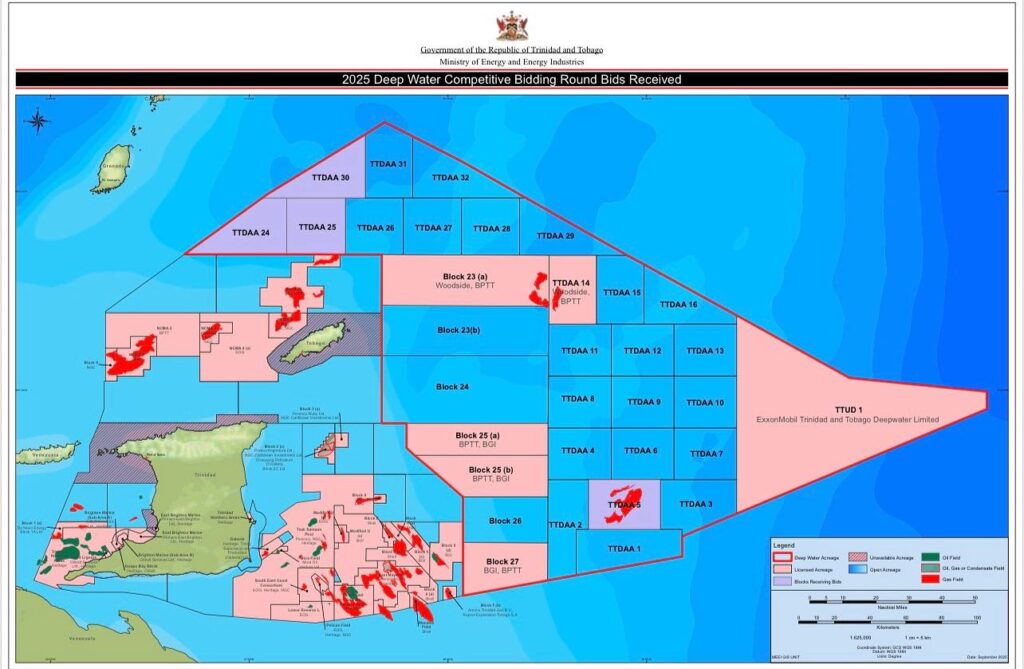
The Honourable Minister also expressed his intention to strengthen cooperation with leading international energy companies in deep water technology to ensure the optimal development of our deep water hydrocarbon resources.
Exxon’s welcome interest indicates a wider shift in the petroliferous region, where Guyana’s offshore discoveries changed the investment outlook for the Orinoco-Trinidad oil province. Guyana is now producing over 900,000 barrels per day from the Stabroek Block, while Exxon continues to apply advanced technology and artificial intelligence to accelerate subsurface interpretation.
Ardill told the OTC in Houston. “We’re using deep learning, classification and so reinforced learning. … We can turn those tools around in just a few days and then the interpreter can get a prioritized list of anomalies to effectively validate.”
Exxon is applying AI and high-performance computing to reduce seismic interpretation times from months to days in Guyana and in other frontier opportunities.
The Energy Chamber said that while it is too early to determine whether Trinidad and Tobago deepwater acreage will yield results comparable to Guyana, the renewed exploration activity is a positive signal.
“It shows that major international operators still see geological potential in the country and are willing to invest in the data needed to unlock new opportunities. The next major milestone will be the completion and interpretation of the seismic survey. If the data supports further drilling, Trinidad and Tobago deepwater could become an important part of the country’s future energy outlook.”
Exxon’s latest comments offer a constructive harbinger for a petrostate seeking to stabilise production and rebuild upstream momentum.
Trinidad and Tobago’s mature energy sector has established infrastructure, technical expertise and regional experience. New deepwater exploration could build on those strengths and position the producer for another phase of energy development.